KYC and AML Requirements for Forex Payment Processing
- August 13, 2026
- Soham Guchait
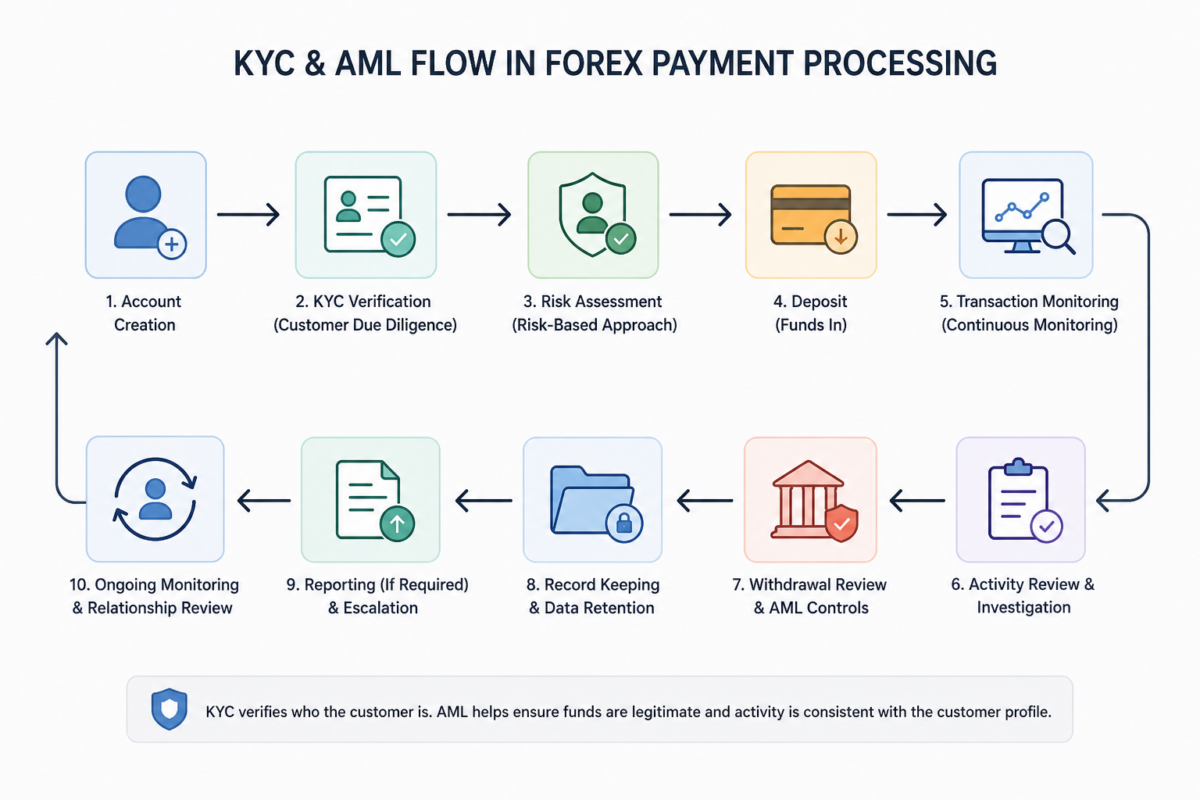
A trader can open a Forex account, complete verification, and attempt to deposit funds within minutes. For the broker, however, that deposit is more than a payment transaction. The business may need to establish who the customer is, assess risk, monitor payment activity, and maintain records explaining how funds moved through the account.
This makes KYC and AML requirements for Forex payment processing an important part of the payment lifecycle and a practical consideration when applying for a Forex merchant account.
KYC, or Know Your Customer, focuses on identifying and verifying customers. AML, or Anti-Money Laundering, covers controls designed to identify and manage risks associated with money laundering and related financial crime.
What Is KYC for a Forex Broker?
KYC refers to procedures used to establish who a customer is and understand the nature of the relationship.
For an individual trader, this may involve identity information and document verification. For a corporate customer, ownership and control may also need to be understood.
KYC helps the broker establish a reliable customer identity and assess relevant risks. That information becomes important once the customer starts moving money, so payment activity should remain connected to the customer relationship.
Why KYC Matters Before a Forex Deposit?
Consider a new trader who opens an account and immediately attempts to deposit $15,000.
Even if authorized, the broker still needs to consider whether the transaction fits the customer’s risk assessment and applicable controls. A typical relationship looks like:
Account creation → KYC → Risk assessment → Deposit → Transaction monitoring → Withdrawal
What Is AML in Forex Payment Processing?
AML stands for Anti-Money Laundering. It refers to measures used to identify, assess, and manage risks associated with money laundering and related financial crime.
For a Forex broker, AML is closely connected to payments because customers move funds into and out of trading accounts. Depending on the framework, AML can involve due diligence, risk assessment, monitoring, record keeping, internal controls, escalation, and reporting.
A change in a customer’s transaction behavior does not automatically mean financial crime; it may simply require further investigation.
How KYC and AML Affect Forex Deposits
A payment provider sees a transaction; the broker also has information about the customer behind it.
Suppose a verified trader normally deposits $500 to $1,000 using one payment method. The customer later attempts several deposits using different cards within a short period. There could be a legitimate explanation, but the pattern may warrant review under the broker’s risk controls.
Payment infrastructure should connect transaction information with the relevant customer account. The client portal, payment system, compliance process, and trading platform should not be disconnected.
Customer Verification and Beneficial Ownership
KYC can become more involved when a customer is a business rather than an individual.
Where applicable, a broker may need to identify the individuals who ultimately own or control a corporate customer. A company may open a trading account under its registered name while the broker needs to understand who ultimately controls it.
This information can affect the broker’s understanding of the customer and associated payment risks. There is no universal KYC checklist; requirements depend on jurisdiction, regulatory status, customer type, and applicable rules.
Taking a Risk-Based Approach
Customers do not necessarily present identical risks.
Risk assessment can consider customer characteristics, geography, transaction behavior, products, and other relevant factors.
One trader may consistently make deposits that match an established pattern. Another may suddenly change payment methods, increase transaction frequency, and conduct activity that differs substantially from their established profile. A risk-based system can distinguish between these situations instead of applying exactly the same response to every customer.
Source-of-Funds Considerations
Source-of-funds considerations may become relevant when payment activity does not appear consistent with information available about a customer or the expected relationship.
A trader who previously made modest deposits may suddenly attempt to fund an account with a substantially larger amount. That does not automatically indicate suspicious activity. However, depending on the circumstances and applicable requirements, the broker may need additional information to understand the origin of the funds and determine what action is appropriate.
How AML Controls Affect Withdrawals?
Compliance does not necessarily end once a deposit has been accepted. Withdrawals can also require controls because the broker may need to determine whether a withdrawal is consistent with the customer’s account, payment history, internal procedures, and applicable requirements.
For example, a customer deposits through one payment method and later requests a withdrawal to a different destination. Depending on the circumstances, that request may require additional review.
The workflow varies between businesses and jurisdictions. A payment processor can facilitate a withdrawal, but it does not automatically assume the broker’s compliance responsibilities.
Transaction Monitoring and Suspicious Activity
Transaction monitoring helps identify activity that may require investigation.
A Forex broker might monitor unusual changes in deposit patterns, unexpected transaction frequency, activity inconsistent with an established customer profile, or other indicators defined by its risk framework.
A flagged transaction is not automatically evidence of financial crime. It may trigger review, additional due diligence, escalation, or another required action. Where reporting obligations apply, the broker must follow the applicable legal and regulatory process.
Record Keeping and Payment Data
KYC and AML processes depend on reliable records. Depending on applicable requirements, a broker may need to maintain customer identification information, verification records, transaction histories, risk assessments, investigations, and other compliance information.
Payment systems therefore need accurate and traceable transaction records.
If a compliance team reviews a $5,000 deposit months later, it should be able to connect the payment to the customer account, payment method, transaction status, and relevant activity. Isolated payment data makes investigations and reconciliation harder.
How Payment Providers Fit Into KYC and AML?
Several parties may have responsibilities within a Forex payment ecosystem. The broker may have its own obligations, while payment processors, acquiring institutions, banks, and other financial service providers can conduct their own onboarding and risk assessments.
A broker should understand what information a prospective provider requires and whether ongoing monitoring applies.
This matters when evaluating a payment processor for a Forex broker. Onboarding, geographic coverage, reporting, monitoring, settlement, and risk policies can affect payment operations.
KYC, AML, and Fraud Are Different
KYC focuses on identifying and understanding the customer.
AML focuses on risks associated with money laundering and related financial crime.
Fraud prevention focuses on unauthorized or deceptive activity, such as stolen payment credentials, fraudulent deposits, or account takeover.
A single transaction can involve more than one risk. A newly created account using stolen card details, for example, could create both customer-verification and payment-fraud concerns. This is why chargeback prevention for Forex brokers and fraud controls should complement the broker’s KYC and AML framework rather than replace it.
Building Compliance Into the Payment Lifecycle
KYC and AML work best when incorporated into payment operations rather than treated as a separate process.
A simplified lifecycle is:
Account creation → KYC → Risk assessment → Deposit → Payment monitoring → Trading activity → Withdrawal review → Reconciliation
This lifecycle connects naturally with the complete guide to Forex payment processing, while merchant-account approval and chargeback controls become relevant at later stages.
What Forex Brokers Should Consider?
When selecting payment infrastructure, brokers should examine transaction-status visibility, reporting, reconciliation, payment-record access, system integration, and support for compliance investigations.
For businesses evaluating infrastructure, how to choose a payment processor for a Forex broker should involve more than fees and payment-method coverage. Risk management, reporting, compliance coordination, settlement, and data visibility also matter.
KYC and AML as Part of Forex Payment Operations
KYC and AML can influence deposits, withdrawals, monitoring, payment reviews, and record keeping throughout the customer relationship.
Requirements vary by jurisdiction, regulatory status, business model, and customer type. Forex businesses should establish procedures around applicable rules and seek appropriate professional advice where necessary.
The payment objective is to keep customer identity, transaction activity, risk controls, and payment records connected. That foundation supports fraud management, processor evaluation, international payments, and scalable deposit and withdrawal operations.

Categories
- ACH Payments (10)
- adult payment processing (11)
- AI (9)
- Altcoins (10)
- Banking (10)
- Bitcoin (133)
- Bitcoin ETF (11)
- Bitcoin Price (30)
- Blockchain (50)
- Brokering World Hunger Away (16)
- Business (17)
- card payment processing (10)
- CBD (11)
- CBDC (11)
- coaching business (11)
- COVID-19 (3)
- Crypto ATMs (1)
- Crypto Banking (17)
- Crypto Bill (1)
- Crypto business owner platform (31)
- Crypto Investment (3)
- Crypto Markets (5)
- Crypto Payment (35)
- Crypto Payment Processor (4)
- Crypto Prices (1)
- Crypto Trading (92)
- Cryptocurrency (402)
- Cryptocurrency Exchange (108)
- Data Visualization (2)
- dating platforms (11)
- debt collection payment processing (10)
- Decentralized Finance (7)
- DeFi Payment (9)
- DEX (3)
- Digital Currency (23)
- dropshipping payment processing (12)
- Ethereum (2)
- FAQ (7)
- file sharing payment processing (11)
- Finance (25)
- Financial Equality (4)
- Financial Freedom (8)
- Forex (35)
- hemp (1)
- ICO (2)
- Investment (11)
- IPTV (11)
- Merchant Account (10)
- Mining (3)
- News (66)
- NFTs (2)
- online gambling (11)
- P2P (1)
- Paybito (139)
- PayBitoPro (693)
- PayBitoPro Coin Listing (6)
- PayBitoPro Exchange (2)
- Payment Gateway (40)
- peptide (10)
- Post COVID Digital Transformation (1)
- Press Release (130)
- Privacy & Security (3)
- Real Estate (1)
- Stablecoin (5)
- Technology (15)
- Travel (11)
- Uncategorized (9)
- US Presidential Election (2)
- Utility Coin (1)
- Web3 business (4)
- Web3 Wallets (2)
- White Label Crypto Exchange (8)
Recent Posts
- ACH vs Wire Transfer: Which Payment Method Is Better for Businesses?
- ACH Fraud Prevention: How Businesses Can Secure Bank Account Payments?
- ACH Credit vs ACH Debit: What’s the Difference? With Real Examples
- ACH vs Credit Card: Which Payment Method Is Better for Businesses?
- How Long Do ACH Payments Take? Processing Times, Settlement, and Same Day ACH