What Is a Merchant Account Reserve? How It Works and Affects Your Business
- August 14, 2026
- Soham Guchait
A business can make a sale today and still not have access to the full proceeds immediately. In some cases, a payment may be temporarily held, a portion of future transactions may be reserved, or a settlement may take longer than expected.
These situations are often described using terms such as merchant account reserve, rolling reserve, payment hold, or settlement delay. Although they are related, they do not mean exactly the same thing.
Understanding the difference is important because restricted funds can affect payroll, inventory purchases, supplier payments, cash-flow planning, and working capital.
What Is a Merchant Account Reserve?
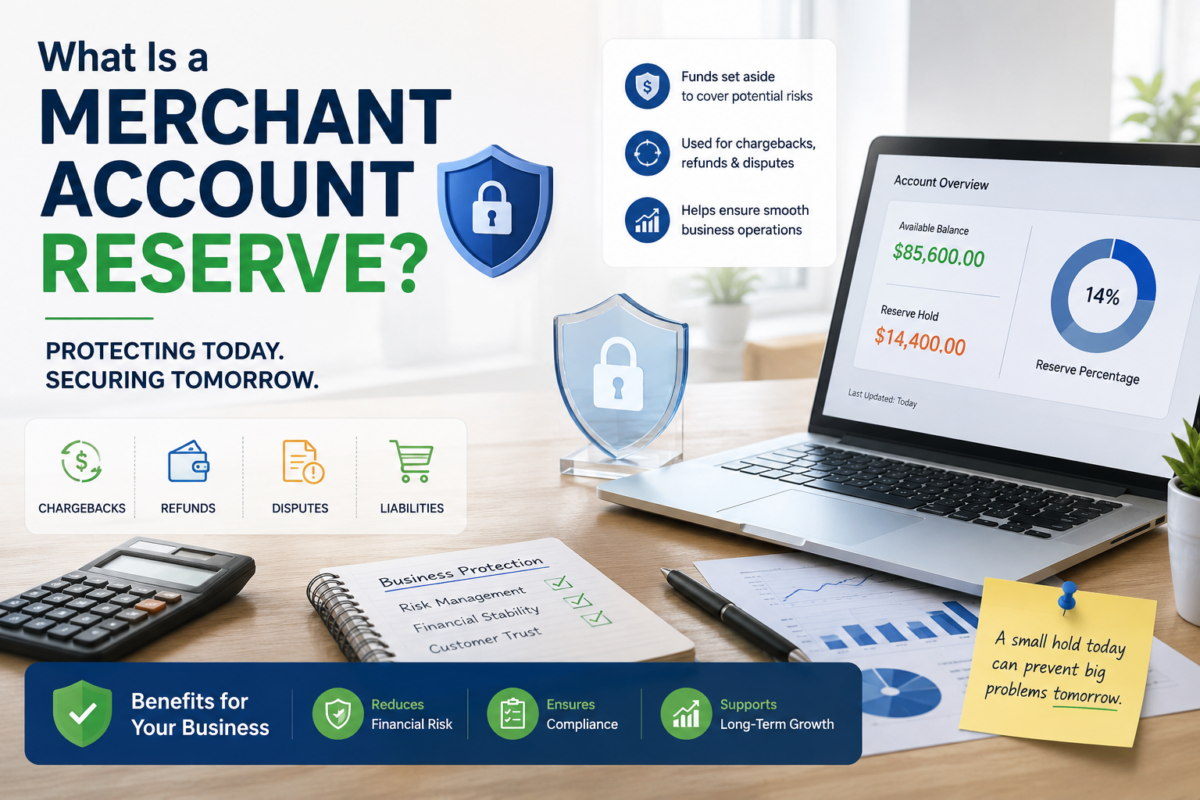
A merchant account reserve is money set aside to cover potential financial obligations associated with a merchant’s card transactions. The reserve provides protection against situations such as refunds, chargebacks, disputes, or other liabilities that could arise after a transaction has been processed.
The basic idea is straightforward: Card payments can create obligations that appear after the original transaction. A customer might dispute a purchase weeks later, for example. If the merchant has already spent the proceeds, someone still has to cover the resulting liability. A reserve provides a financial buffer for that risk. The money in a reserve is not necessarily a fee. It is generally still the merchant’s money, subject to the terms governing when and how it can be released.
However, the merchant may not be able to use those funds while they are being reserved. That distinction is crucial.
A processing fee reduces the merchant’s proceeds.
A reserve restricts access to money temporarily, subject to the reserve agreement. Getting a merchant account can take a few business days to several weeks, depending on the provider, business type, documentation, and account requirements. The timeline can be longer when additional review or documentation is needed during the underwriting process.
Why Do Payment Providers Use Reserves?
Card transactions create a degree of financial risk because the transaction lifecycle does not necessarily end when the customer receives an order confirmation.
A merchant could receive payment today, ship the product tomorrow, and then face a refund or dispute later. The longer the period between payment and the end of the merchant’s potential liability, the greater the importance of managing that exposure.
Reserve requirements can therefore be influenced by the provider’s assessment of the merchant’s risk profile. Factors can include:
- The merchant’s business model and products or services
- Expected processing volume and transaction patterns
- Average transaction size
- Refund, dispute, or chargeback exposure
- How quickly products or services are delivered?
A newly established business may also have limited processing history, making its future transaction behavior harder to assess. This does not mean every new business automatically receives a reserve. Reserve requirements depend on the specific acquiring or processing arrangement and its risk assessment.
How Does a Rolling Reserve Work?
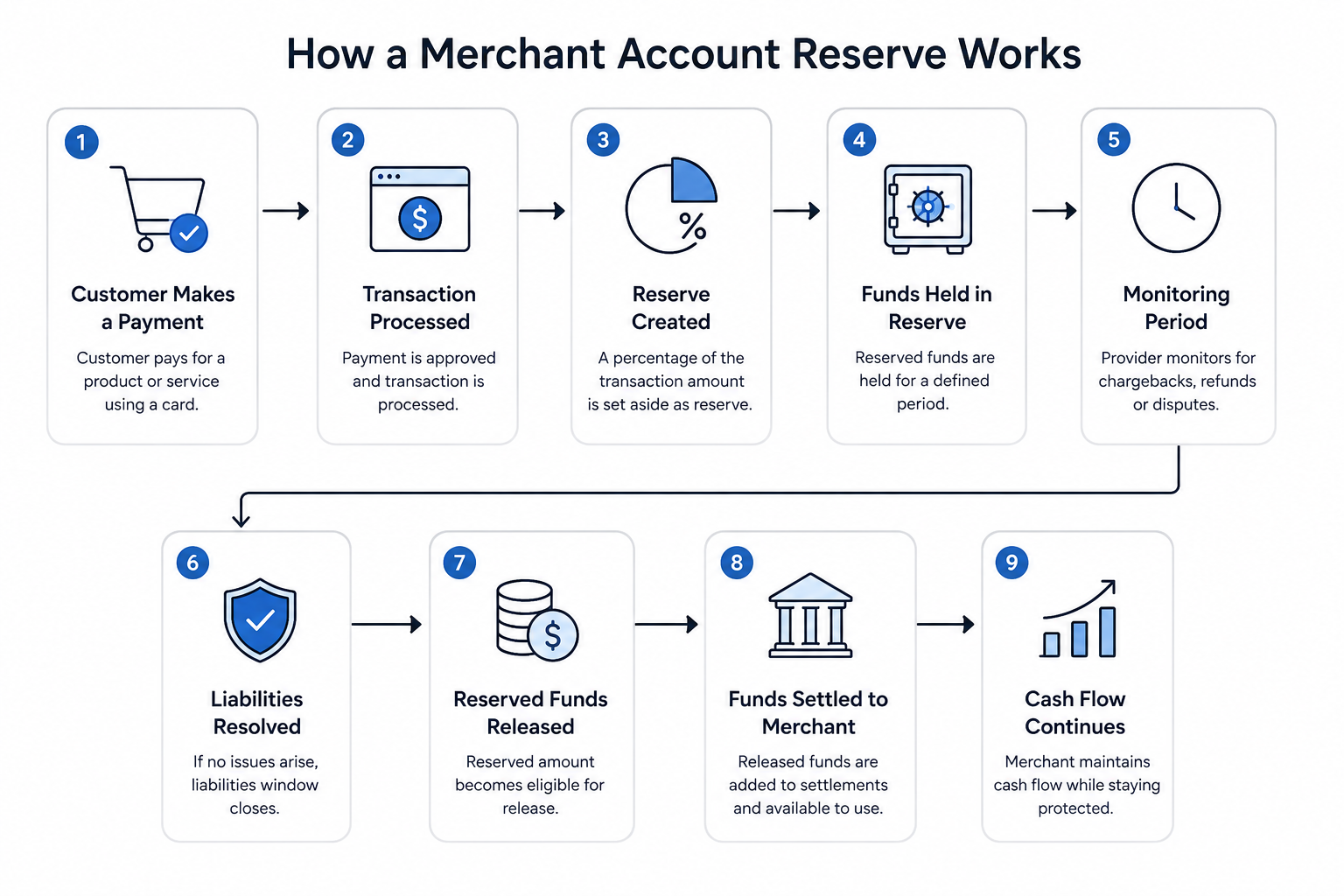
A rolling reserve is one of the most common reserve structures. Under a rolling reserve arrangement, a percentage of processed transactions is withheld for a specified period before being released.
For example, suppose a merchant processes $100,000 in a month and has a 10% rolling reserve with a defined release period. Instead of making the entire $100,000 immediately available for settlement, $10,000 may be placed into the reserve while the remaining amount is handled according to the merchant’s settlement arrangement and applicable fees. The reserved amount is then released according to the agreed schedule.
The important point is that the reserve generally rolls forward. New transactions can create new reserved amounts while older reserved funds become eligible for release. Imagine the arrangement uses a 10% reserve with a 90-day release period.
A simplified example might look like this:
| Month | Processing volume | New reserve at 10% | Reserve potentially released later |
| January | $100,000 | $10,000 | Released according to terms |
| February | $120,000 | $12,000 | January reserve may become eligible |
| March | $110,000 | $11,000 | February reserve may become eligible |
The actual accounting and release schedule can vary by agreement.
This structure allows the provider to maintain protection against liabilities while giving the merchant a predictable path for recovering reserved funds.
Rolling Reserve vs Payment Hold
A rolling reserve should not be confused with a payment hold. A rolling reserve is typically a structured mechanism applied according to predefined terms. A payment hold is a broader description for funds that are temporarily restricted from settlement or withdrawal.
For example, a provider might temporarily hold a particular transaction while reviewing an unusual payment pattern. A reserve, by contrast, may apply systematically to a percentage of transactions over a specified period. The difference matters because the cause, duration, and release conditions can be different. Businesses should therefore ask what type of restriction is being applied rather than treating every unavailable balance as a “reserve.”
What Is a Merchant Account Hold?
A merchant account hold generally means that some or all funds associated with a merchant’s transactions are temporarily withheld from normal settlement or withdrawal. A hold can occur for different reasons depending on the payment arrangement.
For example, a sudden change in processing activity could trigger additional review. A business that normally processes $20,000 per month might suddenly process $200,000, creating a transaction pattern significantly different from its established profile.
That does not automatically mean the transactions are fraudulent. It may simply mean the provider needs additional information or wants to evaluate the financial exposure associated with the change. A hold can also arise from disputes, compliance reviews, suspected unauthorized activity, unusual transaction patterns, or contractual risk provisions.
The important point is that a hold is an action affecting fund availability, not necessarily a permanent loss of the funds. The applicable agreement determines why funds can be held, how long restrictions can remain, and what conditions apply to release.
How Settlement Delays Affect Cash Flow?
Even without a formal reserve, businesses may experience a delay between receiving a customer payment and receiving the corresponding settlement in their bank account.
This is normal in card payments because authorization, capture, clearing, settlement, and payout are separate stages.
Consider a business that sells $50,000 worth of products in one week. If the merchant expects the entire amount to be available immediately but its settlement arrangement results in funds becoming available later, the business may experience a temporary working-capital gap.
Now add a rolling reserve.
If 10% of transactions are being reserved, the business could have substantially less cash available for immediate operating expenses than its headline sales figure suggests. This is why businesses should distinguish between:
Sales volume → processed volume → settled funds → available cash
These figures are related but are not necessarily identical.
Example: Why a Reserve Can Change Working Capital
Suppose an online business processes $200,000 per month and has a 10% rolling reserve.
The business may generate $200,000 in card sales, but $20,000 could be subject to the reserve arrangement. Now imagine the company has:
$80,000 in inventory purchases. $40,000 in payroll. $30,000 in advertising and operating expenses
The company might appear financially comfortable based on its sales volume. But if $20,000 is temporarily unavailable, its immediately accessible working capital is lower. This illustrates why businesses should not build cash-flow forecasts around gross transaction volume alone. The timing of settlement and reserve releases matters just as much as the amount being processed.
What Determines the Size of a Merchant Account Reserve?
There is no universal reserve percentage that applies to every merchant. The terms depend on the provider, acquiring arrangement, merchant profile, and assessed exposure.
During underwriting, providers may examine factors that help them estimate potential financial liability. For example, a business selling inexpensive digital products may have a very different risk profile from a business collecting large advance payments for services that will be delivered months later.
A merchant processing $100,000 through 10,000 $10 purchases also has a different transaction pattern from one processing the same $100,000 through twenty $5,000 transactions. Transaction volume alone therefore does not tell the complete risk story.
Getting a merchant account can take a few business days to several weeks, depending on the provider, business type, documentation, and underwriting requirements. Businesses with more complex or higher-risk profiles may require additional review, which can affect both the approval timeline and the account terms, including potential reserve requirements.
How Businesses Can Prepare for Reserves and Holds?
Businesses cannot always prevent reserves or holds, particularly when they are part of an agreed risk-management arrangement. They can, however, plan for their potential effect.
Before accepting significant card volume, businesses should understand:
- Whether a reserve can be imposed under the merchant agreement?
- How is the reserve calculated?
- When reserved funds are released?
- What circumstances can trigger additional holds or restrictions?
Cash-flow planning should account for settlement timing rather than assuming every completed transaction immediately becomes usable cash.
It is also important to maintain accurate transaction records, order documentation, refund information, and customer communications. Good records can make it easier to respond when transaction questions or disputes arise. Most importantly, businesses should read the applicable merchant agreement carefully. Reserve percentages, release periods, hold provisions, and review procedures are contractual matters and can differ substantially between arrangements.
What Happens When a Reserve Is Released?
When reserved funds become eligible for release, they are generally returned to the merchant according to the agreed settlement process. However, the release does not necessarily mean that every reserved dollar will automatically become available if outstanding liabilities exist.
For example, if a merchant has unresolved chargebacks or other obligations, the provider may use available reserve funds to cover those liabilities according to the applicable agreement.
This is why a reserve should be viewed as risk coverage attached to the merchant relationship, rather than simply money that has been “taken away.”
Merchant Account Reserves Are Mainly About Cash-Flow Visibility
Merchant account reserves, rolling reserves, holds, and settlement delays all affect one fundamental business question:
When can the merchant actually use the money generated by a sale?
A business may process substantial transaction volume while having less immediately available cash because some funds are reserved, held, or awaiting settlement. Understanding the distinction between these mechanisms makes payment operations easier to manage. It also helps businesses forecast working capital more realistically and evaluate merchant-account terms before committing to a particular payment arrangement.
The key is to look beyond the headline processing volume and understand the entire path from customer payment to settled, usable funds.

Categories
- ACH Payments (10)
- adult payment processing (11)
- AI (9)
- Altcoins (10)
- Banking (10)
- Bitcoin (133)
- Bitcoin ETF (11)
- Bitcoin Price (30)
- Blockchain (50)
- Brokering World Hunger Away (16)
- Business (17)
- card payment processing (10)
- CBD (11)
- CBDC (11)
- Chargeback (8)
- coaching business (11)
- COVID-19 (3)
- Crypto ATMs (1)
- Crypto Banking (17)
- Crypto Bill (1)
- Crypto business owner platform (31)
- Crypto Investment (3)
- Crypto Markets (5)
- Crypto Payment (35)
- Crypto Payment Processor (4)
- Crypto Prices (1)
- Crypto Trading (92)
- Cryptocurrency (402)
- Cryptocurrency Exchange (108)
- Data Visualization (2)
- dating platforms (11)
- debt collection payment processing (10)
- Decentralized Finance (7)
- DeFi Payment (9)
- DEX (3)
- Digital Currency (23)
- dropshipping payment processing (12)
- Ethereum (2)
- FAQ (7)
- file sharing payment processing (11)
- Finance (25)
- Financial Equality (4)
- Financial Freedom (8)
- Forex (35)
- hemp (1)
- ICO (2)
- Investment (11)
- IPTV (11)
- Merchant Account (10)
- Mining (3)
- News (66)
- NFTs (2)
- online gambling (11)
- P2P (1)
- Paybito (147)
- PayBitoPro (693)
- PayBitoPro Coin Listing (6)
- PayBitoPro Exchange (2)
- Payment Gateway (48)
- peptide (10)
- Post COVID Digital Transformation (1)
- Press Release (130)
- Privacy & Security (3)
- Real Estate (1)
- Stablecoin (5)
- Technology (15)
- Travel (11)
- Uncategorized (10)
- US Presidential Election (2)
- Utility Coin (1)
- Web3 business (4)
- Web3 Wallets (2)
- White Label Crypto Exchange (8)
Recent Posts
- Payment Gateway vs. Payment Orchestration: What’s the Difference?
- What Is Smart Payment Routing? Strategies to Optimize Payment Performance
- How to Improve Payment Approval Rates for High-Risk Businesses?
- Why Are Online Payments Failing? Common Causes and How to Fix Them
- How to Use Multiple Payment Processors to Reduce Business Disruptions?