Merchant Account vs Payment Processor: What’s the Difference and How Do They Work Together?
- August 14, 2026
- Soham Guchait
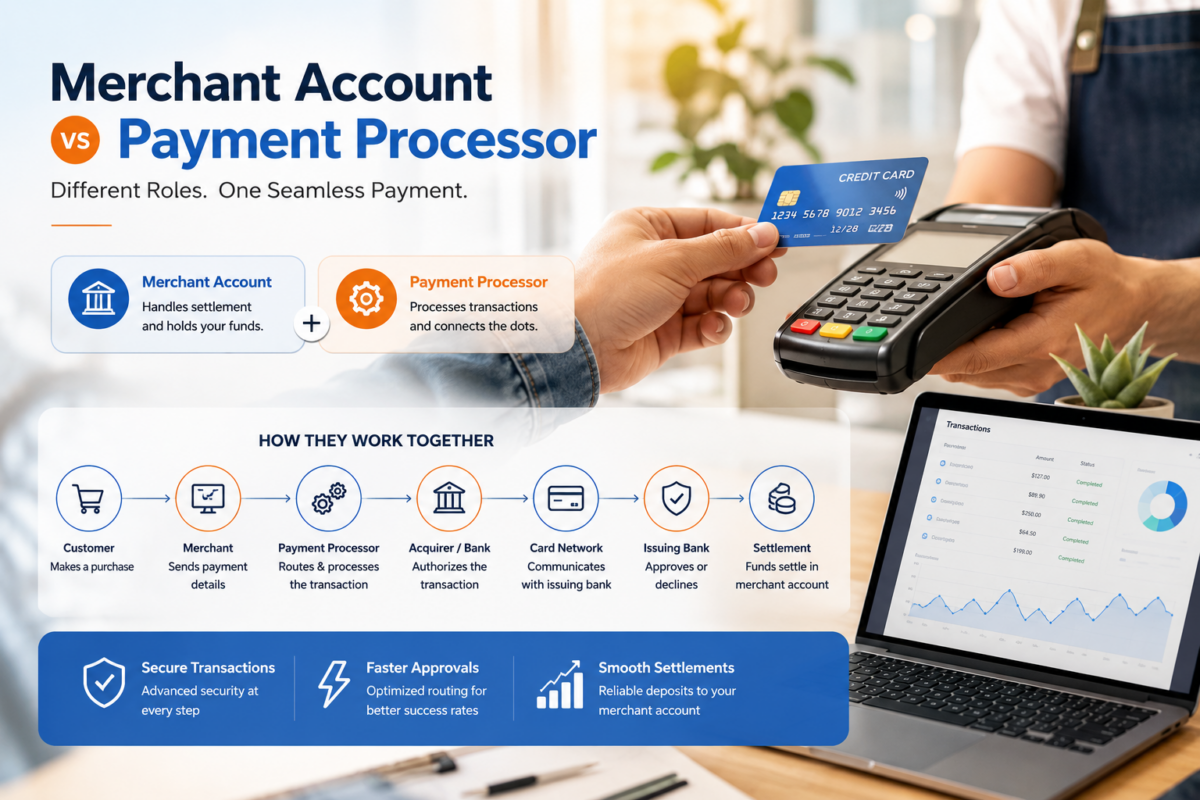
A business can accept a card payment in seconds, but several different parties and systems may be involved before that transaction is authorized and the resulting funds are settled. Two terms often cause confusion: Merchant Account and Payment Processor. They are closely connected, but they do different jobs.
A merchant account is part of the acquiring and settlement infrastructure that supports a business’s ability to accept card payments. A payment processor handles transaction processing and communication between the merchant side, card networks, and financial institutions.
The distinction becomes especially important when a business is comparing payment setups, investigating a declined transaction, reviewing processing fees, or trying to understand where its money goes after a customer pays.
What Is a Merchant Account?
A merchant account is a specialized account used in card payment acceptance. It is associated with the acquiring side of the payment ecosystem and supports the handling and settlement of funds generated by card transactions. It is not the same as the business checking account where a company normally keeps and spends its operating cash.
For example, imagine an online retailer sells a $500 product by credit card. The customer’s $500 does not simply move directly from the cardholder’s bank to the retailer’s checking account when the payment button is pressed. The transaction must be authorized and subsequently processed through the card-payment system. After clearing and settlement, the resulting funds become available to the merchant according to its settlement arrangement.
The merchant account is therefore part of the financial relationship that allows the business to accept card payments and receive settlement funds.
What Is a Payment Processor?
A payment processor is a company or service that facilitates the processing of payment transactions and the communication required between participants in the payment system.
In a card transaction, the processor can route transaction information between the merchant side and the relevant acquiring, card-network, and issuing infrastructure. It may also support functions related to authorization, settlement, reporting, fraud controls, and transaction management, depending on the arrangement.
The processor is therefore primarily involved in moving and processing transaction information through the payment ecosystem. This is different from the merchant account itself. A simple way to think about it is:
Merchant account = The merchant’s Financial Acceptance Relationship.
Payment processor = The Infrastructure that Processes and Routes the Transaction.
The distinction can become less obvious because modern payment companies frequently combine multiple functions into one service. PCI Security Standards Council terminology also notes that payment-industry terms can overlap in practice, so businesses should examine the actual services being provided rather than relying only on the label “processor.”
Merchant Account vs Payment Processor: The Key Difference
The most important difference is function.
|
Merchant account |
Payment processor |
|
Supports the merchant’s card-acceptance and settlement relationship |
Processes and routes payment transactions |
|
Associated with the acquiring side of card payments |
Connects transaction information across relevant payment participants |
| Relates to how funds are received and settled |
Relates to how transactions are processed |
| Connected to merchant underwriting and risk arrangements |
Handles transaction-processing infrastructure |
The two are not competing alternatives. In a traditional card-payment arrangement, they work together. The acquiring institution typically establishes and maintains the merchant relationship, while the processor provides technology and transaction-processing capabilities. In some payment models, one company can perform both roles.
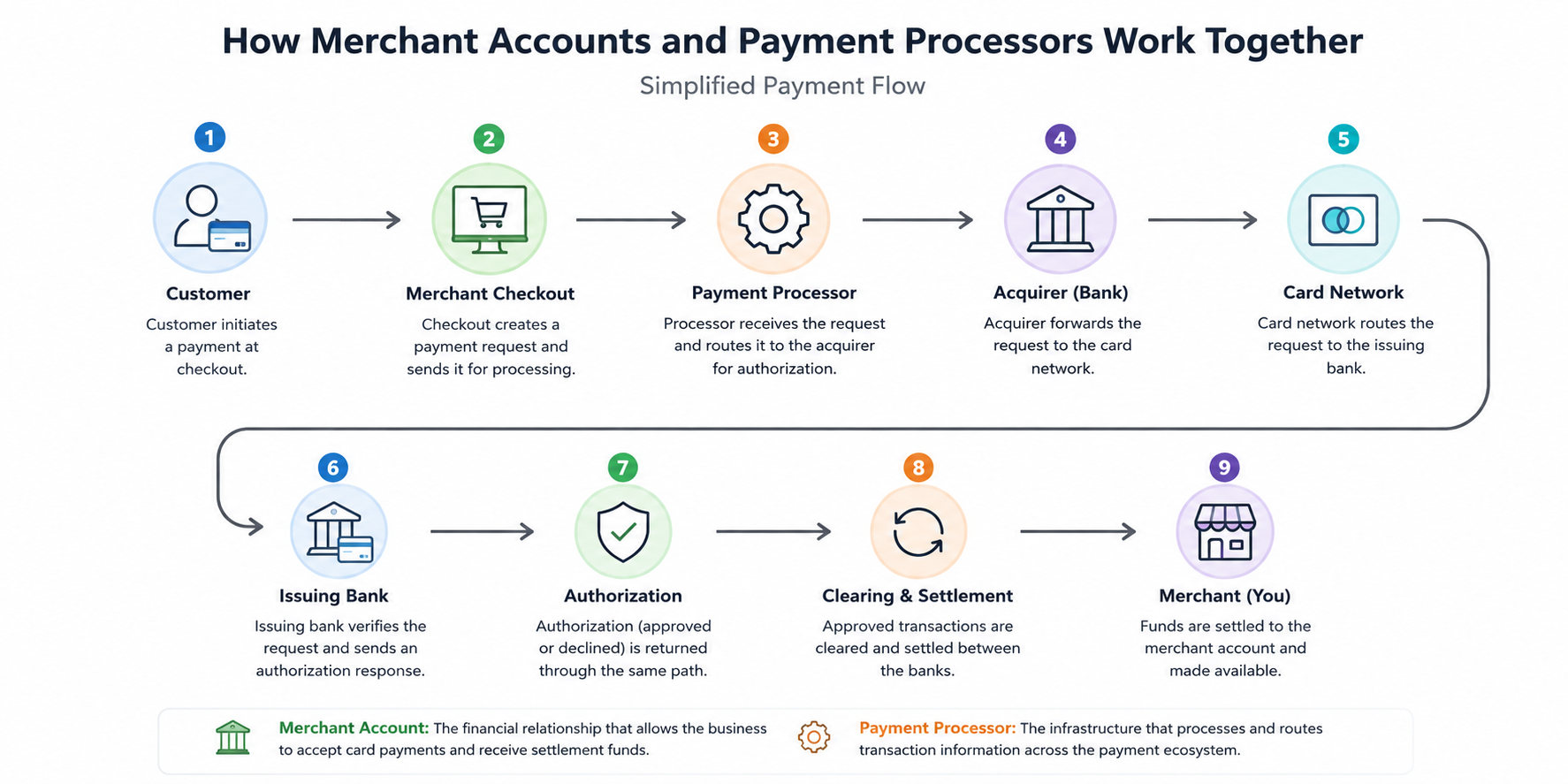
How Merchant Accounts and Payment Processors Work Together?
Consider a customer purchasing a $500 laptop from an ecommerce business. The simplified transaction flow looks like this:
Customer → Checkout → Processor → Acquirer → Card Network → Issuing Bank → Authorization → Clearing → Settlement → Merchant
The exact technical architecture can vary, but the basic sequence illustrates why both processing and acquiring functions are necessary.
1. The customer initiates the payment
The customer enters card details or uses a supported payment method and submits the $500 purchase. The merchant’s checkout system creates a transaction request containing information needed to process the payment.
2. The transaction enters the processing system
The payment processor receives or handles the transaction request and routes it through the appropriate payment infrastructure. This is where the processor’s technical role becomes important. It helps ensure that transaction information reaches the appropriate parties and that responses can return to the merchant’s system.
3. The issuing bank evaluates the transaction
The card network connects the transaction between the acquiring side and the card issuer.
The issuing bank then evaluates the authorization request. Depending on the circumstances, the issuer may consider available credit or funds, card status, transaction information, and applicable authorization or fraud controls. The result is an approval or decline.
4. The response travels back to the merchant
The authorization response travels back through the payment infrastructure to the merchant’s checkout system. If approved, the merchant can generally proceed with the order according to its business logic.
But authorization is not the same thing as final settlement.
This distinction is one of the most important concepts businesses should understand when learning how payment processing works.
5. Clearing and settlement occur
After authorization, the transaction moves through subsequent processing stages. During clearing, transaction information is exchanged and reconciled between the relevant participants.
Settlement is when the financial obligations resulting from the transactions are settled between participants, with the merchant ultimately receiving funds according to its acquiring and settlement arrangement. This is why a customer seeing “payment successful” does not necessarily mean the merchant’s operating bank account has already received the money.
A Real-World Example: Same Sales, Different Payment Profiles
Consider two businesses that each process $100,000 per month.
Business A completes 10,000 transactions with an average transaction value of $10.
Business B completes 20 transactions with an average transaction value of $5,000.
Their monthly volume is identical, but their transaction profiles are very different. For an acquiring or processing relationship, factors such as transaction size, sales pattern, business model, expected volume, refund activity, and dispute exposure can matter when assessing risk and establishing processing arrangements.
This is one reason a merchant account cannot be understood simply as a place where money is deposited. It is part of a broader commercial and risk relationship surrounding card acceptance. That risk relationship can also affect how funds are handled. In some cases, an acquiring institution or payment provider may require a merchant account reserve, where a portion of funds is temporarily held to help cover potential chargebacks, refunds, or other payment-related liabilities. The specific reserve terms depend on the merchant’s risk profile and processing arrangement.
Who Is the Acquirer?
Another term that often gets mixed into the merchant account vs payment processor discussion is Acquirer.
The merchant acquirer, or acquiring institution, is the financial institution that establishes and maintains the merchant relationship for card acceptance. It participates in authorization and settlement and has responsibilities associated with the merchant account and the risks of card transactions. The processor and acquirer can therefore work closely together without being the same entity.
For example, a processor may provide the technical infrastructure for routing transaction information, while the acquiring institution maintains the merchant relationship and supports settlement. However, payment models vary. Some organizations combine processing and acquiring capabilities, while payment service providers may bundle several payment functions into one commercial product.
What About a Payment Gateway?
The payment gateway is another layer that should not automatically be treated as a synonym for a processor. A gateway generally provides the technology for securely transmitting payment information between the merchant’s checkout environment and the payment-processing infrastructure.
For an online purchase, the relationship can be simplified as:
Customer → Checkout/Gateway → Processor → Acquirer/Card Network → Issuer
The gateway focuses heavily on the payment-data communication layer, while the processor handles transaction-processing functions. Modern providers may combine gateway, processing, acquiring, and merchant-account functions, which can make the entire system appear to be one product.
Why Does the Difference Matters to Businesses?
Understanding these distinctions is useful when something goes wrong. Suppose a business receives an approved transaction but later discovers that its funds are delayed. The problem may not have anything to do with the checkout technology itself.
A business may need to determine whether the issue relates to processing, settlement, the acquiring relationship, account controls, transaction review, or another stage of the payment lifecycle.
The same applies when evaluating costs. A merchant may see a single processing rate on an invoice or dashboard, but that does not mean every underlying payment function has the same cost structure. Depending on the arrangement, businesses may encounter transaction-processing charges, network-related costs, gateway charges, chargeback fees, account fees, or other contractual charges. Understanding which party performs which function makes those costs easier to investigate.
What Businesses Should Understand Before Choosing a Payment Setup?
Rather than asking only, “Who is my payment processor?”, businesses should understand the complete payment arrangement.
At minimum, determine:
- Who provides the merchant relationship?
- Who processes and routes transactions?
- Who provides the payment gateway or checkout technology?
- How and when are funds settled into the business bank account?
The answers may point to one provider or several different entities.
A bundled arrangement is not inherently better or worse than a multi-provider setup. What matters is understanding what each party is responsible for, how the components interact, what the contractual terms say, and whether the infrastructure fits the business’s transaction profile.
Merchant Account and Payment Processor: Different Roles, One Payment System
A merchant account and payment processor are not two versions of the same service.
The merchant account represents an important part of the merchant’s acquiring and settlement relationship.
The payment processor provides transaction-processing infrastructure that helps move payment information through the card-payment system.
The acquirer, gateway, card network, issuer, and merchant’s own systems each contribute another part of the transaction lifecycle. That distinction gives businesses a much stronger foundation for evaluating payment infrastructure, understanding transaction problems, and knowing exactly what they are paying for.

Categories
- ACH Payments (10)
- adult payment processing (11)
- AI (9)
- Altcoins (10)
- Banking (10)
- Bitcoin (133)
- Bitcoin ETF (11)
- Bitcoin Price (30)
- Blockchain (50)
- Brokering World Hunger Away (16)
- Business (17)
- card payment processing (10)
- CBD (11)
- CBDC (11)
- Chargeback (8)
- coaching business (11)
- COVID-19 (3)
- Crypto ATMs (1)
- Crypto Banking (17)
- Crypto Bill (1)
- Crypto business owner platform (31)
- Crypto Investment (3)
- Crypto Markets (5)
- Crypto Payment (35)
- Crypto Payment Processor (4)
- Crypto Prices (1)
- Crypto Trading (92)
- Cryptocurrency (402)
- Cryptocurrency Exchange (108)
- Data Visualization (2)
- dating platforms (11)
- debt collection payment processing (10)
- Decentralized Finance (7)
- DeFi Payment (9)
- DEX (3)
- Digital Currency (23)
- dropshipping payment processing (12)
- Ethereum (2)
- FAQ (7)
- file sharing payment processing (11)
- Finance (25)
- Financial Equality (4)
- Financial Freedom (8)
- Forex (35)
- hemp (1)
- ICO (2)
- Investment (11)
- IPTV (11)
- Merchant Account (10)
- Mining (3)
- News (66)
- NFTs (2)
- online gambling (11)
- P2P (1)
- Paybito (147)
- PayBitoPro (693)
- PayBitoPro Coin Listing (6)
- PayBitoPro Exchange (2)
- Payment Gateway (48)
- peptide (10)
- Post COVID Digital Transformation (1)
- Press Release (130)
- Privacy & Security (3)
- Real Estate (1)
- Stablecoin (5)
- Technology (15)
- Travel (11)
- Uncategorized (10)
- US Presidential Election (2)
- Utility Coin (1)
- Web3 business (4)
- Web3 Wallets (2)
- White Label Crypto Exchange (8)
Recent Posts
- Payment Gateway vs. Payment Orchestration: What’s the Difference?
- What Is Smart Payment Routing? Strategies to Optimize Payment Performance
- How to Improve Payment Approval Rates for High-Risk Businesses?
- Why Are Online Payments Failing? Common Causes and How to Fix Them
- How to Use Multiple Payment Processors to Reduce Business Disruptions?