Why Do File Sharing Payments Get Declined and How to Fix Them?
- August 12, 2026
- Soham Guchait
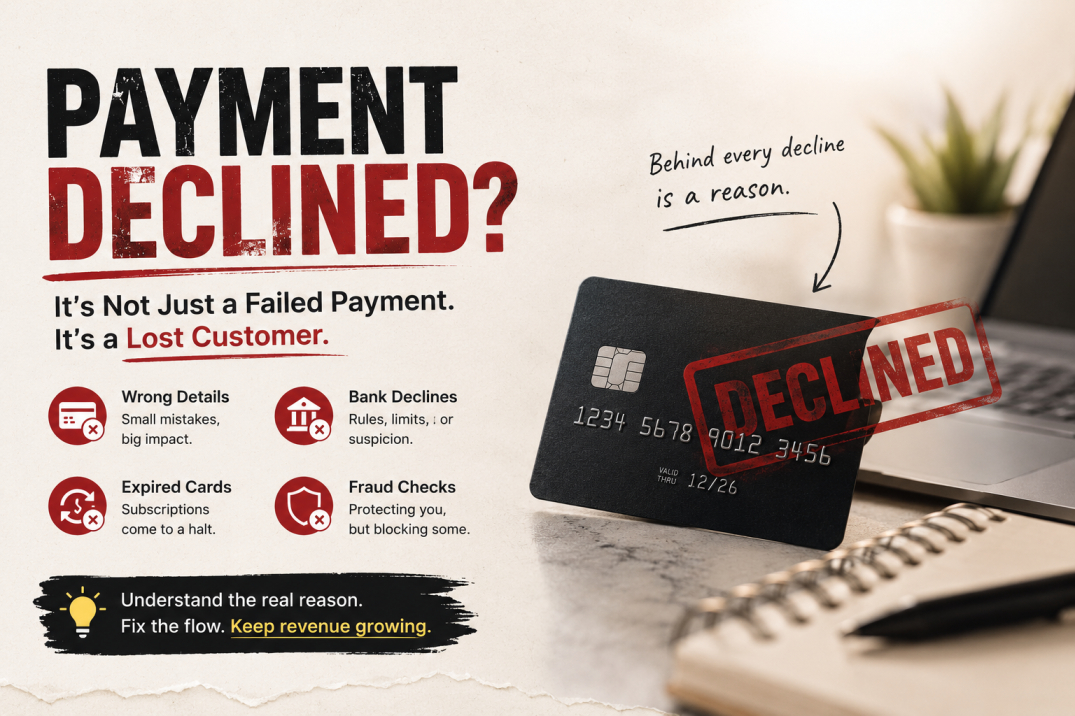
A customer reaches the checkout page of a file-sharing platform, enters their card details, and expects to gain access to a storage plan immediately. Instead, the payment is declined or fails before the subscription is activated. The customer may try the payment again, contact support, update their card details, or simply abandon the checkout process.
For a file-sharing business, a declined payment is more than a single unsuccessful transaction. If the payment is for a new subscription, it can prevent customer acquisition and reduce conversion. If it is a recurring payment, the failure can interrupt access to storage or premium features, increase involuntary churn, and create additional customer-support work.
The important point is that not every declined payment has the same cause. Some declines originate with the customer’s issuing bank or payment method. Others can result from incorrect payment information, insufficient funds, expired credentials, fraud controls, recurring-billing problems, merchant configuration issues, or technical failures within the payment-processing flow. Understanding where and why the payment failed is the first step toward responding appropriately.
What Happens When a File Sharing Payment Is Declined?
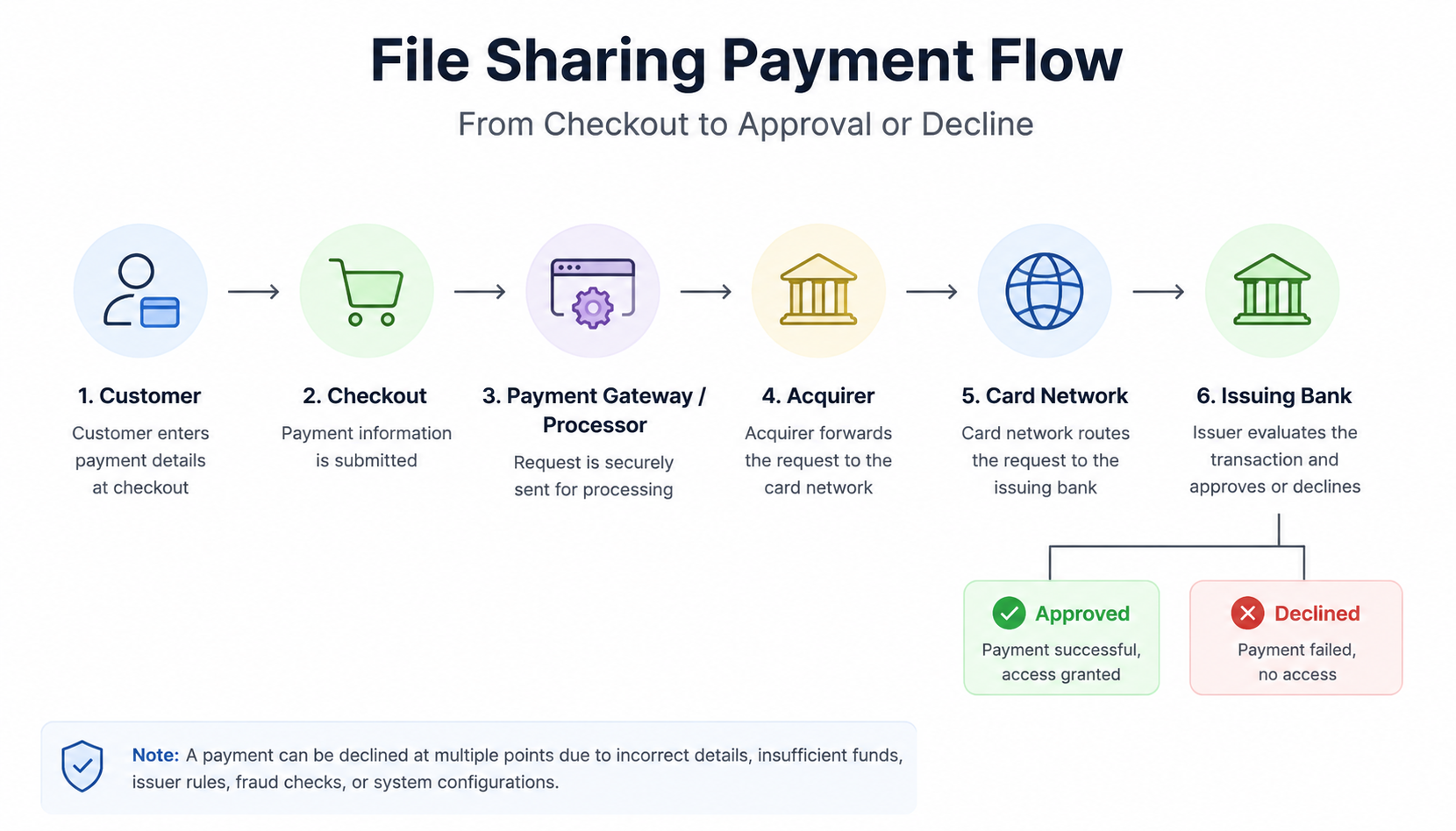
When a customer pays for a file-sharing subscription using a card, the transaction usually passes through several participants before the authorization result is returned. A simplified payment authorization flow looks like this:
Customer → Checkout → Payment Gateway/Processor → Acquirer → Card Network → Issuing Bank → Approval or Decline
The exact payment flow can vary depending on the payment method and processing arrangement, but the issuing bank generally makes the final authorization decision for a card transaction. During the authorization process, the transaction may be checked for factors such as:
- Whether the card details are valid?
- Whether sufficient funds or available credit exist?
- Whether the card is active and permitted to make the transaction?
- Whether the transaction appears unusual or potentially fraudulent?
- Whether required authentication has been completed?
- Whether the merchant or transaction meets applicable issuer and network rules?
A payment provider may also apply its own fraud, risk, or transaction-screening controls before or during processing. This distinction is important because a file-sharing business cannot solve every decline by making changes to its checkout page.
For example, if a customer’s issuing bank declines a transaction because the account does not have sufficient available funds, changing the checkout design will not resolve the underlying reason for the decline. However, if a large number of customers suddenly experience payment failures after a checkout or API change, the problem may be related to the payment integration rather than individual customers.
Common Reasons File Sharing Payments Get Declined
Incorrect Card Information
One of the most common and straightforward reasons for a payment failure is incorrect information entered during checkout. A customer may enter the wrong:
- Card number
- Expiration date
- CVV or security code
- Billing address or postal code
Even a small error can prevent the transaction from being authorized.
Depending on the merchant’s payment configuration, information such as the billing address may also be checked through an Address Verification Service (AVS). An AVS mismatch does not always produce the same outcome for every transaction because the merchant, payment processor, and issuer may apply different rules. In some cases, the transaction may still be authorized; in others, a mismatch can contribute to a decline or risk-based rejection.
For example, a customer signs up for a monthly file-storage plan using a valid card but enters an outdated billing address. If the payment system is configured to reject certain verification mismatches, the transaction may fail even though the card itself remains active. A clear checkout process and appropriate validation can help customers identify obvious data-entry errors before submitting the payment.
Insufficient Funds or Credit Limit
A customer’s bank may decline a transaction because there is not enough available balance or available credit to complete it. This can happen during both:
- Initial subscription purchases
- Recurring subscription renewals
Imagine a customer has been successfully paying $19.99 every month for a file-storage plan. Their fourth renewal fails because their available credit is temporarily insufficient. The subscription itself has not necessarily caused the problem; the customer’s available funds or credit position may simply have changed before the renewal attempt.
For recurring businesses, this type of decline can contribute to involuntary churn if the customer intended to continue the subscription but the payment could not be completed. The business should distinguish insufficient-funds declines from technical, configuration, or account-related problems before deciding how to respond.
Expired, Replaced, or Updated Cards
Recurring billing creates additional opportunities for payment credentials to become outdated. A customer may initially subscribe using a valid card, but the card can later:
- Expire
- Be replaced after being lost or stolen
- Be reissued by the bank
- Be cancelled or closed
- Have its details changed
When the file-sharing platform attempts the next subscription renewal, the stored payment credentials may no longer work.
Card-on-file arrangements can therefore experience disruption when customers receive replacement cards and do not update their payment details. Depending on the payment ecosystem and available network or processor capabilities, some updated credentials may be handled automatically, while other situations require the customer to provide a new payment method.
For a subscription business, this is why payment recovery and payment-method update processes are important parts of recurring billing operations.
Bank or Issuer Declines
Sometimes the customer’s issuing bank simply does not authorize the transaction. An issuer may decline a payment because of:
- Insufficient available funds or credit
- Suspected fraud or unusual activity
- Card restrictions
- Merchant or transaction restrictions
- A blocked or inactive card
- Security or risk controls
- Other authorization conditions determined by the issuer
Businesses may receive a decline code or processor response that provides some indication of what happened. However, the response does not always reveal the complete reason behind the issuing bank’s decision. A customer might therefore see a general message such as “payment declined” without knowing exactly why.
In these situations, repeatedly submitting the same transaction may not solve the problem. Asking the customer to verify their details, contact their card issuer, or use another supported payment method may be more appropriate, depending on the nature of the decline.
Authentication Requirements
Some transactions require additional customer authentication before they can be successfully authorized.
For example, certain markets and payment scenarios may involve authentication requirements designed to confirm that the legitimate cardholder is making the purchase. If the authentication process is not completed successfully, the transaction may fail. A file-sharing business offering subscriptions across multiple regions should therefore understand how authentication requirements can affect:
- Initial subscription payments
- Card-on-file transactions
- Customer-initiated payments
- Merchant-initiated recurring payments
Authentication and authorization are related but distinct parts of the payment process. A customer may successfully complete an authentication step while the issuer still ultimately declines the transaction for another reason.
Fraud and Risk Controls Can Also Block Payments
Not every failed payment is an issuer decline.
Payment processors, gateways, and merchants can use fraud and risk controls to identify transactions that appear suspicious or violate configured rules. Fraud-prevention systems may evaluate signals such as transaction patterns, customer information, device information, payment history, velocity, location, and other risk indicators.
Consider a file-sharing platform that suddenly receives dozens of subscription attempts from different accounts using payment methods associated with unusual transaction patterns. Blocking some of those transactions may help prevent fraudulent activity, even though strict fraud controls can occasionally create false positives and affect legitimate customers.
This is why a business should not treat every failed payment as something that should automatically be overridden. The objective is to distinguish legitimate payment failures from transactions that should remain blocked because of genuine fraud or risk concerns. The payment system should provide enough transaction information for the business to understand whether a failure resulted from:
- An issuer authorization decision
- A fraud or risk rule
- An authentication problem
- A payment-method issue
- A technical processing problem
Why Do Recurring Payments Create Additional Problems?
A successful first payment does not guarantee that every future subscription renewal will succeed. A recurring payment can fail because:
- The card expired or was replaced
- The customer has insufficient available funds or credit
- The stored payment credentials are no longer valid
- The customer cancelled or changed the recurring payment authorization
- The issuer applies a new risk restriction
- Additional authentication or verification is required
- A fraud or risk system blocks the renewal
- A technical or configuration issue affects the payment attempt
Recurring billing also introduces timing considerations. A customer may have successfully paid every previous month but temporarily lack sufficient funds when the next renewal is attempted. This does not necessarily mean the customer wants to cancel the subscription.
For this reason, subscription businesses often need a structured approach to failed payment recovery. Depending on the transaction type and applicable payment rules, a legitimate payment may be retried later, while the customer may also be asked to update their payment method. A file-sharing business therefore needs to manage the entire subscription payment lifecycle, rather than focusing only on the initial checkout.
Customer-Side Problems vs Payment-Processing Problems
One of the most useful ways to troubleshoot a declined payment is to determine whether the problem is primarily customer-side, issuer-side, risk-related, or processing-side.
Customer-Side Problems
Customer-side problems can include:
- Incorrect card details
- An expired card
- Insufficient funds
- An outdated billing address
- A cancelled or inactive payment method
Issuer-Side Problems
The issuing bank may decline a transaction because of:
- Fraud or security concerns
- Transaction restrictions
- Available balance or credit limitations
- Internal authorization policies
Payment-Processing Problems
Payment-processing problems can include:
- Incorrect merchant configuration
- Unsupported payment methods
- Gateway communication failures
- API or integration problems
- Incorrect payment parameters
- Risk-rule blocks
- Processing limits or system interruptions
These issues are often part of broader operational difficulties faced by growing platforms. Businesses should also understand the common payment processing challenges when building a stable payment operation.
For example, if one customer cannot complete a payment while thousands of other customers are successfully completing transactions, the issue may be specific to that customer’s payment method or issuing bank.
However, if hundreds of customers suddenly begin receiving failures at the same time, the business should investigate the payment integration, provider responses, configuration, technical systems, or broader processing issue rather than simply telling every customer to replace their card. The pattern of payment failures can provide valuable diagnostic information.
How to Troubleshoot a Declined Payment?
The first step is to identify the transaction outcome and the available reason or response associated with the failure. Payment systems may provide information such as:
- Authorization status
- Decline or response codes
- Fraud or risk outcomes
- Authentication results
- Processor messages
- Transaction timestamps
- Payment-method information
This information can help determine whether the transaction was declined by the issuer, blocked by a risk system, affected by authentication, or disrupted by another processing issue. The business should then determine whether the problem is isolated or widespread.
For a single failed payment, the appropriate response might include asking the customer to:
- Verify their payment information
- Confirm that the card is active
- Update an expired payment method
- Contact their issuing bank when appropriate
- Try another supported payment method
For repeated failures, the business should examine patterns such as:
- Is the same decline reason appearing repeatedly?
- Are failures affecting new payments or recurring renewals?
- Are particular countries, currencies, or card types affected?
- Did the problem begin after a checkout or payment-system change?
- Are fraud controls blocking legitimate customers?
- Are failures concentrated around a specific payment provider or integration?
- Has the overall payment approval rate changed significantly?
Repeatedly retrying every declined transaction is not a complete solution. Some declines may be eligible for carefully managed retries, while others indicate that the transaction should not simply be submitted again without understanding the reason for the failure.
A Practical Example
Suppose a file-sharing platform has 5,000 active subscribers. Most monthly renewals process normally, but 150 customers suddenly experience failed renewals. The business reviews its transaction records and discovers that a significant number of the affected payments involve expired or outdated cards.
Instead of treating the situation as a general payment gateway failure, the company can focus on the affected customers by providing a clear process for updating payment information and recovering eligible subscriptions.
Now imagine a different situation. The business modifies its checkout integration, and shortly afterward, 80% of new payment attempts begin failing. That pattern points toward a different investigation. The business should examine:
- The recent integration changes
- API requests and responses
- Gateway or processor messages
- Merchant configuration
- Authentication flow
- Payment-provider communication
The word “declined” alone does not always identify the underlying problem. The timing, transaction type, affected customer segment, and payment-system response often provide more useful information.
Building a More Reliable Payment Process
Reducing unnecessary payment failures starts with understanding why they occur rather than attempting to eliminate every decline.
Some declines are legitimate and should remain blocked. Others may result from outdated payment credentials, customer errors, temporary financial conditions, overly restrictive risk rules, or technical problems that the business can address. A file-sharing business should maintain a clear process for:
- Identifying and categorizing payment outcomes
- Monitoring approval and decline patterns
- Communicating clearly with customers
- Updating expired or invalid payment methods
- Recovering eligible failed subscription payments
- Investigating technical failures
- Reviewing fraud controls for potential false positives
- Escalating recurring processing problems to the appropriate payment provider
The business should also make sure customers understand what they are being charged for and when recurring payments will occur. Maintaining accurate business information, clear billing practices, and transaction transparency can support broader compliance and operational requirements, including KYC and AML requirements that payment providers may consider during onboarding and ongoing monitoring.
Clear billing information can also help reduce customer confusion around recurring subscriptions and may become particularly important when managing chargebacks for file-sharing businesses.
As transaction volume grows, payment monitoring becomes increasingly important. A larger platform may require:
- More detailed transaction reporting
- Automated payment-recovery workflows
- Better visibility into decline reasons
- More sophisticated fraud controls
- Monitoring of authorization and approval rates
- Detailed analysis of recurring payment failures
Businesses that require greater control over payment workflows, integrations, and customer payment experiences may eventually explore a white-label payment platform as they scale.
A declined payment is therefore not simply a checkout problem. For a subscription-based file-sharing business, it is part of a broader payment operation involving authorization, authentication, recurring billing, fraud prevention, customer communication, transaction monitoring, and payment recovery. Understanding the difference between these potential causes can help a business respond to payment failures more effectively while improving the reliability of its overall payment experience.

Categories
- ACH Payments (10)
- adult payment processing (11)
- AI (9)
- Altcoins (10)
- Banking (10)
- Bitcoin (133)
- Bitcoin ETF (11)
- Bitcoin Price (30)
- Blockchain (50)
- Brokering World Hunger Away (16)
- Business (17)
- card payment processing (10)
- CBD (11)
- CBDC (11)
- Chargeback (8)
- coaching business (11)
- COVID-19 (3)
- Crypto ATMs (1)
- Crypto Banking (17)
- Crypto Bill (1)
- Crypto business owner platform (31)
- Crypto Investment (3)
- Crypto Markets (5)
- Crypto Payment (35)
- Crypto Payment Processor (4)
- Crypto Prices (1)
- Crypto Trading (92)
- Cryptocurrency (402)
- Cryptocurrency Exchange (108)
- Data Visualization (2)
- dating platforms (11)
- debt collection payment processing (10)
- Decentralized Finance (7)
- DeFi Payment (9)
- DEX (3)
- Digital Currency (23)
- dropshipping payment processing (12)
- Ethereum (2)
- FAQ (7)
- file sharing payment processing (11)
- Finance (25)
- Financial Equality (4)
- Financial Freedom (8)
- Forex (35)
- hemp (1)
- ICO (2)
- Investment (11)
- IPTV (11)
- Merchant Account (10)
- Mining (3)
- News (66)
- NFTs (2)
- online gambling (11)
- P2P (1)
- Paybito (147)
- PayBitoPro (693)
- PayBitoPro Coin Listing (6)
- PayBitoPro Exchange (2)
- Payment Gateway (48)
- peptide (10)
- Post COVID Digital Transformation (1)
- Press Release (130)
- Privacy & Security (3)
- Real Estate (1)
- Stablecoin (5)
- Technology (15)
- Travel (11)
- Uncategorized (10)
- US Presidential Election (2)
- Utility Coin (1)
- Web3 business (4)
- Web3 Wallets (2)
- White Label Crypto Exchange (8)
Recent Posts
- Payment Gateway vs. Payment Orchestration: What’s the Difference?
- What Is Smart Payment Routing? Strategies to Optimize Payment Performance
- How to Improve Payment Approval Rates for High-Risk Businesses?
- Why Are Online Payments Failing? Common Causes and How to Fix Them
- How to Use Multiple Payment Processors to Reduce Business Disruptions?