Common Payment Processing Challenges for File Sharing Businesses
- August 12, 2026
- Soham Guchait
A file-sharing business can have a well-designed platform, paying customers, and a growing subscription base, yet payment problems can still disrupt revenue. A customer may be unable to complete a purchase, a recurring payment may fail, a legitimate transaction may be blocked by a fraud control, or an international payment may require additional processing support.
These problems rarely come from a single source. Payment processing involves the customer, payment gateway, payment processor, issuing bank, card network, fraud systems, and the business’s own billing platform. A failure at any point can affect the customer’s ability to pay.
For high risk businesses such as file-sharing services, the situation can become more complex because many platforms depend on recurring subscriptions. A failed renewal can interrupt account access, create customer support issues, and potentially result in subscription cancellations.
1. Merchant Account Approval and Business Verification
Before a file-sharing business can process card payments, it generally needs to complete a merchant onboarding and underwriting process. Payment providers may need information about the company’s business model, ownership, website, expected transaction activity, licensing where applicable, and other relevant details.
A common problem occurs when the information provided during onboarding does not clearly match the actual business.
For example, imagine a company describes itself as a software consultancy during payment onboarding while its website primarily sells monthly cloud-storage subscriptions. The provider may request clarification because the business description, website, and expected transaction activity do not appear consistent.
The solution is not to change the description simply to make approval easier. Businesses should accurately explain their services and provide the documentation requested during underwriting.
Operators should also be prepared for additional review if their transaction profile changes significantly. Accurate documentation therefore remains important throughout the payment relationship, not only during initial onboarding.
2. Payment Declines
Payment declines are among the most visible payment problems because customers experience the failure immediately. However, a “payment declined” message does not necessarily explain the underlying cause.
A transaction can fail because the issuing bank rejected it, a fraud system blocked it, card information was incorrect, authentication was unsuccessful, or a technical problem occurred during the payment flow.
For example, consider a customer with a $15 monthly file-storage subscription. Their renewal may fail because their card has expired. Another customer may have sufficient funds but still receive a decline because the issuer does not approve the transaction. A third payment could be blocked because the system detects unusual activity.
These situations require different responses. Businesses should therefore examine decline information, payment logs, customer details, and recurring billing status rather than simply telling every customer to “try again.”
Understanding why file sharing payments get declined is particularly important for subscription businesses because repeated failures can eventually result in lost customers.
3. Recurring Payment Failures
Recurring billing creates a different type of payment challenge. The initial subscription payment may succeed, while future renewals fail because:
- The customer’s card has expired.
- The payment method has changed.
- Sufficient funds are unavailable.
- Additional authentication is required.
- The issuer does not approve the recurring transaction.
For a file-sharing platform, this can create a chain reaction:
Renewal fails → subscription becomes overdue → account access may be affected → customer contacts support → customer may cancel the service.
The business therefore needs a process for recovering failed renewals rather than relying entirely on the original payment attempt. Depending on the payment setup, tools such as updated payment credentials, customer notifications, alternative payment methods, and appropriately timed retry attempts may help recover legitimate subscription payments.
For example, if a customer’s card has expired, sending a secure request to update their payment information may be more effective than repeatedly attempting the same transaction.
4. Chargebacks and Subscription Disputes
A successful payment does not necessarily mean the payment issue is finished. A customer can later dispute a transaction with their card issuer. This is known as a chargeback or payment dispute.
Subscription businesses can be particularly exposed because customers may forget that a subscription is recurring, fail to recognize the billing descriptor, or dispute a renewal after believing they cancelled the service.
Digital businesses can also face challenges when demonstrating service delivery because there is no physical shipment to use as fulfillment evidence. For a file-sharing business, useful practices include making subscription terms clear, showing renewal information before purchase, providing an understandable cancellation process, and maintaining records showing when the customer subscribed and what service they received.
For example, a customer subscribes to a $30 monthly business storage plan and later claims they never agreed to recurring billing. The business may need records showing the subscription agreement, transaction details, billing communications, and cancellation history when responding to the dispute. This is why chargeback prevention for file sharing businesses should begin before a dispute occurs.
5. Payment Fraud
Fraud is different from a normal payment decline and different from a chargeback. A fraudulent transaction may involve stolen card information, account takeover, automated card testing, or other unauthorized activity.
File-sharing platforms can be attractive targets because accounts and services are created digitally. A fraudulent user may register an account, make a payment, and gain immediate access without any physical delivery process.
Fraud controls can consider transaction patterns, account activity, device information, payment behavior, and other available signals. However, businesses need to find the right balance. If fraud controls are too weak, suspicious transactions may pass through. If they are too aggressive, legitimate customers may be blocked.
Operators should therefore regularly review fraud patterns and adjust their controls based on actual transaction behavior rather than assuming that every unusual transaction is fraudulent.
6. International Payment Challenges
A file-sharing platform can have customers in several countries without having a physical presence in each market. This creates additional payment considerations.
Customers may use cards issued in different countries, pay in different currencies, or prefer local payment methods. Transactions may also involve different issuer controls, authentication requirements, currency-conversion processes, and settlement arrangements.
For example, a file-sharing company based in one country may sell subscriptions to customers in the United States, Germany, India, and Australia. A payment setup that works well for domestic customers may not provide the same experience across all four markets. International payment acceptance therefore involves more than simply accepting international cards. Businesses should consider:
- Supported currencies
- Local payment methods
- Settlement arrangements
- Transaction approval rates
- Payment fees
- Compliance requirements
- Customer preferences
Understanding these factors can help businesses build a payment setup that is better suited to their target markets.
7. Refund and Cancellation Problems
Refunds and cancellations can create payment problems when the process is unclear or disconnected from the subscription system.
Imagine a customer cancels a monthly storage plan but is charged again because the cancellation was recorded in the account system but not correctly reflected in the billing system. The customer may then request a refund.
If the refund is delayed or not properly recorded, the customer may eventually dispute the transaction with their bank. A reliable payment operation should connect subscription status, billing records, cancellation events, refunds, and customer communications.
The objective is simple: What the customer sees in their account should accurately reflect what the payment and billing systems are doing.
8. Settlement and Reconciliation Issues
Processing a payment and receiving the corresponding funds are not necessarily the same event.
A transaction may be authorized and captured before the business receives the corresponding settlement. Settlement timing can vary depending on the payment method and provider. This can create reconciliation problems when a file-sharing business cannot easily match payments in its payment system with invoices, subscriptions, refunds, fees, and bank deposits.
For example, a platform’s billing system may show 1,000 successful subscription payments while the finance team is reconciling a different settlement amount because of refunds, processing fees, adjustments, or differences in payment timing.
A good reconciliation process helps the business understand:
- What was charged?
- What was refunded?
- What fees were deducted?
- What was settled?
- What remains outstanding?
This makes it easier to identify discrepancies before they become larger accounting or operational problems.
9. Scaling Payment Operations
Payment problems can become more difficult as a file-sharing business grows. A platform processing 200 subscription payments each month may be able to investigate many problems manually. A platform processing 200,000 transactions cannot handle every payment issue individually.
At higher volumes, businesses may need:
- Better transaction reporting
- Automated subscription recovery
- Fraud monitoring
- Payment-method management
- Reconciliation tools
- Automated alerts
- Clearer operational workflows
Growth can also change the business’s payment requirements.
A company may introduce annual plans, enterprise accounts, international customers, additional payment methods, or new subscription tiers. Each change can create new payment considerations. The infrastructure that was sufficient for a small file-sharing service may therefore become inadequate as transaction volume and operational complexity increase.
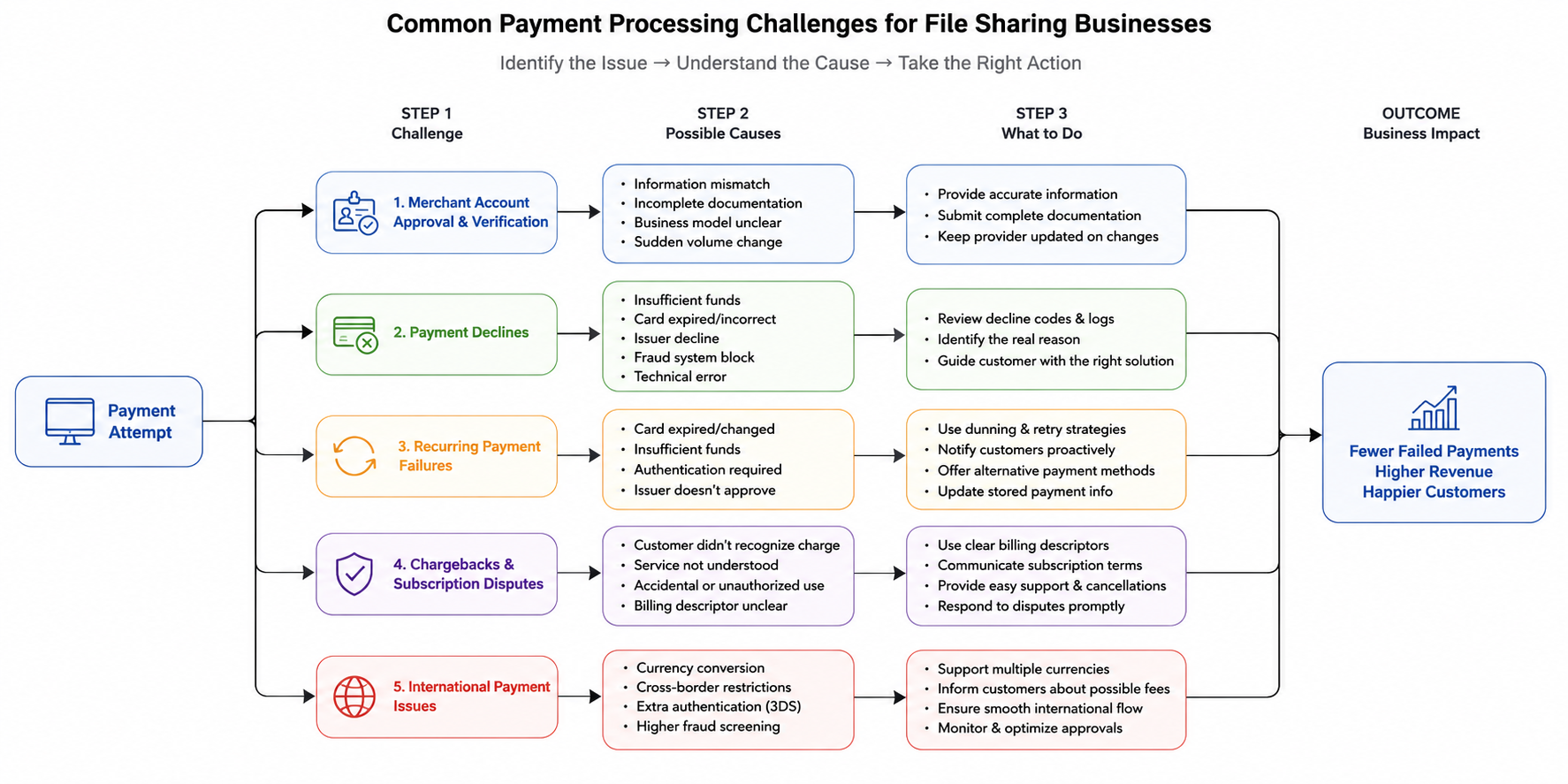
How Should a File-Sharing Business Approach Payment Problems?
The first step is to identify the type of problem rather than treating every failed transaction as a general payment issue.
A useful starting point is to ask:
Did the payment fail before authorization, after authorization, during recurring billing, or after the transaction was completed?
The answer can help narrow down where the problem occurred.
A payment decline requires a different response from a chargeback. A fraudulent transaction requires different controls from an expired card. A reconciliation issue requires a different solution from an international payment problem.
Businesses should also monitor payment performance over time instead of looking only at individual transactions. Patterns in:
- Decline reasons
- Failed renewals
- Refunds
- Chargebacks
- Fraud attempts
- Settlement differences
can reveal problems that are difficult to identify from individual transactions.
Building a More Reliable Payment Operation
Payment processing for a file-sharing business is not simply about adding a checkout page.
The payment operation needs to support the complete payment lifecycle:
Checkout → Authorization → Subscription billing → Renewals → Payment recovery → Refunds → Fraud monitoring → Chargeback management → Settlement → Reconciliation
A small file-sharing business may be able to manage many of these processes through a straightforward payment setup. As the business grows, however, better reporting, automation, payment-method coverage, risk controls, and system integration become increasingly important. The key is to solve the underlying operational problem rather than treating each payment failure as an isolated event.
When payment challenges are categorized correctly, a file-sharing business can determine whether the issue relates to merchant approval, payment acceptance, recurring billing, fraud, disputes, international processing, or broader payment infrastructure.

Categories
- ACH Payments (10)
- adult payment processing (11)
- AI (9)
- Altcoins (10)
- Banking (10)
- Bitcoin (133)
- Bitcoin ETF (11)
- Bitcoin Price (30)
- Blockchain (50)
- Brokering World Hunger Away (16)
- Business (17)
- card payment processing (10)
- CBD (11)
- CBDC (11)
- Chargeback (8)
- coaching business (11)
- COVID-19 (3)
- Crypto ATMs (1)
- Crypto Banking (17)
- Crypto Bill (1)
- Crypto business owner platform (31)
- Crypto Investment (3)
- Crypto Markets (5)
- Crypto Payment (35)
- Crypto Payment Processor (4)
- Crypto Prices (1)
- Crypto Trading (92)
- Cryptocurrency (402)
- Cryptocurrency Exchange (108)
- Data Visualization (2)
- dating platforms (11)
- debt collection payment processing (10)
- Decentralized Finance (7)
- DeFi Payment (9)
- DEX (3)
- Digital Currency (23)
- dropshipping payment processing (12)
- Ethereum (2)
- FAQ (7)
- file sharing payment processing (11)
- Finance (25)
- Financial Equality (4)
- Financial Freedom (8)
- Forex (35)
- hemp (1)
- ICO (2)
- Investment (11)
- IPTV (11)
- Merchant Account (10)
- Mining (3)
- News (66)
- NFTs (2)
- online gambling (11)
- P2P (1)
- Paybito (147)
- PayBitoPro (693)
- PayBitoPro Coin Listing (6)
- PayBitoPro Exchange (2)
- Payment Gateway (48)
- peptide (10)
- Post COVID Digital Transformation (1)
- Press Release (130)
- Privacy & Security (3)
- Real Estate (1)
- Stablecoin (5)
- Technology (15)
- Travel (11)
- Uncategorized (10)
- US Presidential Election (2)
- Utility Coin (1)
- Web3 business (4)
- Web3 Wallets (2)
- White Label Crypto Exchange (8)
Recent Posts
- Payment Gateway vs. Payment Orchestration: What’s the Difference?
- What Is Smart Payment Routing? Strategies to Optimize Payment Performance
- How to Improve Payment Approval Rates for High-Risk Businesses?
- Why Are Online Payments Failing? Common Causes and How to Fix Them
- How to Use Multiple Payment Processors to Reduce Business Disruptions?