How Much Does a Payment Gateway Cost? Fees, Pricing Models, and Hidden Charges
- August 17, 2026
- Soham Guchait
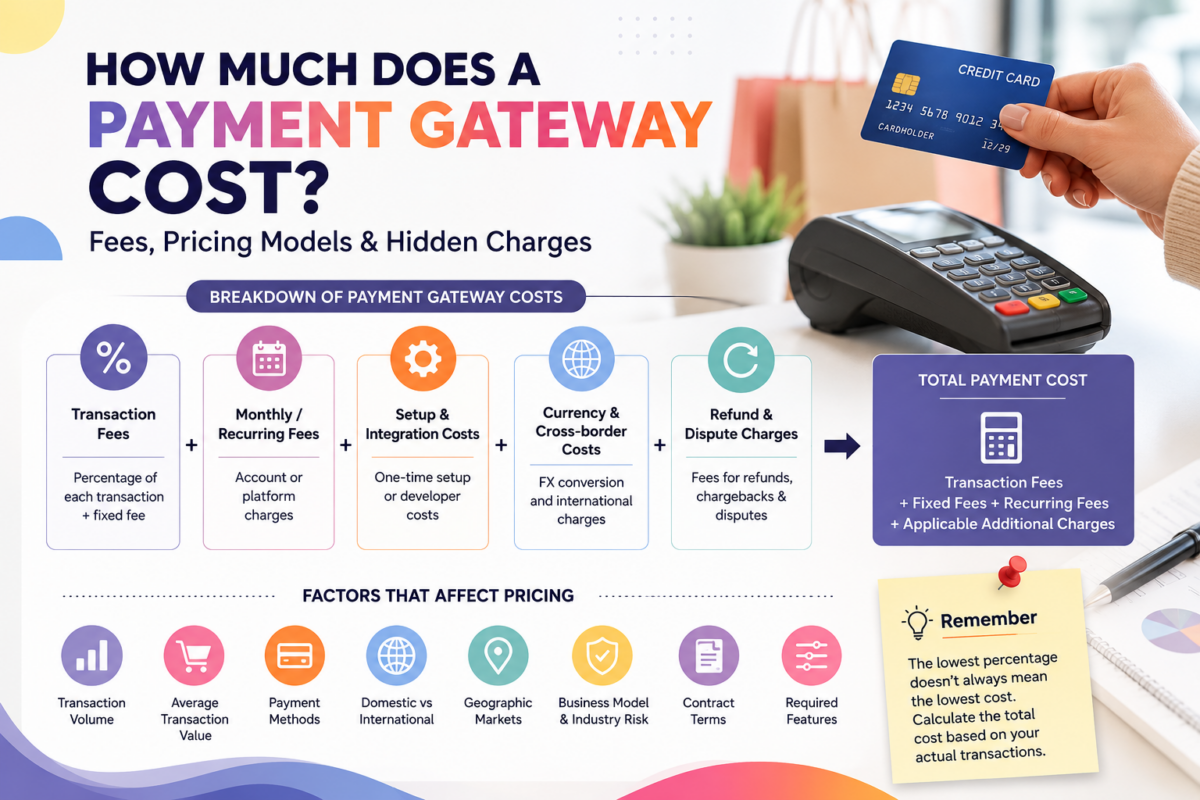
A payment gateway can cost a business much more – or much less – than its advertised transaction rate suggests.
A provider might advertise a percentage such as 2.5%, but the actual cost of accepting payments can also depend on fixed transaction fees, monthly charges, payment methods, currencies, transaction volume, and the terms of the merchant’s agreement.
So, how much does a payment gateway cost?
There is no universal price. The better approach is to understand the different components of payment gateway pricing and calculate what they mean for a business’s actual transactions.
How Does Payment Gateway Pricing Work?
Payment gateway pricing is commonly structured around transaction-based charges. These may include a percentage of the transaction, a fixed fee, or both.
For example, assume a hypothetical provider charges:
2.5% + $0.30 per transaction
If a customer makes a $100 purchase:
$100 × 2.5% = $2.50
Add the fixed fee:
$2.50 + $0.30 = $2.80
The merchant therefore pays $2.80 for that transaction before considering any other applicable charges. The same pricing structure produces a different effective cost for a smaller transaction.
For a $10 purchase:
$10 × 2.5% + $0.30 = $0.55
That $0.55 represents 5.5% of the transaction value.
For a $1,000 purchase:
$1,000 × 2.5% + $0.30 = $25.30
The effective rate is approximately 2.53%.
This is why businesses should not compare payment gateway pricing using the percentage rate alone. The fixed component can have a significant effect, particularly for businesses with low-value transactions.
Common Payment Gateway Fees
Not every provider charges every type of fee. Pricing depends on the provider, contract, payment methods, geography, business model, and other factors.
Transaction Fees
Transaction fees are charged based on payments processed. They may be percentage-based, fixed, or a combination of both.
A business processing large transactions may be more concerned with the percentage component, while a business processing many small transactions may feel the impact of fixed fees more strongly.
For example, a subscription company charging $10 per month can experience a very different effective payment cost from a B2B business processing $2,000 invoices, even if both use the same pricing structure.
Monthly or Recurring Fees
Some payment arrangements include monthly account, gateway, platform, or service charges. Consider a hypothetical $25 monthly fee. If a business processes $10,000 in payments during the month, that fee represents:
$25 ÷ $10,000 = 0.25%
If it processes only $1,000, the same fee represents:
2.5%
A fixed fee therefore needs to be evaluated against expected payment volume rather than viewed in isolation.
Setup and Integration Costs
Some businesses may also have initial setup or implementation expenses. These might come from the payment provider, but they can also come from the merchant’s own development work.
For example, a provider might not charge an integration fee, while the merchant spends money on developers to connect the payment system to its ecommerce platform. That development expense is part of the overall cost of adopting payment infrastructure, even though it does not appear as a gateway transaction fee.
Currency and Cross-Border Costs
International payments can introduce additional costs. Depending on the provider and arrangement, these may include currency-conversion or cross-border charges.
A business selling internationally should therefore calculate the cost of accepting payments in each important market instead of assuming that its domestic transaction rate applies identically everywhere.
Refund and Dispute-Related Charges
Refunds and payment disputes can also affect payment economics. For example, a merchant refunding a $200 purchase should not automatically assume that every fee associated with the original transaction will be returned.
The treatment of transaction fees, refunds, and disputes varies by provider and agreement. This is why reviewing the complete pricing terms is more useful than relying on a headline rate.
How Transaction Size Changes the Effective Cost?
Consider a hypothetical pricing model of 2.5% + $0.30.
|
Transaction |
Percentage fee | Fixed fee |
Total fee |
|
$10 |
$0.25 | $0.30 |
$0.55 |
|
$100 |
$2.50 | $0.30 |
$2.80 |
|
$500 |
$12.50 | $0.30 |
$12.80 |
|
$1,000 |
$25.00 | $0.30 |
$25.30 |
The percentage remains the same, but the effective cost changes.
For the $10 transaction, the total fee equals 5.5% of the payment.
For the $1,000 transaction, it is approximately 2.53%.
This matters when comparing payment gateways because two businesses with the same monthly payment volume can have very different payment costs if their average transaction values differ.
How Transaction Volume Affects Payment Gateway Costs?
Transaction value is only one part of the calculation. Transaction count also matters.
Suppose an ecommerce business processes $100,000 per month under a hypothetical pricing structure of 2.5% + $0.30. The percentage component is:
$100,000 × 2.5% = $2,500
Now assume the business processes 1,000 transactions. Fixed fees add:
1,000 × $0.30 = $300
The transaction-related cost is therefore approximately:
$2,800
Now imagine the same $100,000 is spread across 10,000 transactions.
The percentage charge remains $2,500, but fixed fees become:
10,000 × $0.30 = $3,000
The total becomes approximately $5,500. The business processed exactly the same dollar volume, but the number of transactions dramatically changed the cost. This is particularly important for subscription businesses, marketplaces, and other models that may process large numbers of relatively small payments.
What Are “Hidden” Payment Gateway Fees?
A fee is not necessarily “hidden” simply because it is not included in an advertised headline rate. It may be disclosed separately in pricing documentation or contractual terms. Businesses should investigate whether their arrangement includes charges such as:
- Monthly or account fees
- Setup or implementation charges
- Refund-related costs
- Dispute or chargeback fees
- Currency-conversion costs
- Cross-border charges
- Additional payment-method fees
- Minimum monthly commitments
- Contract termination charges
Not every provider applies these charges. The practical lesson is simple: Calculate the total expected cost from the complete pricing schedule rather than assuming the advertised transaction rate is the final price.
How to Calculate the Real Cost of a Payment Gateway?
A useful calculation is:
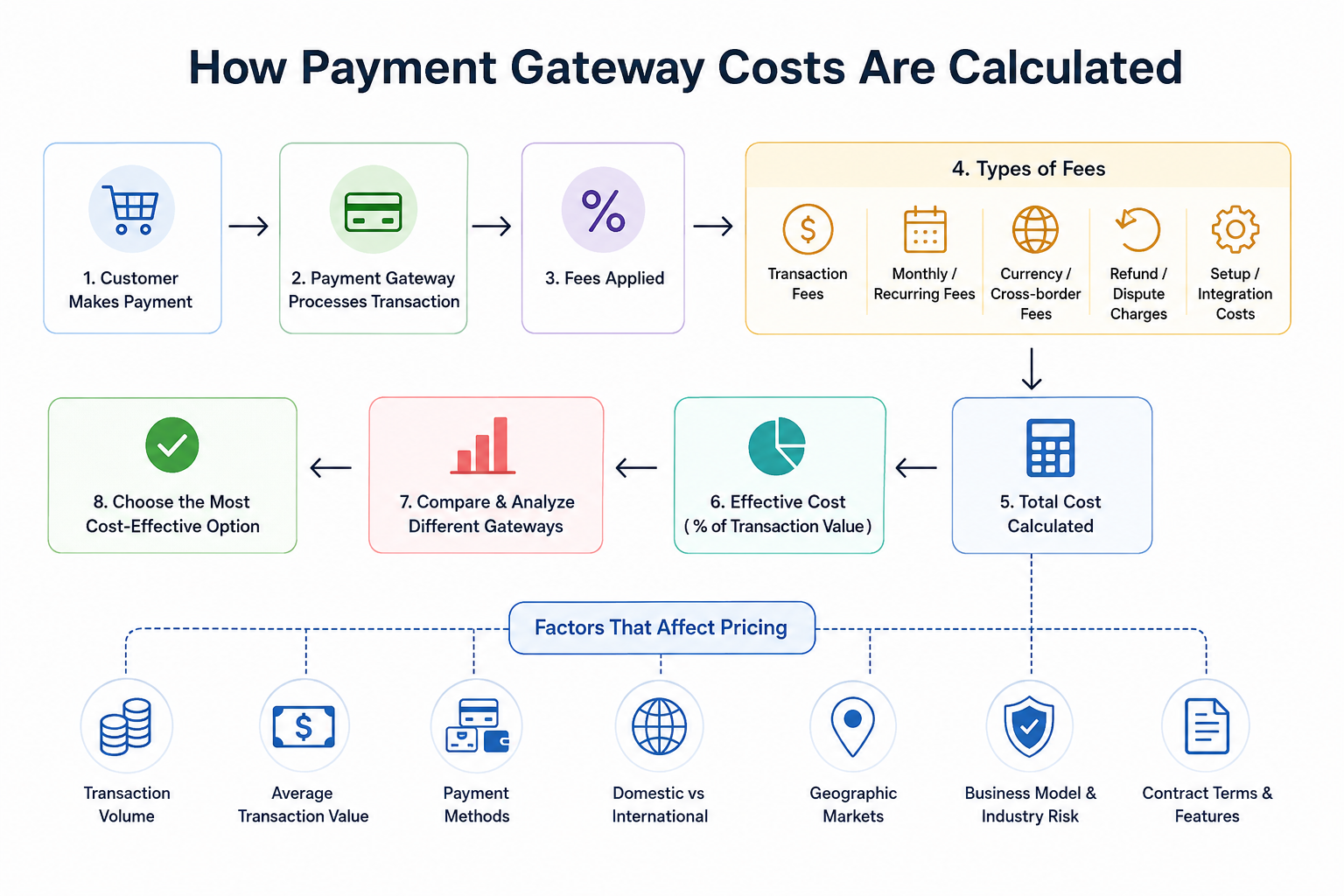
Total Payment Cost = Transaction Fees + Fixed Fees + Recurring Fees + Applicable Additional Charges
Consider a hypothetical business processing $50,000 per month across 500 transactions. Assume:
- 2.5% transaction fee
- $0.30 fixed transaction fee
- $20 monthly fee
Percentage fees:
$50,000 × 2.5% = $1,250
Fixed transaction fees:
500 × $0.30 = $150
Monthly fee:
$20
Total monthly payment cost:
$1,420
The effective cost is:
$1,420 ÷ $50,000 = 2.84%
The business therefore needs to think in terms of an effective payment cost of 2.84%, rather than simply the advertised 2.5% percentage. That figure is much more useful for budgeting and comparing different pricing arrangements.
What Determines Payment Gateway Pricing?
Payment gateway pricing can vary according to several factors, including:
- Transaction volume
- Average transaction value
- Payment methods
- Domestic versus international transactions
- Geographic markets
- Business model
- Industry and risk considerations
- Contract structure
- Payment failure rates
- Required features
- Settlement arrangements
A high-volume business may receive a different commercial arrangement from a smaller merchant. Similarly, a business accepting only domestic card payments may have a different cost structure from one accepting multiple currencies and payment methods. This is why there is no single “standard” payment gateway price that applies to every merchant.
The Bottom Line
The cost of a payment gateway is rarely just one percentage.
Transaction fees, fixed charges, recurring fees, international payment costs, refunds, disputes, and implementation expenses can all affect the final economics.
The most useful calculation is based on the business’s actual transaction size, transaction count, monthly payment volume, payment methods, and expected additional charges.
A gateway offering 2.5% is not automatically cheaper than one offering 2.7%. The fixed fee, monthly charges, international costs, and other terms could change the final result.
The better question is not simply:
“What does the payment gateway charge?”
It is:
“What will this payment infrastructure actually cost our business based on how we accept payments?”
That is the figure worth using when comparing payment gateway pricing.

Categories
- ACH Payments (10)
- adult payment processing (11)
- AI (9)
- Altcoins (10)
- Banking (10)
- Bitcoin (133)
- Bitcoin ETF (11)
- Bitcoin Price (30)
- Blockchain (50)
- Brokering World Hunger Away (16)
- Business (17)
- card payment processing (10)
- CBD (11)
- CBDC (11)
- Chargeback (8)
- coaching business (11)
- COVID-19 (3)
- Crypto ATMs (1)
- Crypto Banking (17)
- Crypto Bill (1)
- Crypto business owner platform (31)
- Crypto Investment (3)
- Crypto Markets (5)
- Crypto Payment (35)
- Crypto Payment Processor (4)
- Crypto Prices (1)
- Crypto Trading (92)
- Cryptocurrency (402)
- Cryptocurrency Exchange (108)
- Data Visualization (2)
- dating platforms (11)
- debt collection payment processing (10)
- Decentralized Finance (7)
- DeFi Payment (9)
- DEX (3)
- Digital Currency (23)
- dropshipping payment processing (12)
- Ethereum (2)
- FAQ (7)
- file sharing payment processing (11)
- Finance (25)
- Financial Equality (4)
- Financial Freedom (8)
- Forex (35)
- hemp (1)
- ICO (2)
- Investment (11)
- IPTV (11)
- Merchant Account (10)
- Mining (3)
- News (66)
- NFTs (2)
- online gambling (11)
- P2P (1)
- Paybito (147)
- PayBitoPro (693)
- PayBitoPro Coin Listing (6)
- PayBitoPro Exchange (2)
- Payment Gateway (48)
- peptide (10)
- Post COVID Digital Transformation (1)
- Press Release (130)
- Privacy & Security (3)
- Real Estate (1)
- Stablecoin (5)
- Technology (15)
- Travel (11)
- Uncategorized (10)
- US Presidential Election (2)
- Utility Coin (1)
- Web3 business (4)
- Web3 Wallets (2)
- White Label Crypto Exchange (8)
Recent Posts
- Payment Gateway vs. Payment Orchestration: What’s the Difference?
- What Is Smart Payment Routing? Strategies to Optimize Payment Performance
- How to Improve Payment Approval Rates for High-Risk Businesses?
- Why Are Online Payments Failing? Common Causes and How to Fix Them
- How to Use Multiple Payment Processors to Reduce Business Disruptions?