What Is a Rolling Reserve?
- August 14, 2026
- Soham Guchait
A business can process a card payment today and still not have immediate access to every dollar generated by that transaction. One reason is a rolling reserve.
A rolling reserve is a risk-management arrangement in which a payment provider or acquiring institution withholds a percentage of a merchant’s processed funds for a defined period before releasing those funds. The reserve is designed to provide a source of funds for potential chargebacks, refunds, disputes, or other payment-related losses that may arise after a transaction has already been processed. The important point is that a rolling reserve is generally not an additional processing fee. The money belongs to the merchant, but access to it is delayed according to the reserve terms.
Understanding how rolling reserves work is important because they directly affect a business’s available cash flow.
How Does a Rolling Reserve Work?
The easiest way to understand a rolling reserve is through an example.
Suppose an online business processes $100,000 in card payments during a month, and its payment agreement requires a 10% rolling reserve with a 90-day release period.
Instead of making the entire $100,000 available for normal settlement, the provider may withhold $10,000 as reserve funds while the remaining $90,000 is made available according to the merchant’s normal funding schedule.
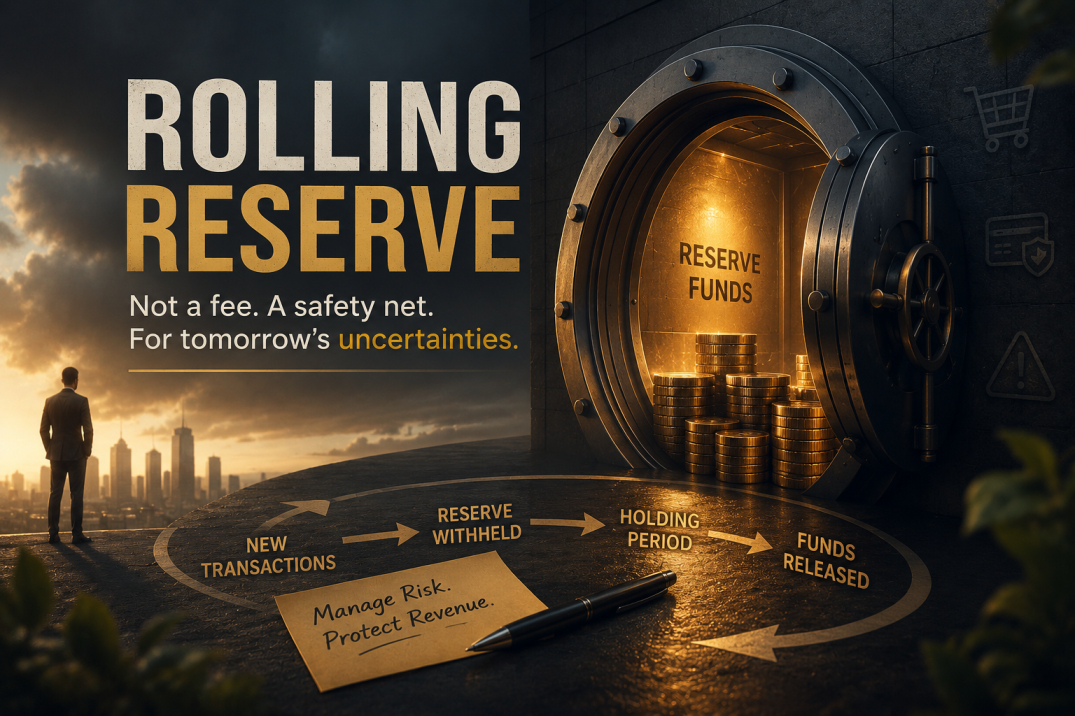
As new transactions are processed, additional amounts may be added to the reserve. At the same time, older reserved amounts can become eligible for release once their applicable holding period expires. This creates a rolling cycle:
New transactions → Reserve withheld → Holding period → Older reserve released → New reserve added
That is where the term rolling reserve comes from.
The reserve effectively moves forward with the merchant’s transaction activity rather than being a one-time deposit that simply remains untouched.
A Simple 90-Day Example
Imagine a merchant processes $20,000 during January and has a 10% rolling reserve.
- $2,000 is placed into the reserve.
- The applicable reserve period begins.
- The merchant continues processing payments in February and March.
- Once the January reserve reaches the release point, the $2,000 may become available, subject to the terms of the merchant agreement and any applicable refunds or disputes.
- Meanwhile, new reserve amounts have been created from February and March transactions.
The merchant therefore does not necessarily receive a single $2,000 payment after 90 days and then have the reserve disappear. Instead, the reserve can continue moving through the account as new transactions are processed.
The exact calculation method, percentage, release period, and treatment of disputes vary by provider and agreement.
Why Do Payment Providers Use Rolling Reserves?
The fundamental reason is future financial exposure.
A card transaction that has been authorized and settled does not eliminate every possible liability for the merchant. A customer can later dispute a transaction, request a refund, or raise another type of payment claim.
This creates a timing problem.
Consider a business selling a $1,000 service that will not be delivered for several months. The customer may pay today, but the merchant’s obligation to deliver the service continues into the future. If the business later fails to deliver the service and customers dispute their payments, the payment provider may still need to facilitate refunds or handle resulting financial obligations.
A reserve provides a pool of funds that can help cover that potential exposure. Payment providers may consider factors such as industry, processing history, dispute and refund activity, financial stability, transaction patterns, and fulfillment timelines when assessing risk.
This is also why rolling reserves can appear more frequently in situations where there is greater uncertainty between when a customer pays and when the merchant fulfills its obligation.
What Determines the Size of a Rolling Reserve?
There is no universal rolling-reserve percentage that applies to every merchant. The reserve terms are generally connected to the perceived risk of the merchant’s payment activity.
For example, imagine two businesses each processing $200,000 per month.
Business A sells $20 physical products and ships them within 24 hours.
Business B sells $5,000 products that customers receive several months after payment.
Their processing volume is identical, but their potential exposure is not necessarily identical. A provider may consider Business B’s longer fulfillment cycle when evaluating the possibility of future refunds or disputes. Other factors can also influence the assessment, including a merchant’s previous processing history and dispute patterns.
Rolling Reserve vs. Payment Processing Fees
One of the biggest misconceptions about rolling reserves is treating withheld funds as a processing expense. They are fundamentally different. Suppose a merchant processes a $10,000 payment batch and has:
- $300 in processing fees
- $1,000 subject to a 10% rolling reserve
- $8,700 available after those amounts
The $300 processing fee is a cost of accepting the payments. The $1,000 reserve is different. It is temporarily restricted merchant funds, assuming the applicable agreement provides for its eventual release.
This distinction matters when calculating the actual cost of accepting payments. Businesses evaluating their payment expenses should therefore consider both processing charges and potential effects on available working capital.
For a broader explanation of payment expenses, see have to how much does a merchant account cost.
How Does a Rolling Reserve Affect Cash Flow?
The biggest practical effect is often cash-flow timing. A business may generate strong sales while having less immediately available cash than its gross processing volume suggests.
Consider a subscription business processing $150,000 per month. If 10% is reserved, $15,000 of each month’s processing volume may be subject to the reserve arrangement. That does not necessarily mean the business has lost $15,000. It means the business needs enough operating liquidity to function while part of its payment proceeds remain unavailable.
This can become particularly important for businesses that have significant expenses immediately after making a sale, such as inventory purchases, shipping, advertising, payroll, or supplier payments. For that reason, businesses should evaluate a payment arrangement based not only on its advertised transaction rate but also on how settlement and reserves affect working capital.
The distinction between ordinary settlement timing and restricted funds is also useful when learning about how long will it take to get a merchant account ,because funding terms are part of the broader payment-account setup.
Is a Rolling Reserve the Same as a Hold?
Not exactly. The terms are sometimes used loosely, but they describe different mechanisms.
A rolling reserve generally involves withholding a defined portion of transaction funds and releasing those funds according to a recurring schedule.
A hold can refer more broadly to funds being temporarily restricted because of a particular transaction, review, dispute, risk event, or other circumstance.
For example, a merchant could have a 10% rolling reserve as part of its normal processing agreement while separately experiencing a temporary hold on particular funds because of an account review.
The practical details depend on the provider’s agreement, so businesses should examine the exact language governing reserves, holds, settlement, and release conditions.
Can a Rolling Reserve Be Reduced or Removed?
Potentially, but there is no universal rule.
Reserve arrangements are contractual and risk-based. If a merchant’s processing profile becomes more predictable over time, its financial position improves, dispute activity declines, or other relevant risk factors change, the provider may reassess the arrangement.
That does not mean a merchant can automatically request a lower percentage and have it changed.
Businesses should instead understand why the reserve exists, what conditions govern it, how long funds remain restricted, and what circumstances can trigger a review.
The underlying risk assessment is closely related to the information collected during the merchant-account application and underwriting process. Businesses preparing for that process can also review the documents they would need for a merchant account to understand why financial and operational documentation matters.
What Businesses Should Check Before Accepting a Rolling Reserve?
Before agreeing to a payment-processing arrangement that includes a rolling reserve, a business should understand the mechanics rather than focusing only on the percentage. Pay particular attention to:
- Reserve percentage: What portion of transactions is withheld?
- Release period: When does each reserved amount become eligible for release?
- Calculation method: Is the reserve calculated from gross transactions, net amounts, or another basis?
- Release conditions: What needs to happen before funds are released?
- Dispute treatment: Can disputes or refunds be deducted from reserved funds?
- Changes to the reserve: Under what circumstances can the provider increase, decrease, or extend it?
These details can have a substantial impact on working capital even when the underlying processing rate appears attractive.
Rolling Reserves Are About Risk and Timing
A rolling reserve does not necessarily mean that a business has done something wrong or that its money has been permanently taken.
It is a mechanism used to manage the possibility that future refunds, disputes, chargebacks, or other liabilities could arise after transactions have already been processed.
For merchants, the most important issue is therefore cash-flow planning.
A business processing $100,000 per month should not automatically assume that $100,000 will be immediately available for operating expenses. Processing fees, settlement schedules, refunds, and reserve requirements can all affect when and how much money becomes accessible.
Understanding rolling reserves gives businesses a more realistic picture of how merchant accounts work – and why the headline processing volume is not always the same as immediately available cash.

Categories
- ACH Payments (10)
- adult payment processing (11)
- AI (9)
- Altcoins (10)
- Banking (10)
- Bitcoin (133)
- Bitcoin ETF (11)
- Bitcoin Price (30)
- Blockchain (50)
- Brokering World Hunger Away (16)
- Business (17)
- card payment processing (10)
- CBD (11)
- CBDC (11)
- coaching business (11)
- COVID-19 (3)
- Crypto ATMs (1)
- Crypto Banking (17)
- Crypto Bill (1)
- Crypto business owner platform (31)
- Crypto Investment (3)
- Crypto Markets (5)
- Crypto Payment (35)
- Crypto Payment Processor (4)
- Crypto Prices (1)
- Crypto Trading (92)
- Cryptocurrency (402)
- Cryptocurrency Exchange (108)
- Data Visualization (2)
- dating platforms (11)
- debt collection payment processing (10)
- Decentralized Finance (7)
- DeFi Payment (9)
- DEX (3)
- Digital Currency (23)
- dropshipping payment processing (12)
- Ethereum (2)
- FAQ (7)
- file sharing payment processing (11)
- Finance (25)
- Financial Equality (4)
- Financial Freedom (8)
- Forex (35)
- hemp (1)
- ICO (2)
- Investment (11)
- IPTV (11)
- Merchant Account (10)
- Mining (3)
- News (66)
- NFTs (2)
- online gambling (11)
- P2P (1)
- Paybito (139)
- PayBitoPro (693)
- PayBitoPro Coin Listing (6)
- PayBitoPro Exchange (2)
- Payment Gateway (40)
- peptide (10)
- Post COVID Digital Transformation (1)
- Press Release (130)
- Privacy & Security (3)
- Real Estate (1)
- Stablecoin (5)
- Technology (15)
- Travel (11)
- Uncategorized (9)
- US Presidential Election (2)
- Utility Coin (1)
- Web3 business (4)
- Web3 Wallets (2)
- White Label Crypto Exchange (8)
Recent Posts
- ACH vs Wire Transfer: Which Payment Method Is Better for Businesses?
- ACH Fraud Prevention: How Businesses Can Secure Bank Account Payments?
- ACH Credit vs ACH Debit: What’s the Difference? With Real Examples
- ACH vs Credit Card: Which Payment Method Is Better for Businesses?
- How Long Do ACH Payments Take? Processing Times, Settlement, and Same Day ACH