How Much Does a Merchant Account Cost? Fees, Rates and Pricing Explained
- August 14, 2026
- Soham Guchait
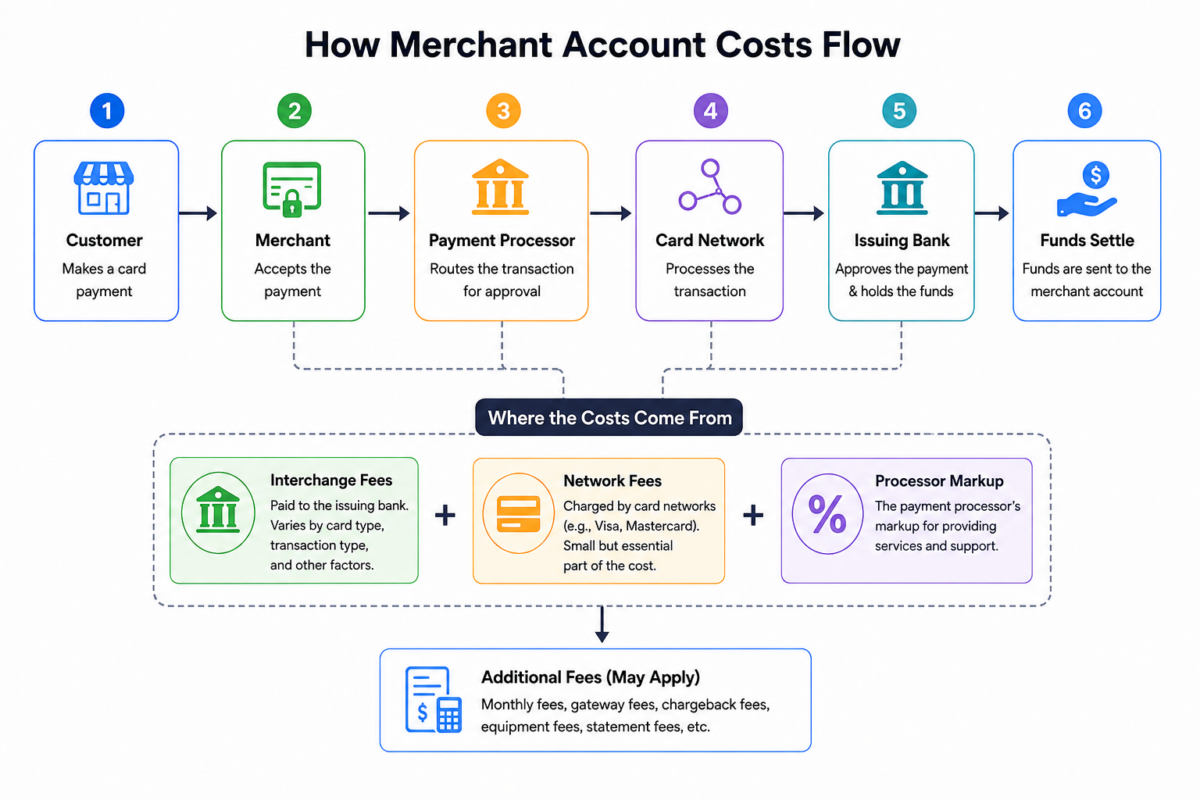
A business can process thousands of card payments every month without ever seeing a single line simply labeled “merchant account cost“. Instead, the expense appears across transaction fees, network charges, processor markups, monthly fees, and sometimes additional charges for specific services or events.
That is why asking how much a merchant account costs does not have a single answer. The actual cost depends on how the provider prices transactions, the types of cards customers use, how payments are accepted, transaction volume, and the services included in the agreement. Depending on the business and its risk profile, the provider may also require a merchant account reserve, which can temporarily hold a portion of processed funds. More importantly, a quoted rate is not necessarily the same as the business’s effective processing cost. To understand what a business is actually paying, it helps to look beneath the headline rate.
What Are Merchant Account Fees?
Merchant account fees are the costs associated with accepting and processing card payments. They are not all paid to the same party. A typical card transaction involves three major layers of cost:
- Interchange fees — Paid to the card-issuing bank.
- Network fees — Charged by the card network.
- Processor markup — The extra amount charged by the payment processor.
The important point is that not every part of the cost is controlled by the processor. Interchange can vary according to factors such as the card product, transaction type, merchant category, and how the transaction is submitted.
The Three Main Layers of Card Processing Costs
Interchange Fees
Interchange is a fee associated with the issuing bank and is one of the largest components of card acceptance costs.
The rate can differ depending on the transaction. A card-present purchase using a particular debit card can have a different interchange category from an online purchase made with a premium credit card. This means a merchant cannot accurately estimate its total processing cost simply by knowing its monthly sales volume.
For example, imagine two businesses each process $100,000 per month. One receives mostly debit-card transactions from customers making small purchases. The other sells higher-priced products online and receives a larger proportion of credit-card transactions. Their processing costs may differ even though their revenue from card payments is identical.
Assessment or Network Fees
Card networks also charge fees associated with operating their payment networks. These are separate from interchange. They are generally much smaller components of the overall cost, but they still contribute to what a merchant ultimately pays.
The exact fees and structures can change, and they can differ between networks and transaction environments. This is one reason businesses should look at the actual pricing structure rather than assuming that every processor’s quoted percentage represents the same underlying costs.
Processor Markup
The processor’s markup is the amount charged above the underlying card-network and interchange costs. This is where pricing between providers can differ significantly.
A processor may charge a percentage, a fixed amount per transaction, monthly account fees, or a combination of these. The markup can also be bundled into a single rate rather than displayed separately.
For businesses comparing payment providers, separating the underlying card costs from the processor’s own pricing is therefore extremely useful.
How Merchant Account Pricing Models Work?
The same underlying transaction costs can look very different depending on the pricing model used.
Interchange-Plus Pricing
With interchange-plus pricing, the business pays the applicable interchange and network costs plus a clearly defined processor markup. For example, a hypothetical agreement might be expressed as:
Interchange + 0.30% + $0.10 per transaction
The actual interchange component can change from one transaction to another, while the processor’s markup remains defined by the agreement. This model provides greater visibility because the underlying costs and processor markup are separated. Stripe describes interchange-plus as passing through actual interchange and assessment costs while adding a fixed processor markup.
Flat-Rate Pricing
A flat-rate model combines the costs into a simpler rate. For example, a provider might charge a hypothetical:
2.9% + $0.30 per transaction
The appeal is simplicity. A business does not need to interpret different interchange categories for every transaction. The trade-off is that the business has less visibility into exactly how much of the rate represents underlying card costs and how much represents the provider’s pricing. Flat-rate pricing can therefore be convenient for businesses that value predictability, while businesses with more substantial or consistent processing volume may want greater visibility into their underlying costs.
Tiered Pricing
Tiered pricing groups transactions into categories, often using labels such as qualified, mid-qualified, and non-qualified.
The problem is that the headline “qualified” rate does not necessarily represent what most of a merchant’s transactions will cost. Different card types and transaction characteristics can place transactions into different tiers, making the final cost harder to predict. For this reason, businesses evaluating a tiered agreement should understand exactly what determines the classification of each transaction.
A Simple Example of Merchant Account Costs
Suppose an online business processes $50,000 in card payments during a month. Assume, purely for illustration, that its total processing expenses work out to an average of 2.5% plus $0.20 per transaction, and the business processes 500 transactions.
The percentage component would be:
$50,000 × 2.5% = $1,250
The transaction component would be:
500 × $0.20 = $100
The illustrative total would therefore be:
$1,350
That works out to an effective cost of 2.7% of processed volume.
This example is intentionally hypothetical. Actual costs can vary considerably because interchange, network fees, processor pricing, transaction mix, and account-level charges differ between businesses. The useful lesson is that a business should evaluate its total cost, rather than looking only at the percentage printed in an advertisement or proposal.
What Other Merchant Account Fees Can Appear?
Not every cost is attached directly to an individual card transaction. Depending on the agreement and services being used, a merchant may encounter fees associated with account administration, payment technology, equipment, or particular events.
Examples can include:
- Monthly or annual account fees
- Payment gateway fees
- Statement or reporting fees
- Chargeback-related fees
- Equipment or terminal costs
- Batch or settlement-related fees
Not every merchant will pay every fee on this list. Some providers bundle certain services into their pricing, while others itemize them separately. This is why reading the complete pricing schedule is more useful than comparing one advertised rate.
Why Does Your Average Transaction Size Matters?
Two businesses with the same processing volume can have very different costs because of their average transaction size.
Imagine:
Business A: 10,000 transactions × $10 = $100,000
Business B: 100 transactions × $1,000 = $100,000
If both businesses have a hypothetical fixed fee of $0.20 per transaction, Business A would pay $2,000 in transaction fees, while Business B would pay only $20. The percentage-based portion would be identical if the same rate applied, but the fixed per-transaction component would have a dramatically different impact. This is why businesses should evaluate merchant account pricing using their actual transaction count and average ticket size, not just monthly revenue.
What Is an Effective Processing Rate?
The effective rate gives a business a more practical way to understand its overall processing cost. The basic calculation is:
Total processing fees ÷ Total processed volume × 100
Suppose a merchant processes $100,000 in one month and pays $2,800 in total processing-related fees.
Its effective rate is:
$2,800 ÷ $100,000 × 100 = 2.8%
This number is useful because it incorporates the combined effect of percentage fees, per-transaction charges, and applicable account-level costs. However, businesses should still examine the underlying statement. Two merchants can have the same effective rate for completely different reasons.
Why Card Type and Transaction Method Affect Cost?
The cost of a transaction can depend on how the payment is accepted.
An in-person chip or contactless transaction can have a different interchange category from an ecommerce transaction where the card is not physically present. Card type matters as well. Different card products can fall into different interchange categories. This is one reason an online merchant should not automatically assume that a quoted in-person processing rate will represent its ecommerce costs.
Before approving a merchant account, providers typically assess the business through a merchant account underwriting process. This review considers factors such as the business model, expected processing volume, transaction history, and potential payment risks. The outcome can influence the pricing, terms, and requirements attached to the account.
How Businesses Should Compare Merchant Account Costs?
The cheapest-looking rate is not necessarily the cheapest arrangement. When comparing offers, look at the complete economics:
- What percentage is charged?
- What is the per-transaction fee?
- Which fees are pass-through costs and which are processor charges?
- Are there monthly, gateway, statement, equipment, or other account fees?
- How are refunds and chargebacks priced?
- What pricing model is being used?
A business should also compare the proposal against its own transaction profile. A pricing model that works well for a small business processing a few thousand dollars per month may not have the same economics for a company processing hundreds of thousands. This is also where understanding how a merchant account works with payment processing becomes useful. Costs make much more sense once the roles of the merchant account, processor, gateway, acquirer, and card networks are separated.
The Bottom Line
There is no universal answer to how much a merchant account costs. The actual expense depends on the transaction mix, card types, payment channels, processing volume, average ticket size, pricing model, processor markup, and additional account fees.
The most useful approach is to look beyond the advertised rate. Understand the difference between interchange, network fees, processor markup, and account-level charges, then calculate the effective cost using the business’s real payment activity.
A merchant processing arrangement should ultimately be evaluated on its total cost and pricing structure, not on one attractive percentage printed at the top of a sales proposal.

Categories
- ACH Payments (10)
- adult payment processing (11)
- AI (9)
- Altcoins (10)
- Banking (10)
- Bitcoin (133)
- Bitcoin ETF (11)
- Bitcoin Price (30)
- Blockchain (50)
- Brokering World Hunger Away (16)
- Business (17)
- card payment processing (10)
- CBD (11)
- CBDC (11)
- Chargeback (8)
- coaching business (11)
- COVID-19 (3)
- Crypto ATMs (1)
- Crypto Banking (17)
- Crypto Bill (1)
- Crypto business owner platform (31)
- Crypto Investment (3)
- Crypto Markets (5)
- Crypto Payment (35)
- Crypto Payment Processor (4)
- Crypto Prices (1)
- Crypto Trading (92)
- Cryptocurrency (402)
- Cryptocurrency Exchange (108)
- Data Visualization (2)
- dating platforms (11)
- debt collection payment processing (10)
- Decentralized Finance (7)
- DeFi Payment (9)
- DEX (3)
- Digital Currency (23)
- dropshipping payment processing (12)
- Ethereum (2)
- FAQ (7)
- file sharing payment processing (11)
- Finance (25)
- Financial Equality (4)
- Financial Freedom (8)
- Forex (35)
- hemp (1)
- ICO (2)
- Investment (11)
- IPTV (11)
- Merchant Account (10)
- Mining (3)
- News (66)
- NFTs (2)
- online gambling (11)
- P2P (1)
- Paybito (147)
- PayBitoPro (693)
- PayBitoPro Coin Listing (6)
- PayBitoPro Exchange (2)
- Payment Gateway (48)
- peptide (10)
- Post COVID Digital Transformation (1)
- Press Release (130)
- Privacy & Security (3)
- Real Estate (1)
- Stablecoin (5)
- Technology (15)
- Travel (11)
- Uncategorized (10)
- US Presidential Election (2)
- Utility Coin (1)
- Web3 business (4)
- Web3 Wallets (2)
- White Label Crypto Exchange (8)
Recent Posts
- Payment Gateway vs. Payment Orchestration: What’s the Difference?
- What Is Smart Payment Routing? Strategies to Optimize Payment Performance
- How to Improve Payment Approval Rates for High-Risk Businesses?
- Why Are Online Payments Failing? Common Causes and How to Fix Them
- How to Use Multiple Payment Processors to Reduce Business Disruptions?