Chargeback Prevention for Travel Businesses: How to Reduce Payment Disputes?
- July 29, 2026
- Soham Guchait
Chargebacks are one of the biggest payment challenges faced by travel businesses. Unlike many industries where customers receive a product immediately after purchase, travel companies often collect payments weeks or months before the actual service takes place.
A customer may book a vacation package today and travel several months later. During that time, plans can change, cancellations may happen, and misunderstandings about policies can lead to payment disputes. Because travel businesses handle advance payments and delayed service delivery, they are often considered a higher-risk industry by payment providers.
Effective chargeback prevention for travel businesses requires more than simply responding to disputes after they occur. It involves creating clear policies, maintaining accurate records, improving customer communication, and building a reliable payment process.
What Is a Chargeback?
A chargeback occurs when a customer disputes a transaction with their bank or card provider and requests that the payment be reversed. Unlike a normal refund, a chargeback is handled through the payment network and financial institutions (such as issuing banks and card networks).
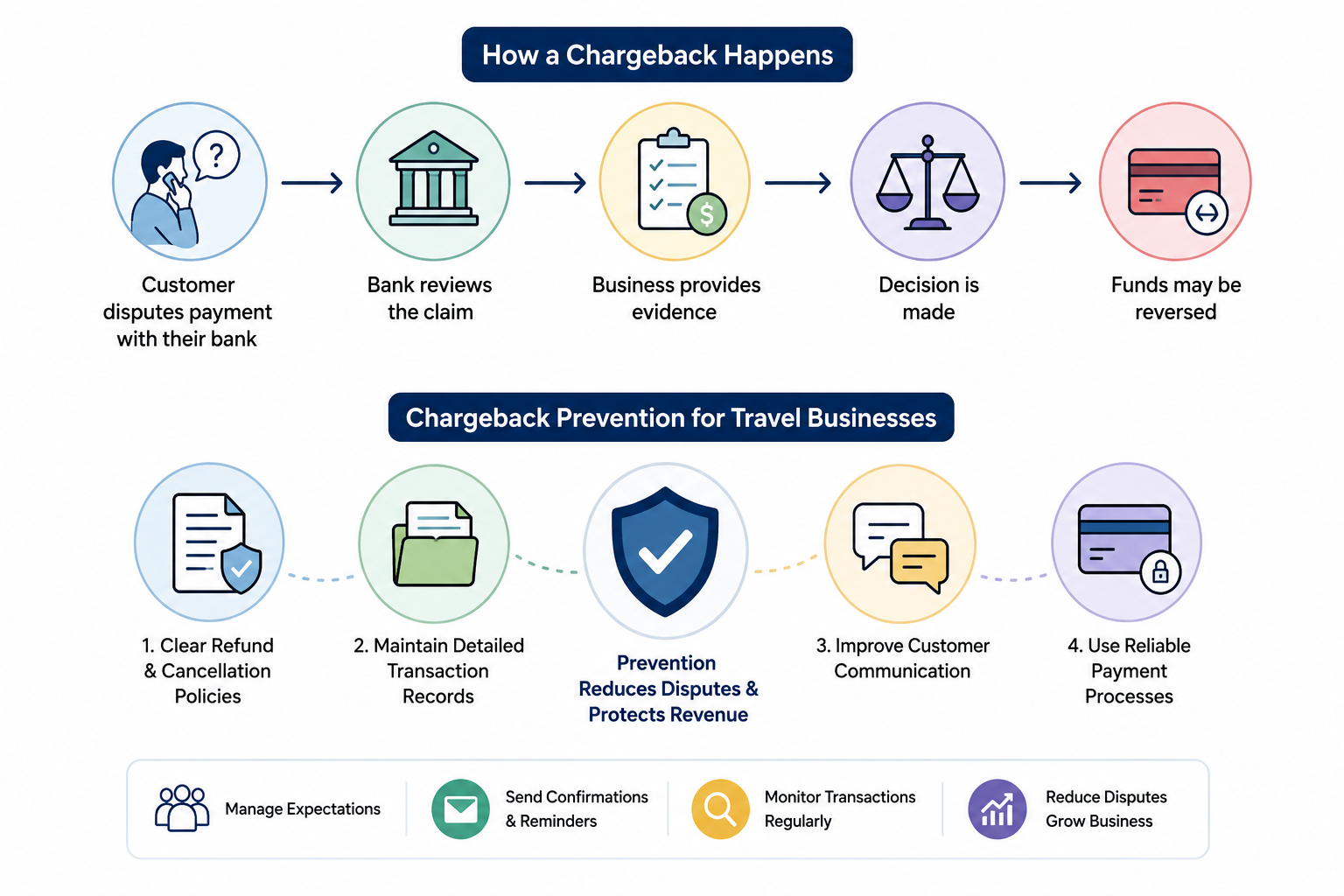
A typical chargeback process involves:
- Customer contacts their bank to dispute a payment
- The bank reviews the claim
- The business may be asked to provide transaction evidence
- A decision is made regarding the disputed amount
For example, a customer books a $2,000 holiday package but later claims they were unaware of the cancellation terms. If the dispute is accepted, the business may lose the payment amount along with additional processing costs.
Why Do Travel Businesses Experience More Chargebacks?
Travel companies often face higher dispute risks because of the nature of the industry.
Advance Payments and Delayed Service Delivery
Travel customers usually pay before receiving the actual service. The payment method customers use can also influence their experience. For example, customers using familiar payment options may have greater confidence during checkout, while unclear payment processes or unfamiliar transaction descriptions can increase confusion and potential disputes.
A booking may be made months before:
- A flight departure
- A hotel stay
- A guided tour
- A vacation experience
This creates a longer period where circumstances can change.
Example:
A customer books an international tour in January for a July trip. In May, they request cancellation but disagree with the refund policy. If communication is unclear, the situation may become a payment dispute.
Cancellation and Refund Confusion
Many travel disputes happen because customers do not fully understand cancellation conditions.
Common problems include:
- Non-refundable bookings
- Partial refund rules
- Rescheduling limitations
- Cancellation deadlines
Clear policies help customers understand their options before making a purchase.
Customer Expectations Not Matching Services
Travel experiences often involve multiple components, including:
- Accommodation
- Transportation
- Activities
- Guides
- Additional services
A customer may dispute a payment if the delivered experience does not match their expectations. Providing detailed service descriptions before purchase can help reduce misunderstandings.
Common Reasons for Travel Chargebacks
1. Customer Does Not Recognize the Transaction
Customers may forget a purchase or fail to recognize the business name appearing on their bank statement. Businesses can reduce this risk by ensuring:
- Billing names are recognizable
- Customers receive confirmation emails
- Transaction details are clearly communicated
2. Cancellation Disagreements
Cancellation disputes are among the most common issues in travel.
For example:
A customer books a luxury vacation package with a strict cancellation policy. Later, they cancel and expect a full refund because they were unaware of the conditions.
Solution:
Businesses should clearly display cancellation rules before payment and remind customers about important terms.
3. Service Delivery Disputes
Customers may file disputes if they believe the service was not provided as expected. Businesses can reduce these situations by maintaining:
- Booking confirmations
- Service descriptions
- Customer communication records
- Proof of completed services
How Travel Businesses Can Prevent Chargebacks?
Create Clear Refund and Cancellation Policies
A strong refund policy should explain:
- Cancellation deadlines
- Refund eligibility
- Processing times
- Rescheduling options
- Non-refundable services
Policies should be easy for customers to find before completing payment.
Maintain Detailed Transaction Records
Proper documentation is essential when responding to disputes. Important records may include:
- Booking confirmations
- Payment receipts
- Customer emails
- Terms accepted during checkout
- Service delivery information
For example, a tour operator should keep records showing when a customer booked, what service they purchased, and what policies they accepted.
Improve Customer Communication
Many disputes can be avoided through better communication. Businesses should provide:
- Booking confirmations
- Payment receipts
- Reminder messages
- Cancellation instructions
- Updates about schedule changes
A customer who understands the process is less likely to immediately request a chargeback.
Use Reliable Payment Processes
A strong payment setup begins with having the right payment infrastructure, including a suitable merchant account for a travel business and a reliable payment processing system. A properly structured merchant account helps businesses receive customer payments, maintain transaction records, manage refunds, and provide documentation when responding to disputes.
Understanding complete travel payment processing can help companies improve payment tracking, transaction management, and dispute handling.
How Chargebacks Connect With Payment Declines?
Payment declines and chargebacks are different challenges but are often connected. A payment decline happens when a transaction fails before completion. A chargeback happens after a successful payment when a customer disputes the transaction.
Travel businesses should manage both areas because payment problems at any stage can affect revenue and customer relationships. Businesses dealing with frequent failed transactions should also understand how to reduce payment declines for travel businesses.
Examples of Chargeback Prevention in Travel Businesses
Example 1: Tour Operator
A tour company receives disputes because customers claim they did not understand cancellation rules.
Solution:
The company improves its booking page by displaying cancellation terms before payment.
Example 2: Vacation Rental Business
A rental company receives disputes after guests cancel last-minute.
Solution:
The business creates clearer refund conditions and sends confirmation messages after every booking.
Example 3: International Travel Agency
A travel agency receives disputes from overseas customers who do not recognize transactions.
Solution:
The company improves payment descriptions and sends detailed booking confirmations.
Conclusion
Chargeback prevention for travel businesses requires a proactive approach. Since travel involves advance payments, changing plans, and high-value bookings, disputes can occur if customers do not clearly understand policies or services.
By creating transparent refund rules, maintaining detailed records, improving communication, and managing payments effectively, travel businesses can reduce disputes and protect revenue. A well-managed payment process helps travel companies build stronger customer relationships while creating a more reliable booking experience.

Categories
- ACH Payments (10)
- adult payment processing (11)
- AI (9)
- Altcoins (10)
- Banking (10)
- Bitcoin (133)
- Bitcoin ETF (11)
- Bitcoin Price (30)
- Blockchain (50)
- Brokering World Hunger Away (16)
- Business (17)
- card payment processing (10)
- CBD (11)
- CBDC (11)
- coaching business (11)
- COVID-19 (3)
- Crypto ATMs (1)
- Crypto Banking (17)
- Crypto Bill (1)
- Crypto business owner platform (31)
- Crypto Investment (3)
- Crypto Markets (5)
- Crypto Payment (35)
- Crypto Payment Processor (4)
- Crypto Prices (1)
- Crypto Trading (92)
- Cryptocurrency (402)
- Cryptocurrency Exchange (108)
- Data Visualization (2)
- dating platforms (11)
- debt collection payment processing (10)
- Decentralized Finance (7)
- DeFi Payment (9)
- DEX (3)
- Digital Currency (23)
- dropshipping payment processing (12)
- Ethereum (2)
- FAQ (7)
- file sharing payment processing (11)
- Finance (25)
- Financial Equality (4)
- Financial Freedom (8)
- Forex (35)
- hemp (1)
- ICO (2)
- Investment (11)
- IPTV (11)
- Merchant Account (10)
- Mining (3)
- News (66)
- NFTs (2)
- online gambling (11)
- P2P (1)
- Paybito (139)
- PayBitoPro (693)
- PayBitoPro Coin Listing (6)
- PayBitoPro Exchange (2)
- Payment Gateway (40)
- peptide (10)
- Post COVID Digital Transformation (1)
- Press Release (130)
- Privacy & Security (3)
- Real Estate (1)
- Stablecoin (5)
- Technology (15)
- Travel (11)
- Uncategorized (9)
- US Presidential Election (2)
- Utility Coin (1)
- Web3 business (4)
- Web3 Wallets (2)
- White Label Crypto Exchange (8)
Recent Posts
- ACH vs Wire Transfer: Which Payment Method Is Better for Businesses?
- ACH Fraud Prevention: How Businesses Can Secure Bank Account Payments?
- ACH Credit vs ACH Debit: What’s the Difference? With Real Examples
- ACH vs Credit Card: Which Payment Method Is Better for Businesses?
- How Long Do ACH Payments Take? Processing Times, Settlement, and Same Day ACH