Why Are CBD, Hemp, and Cannabis Businesses Considered High Risk?
- August 3, 2026
- Soham Guchait
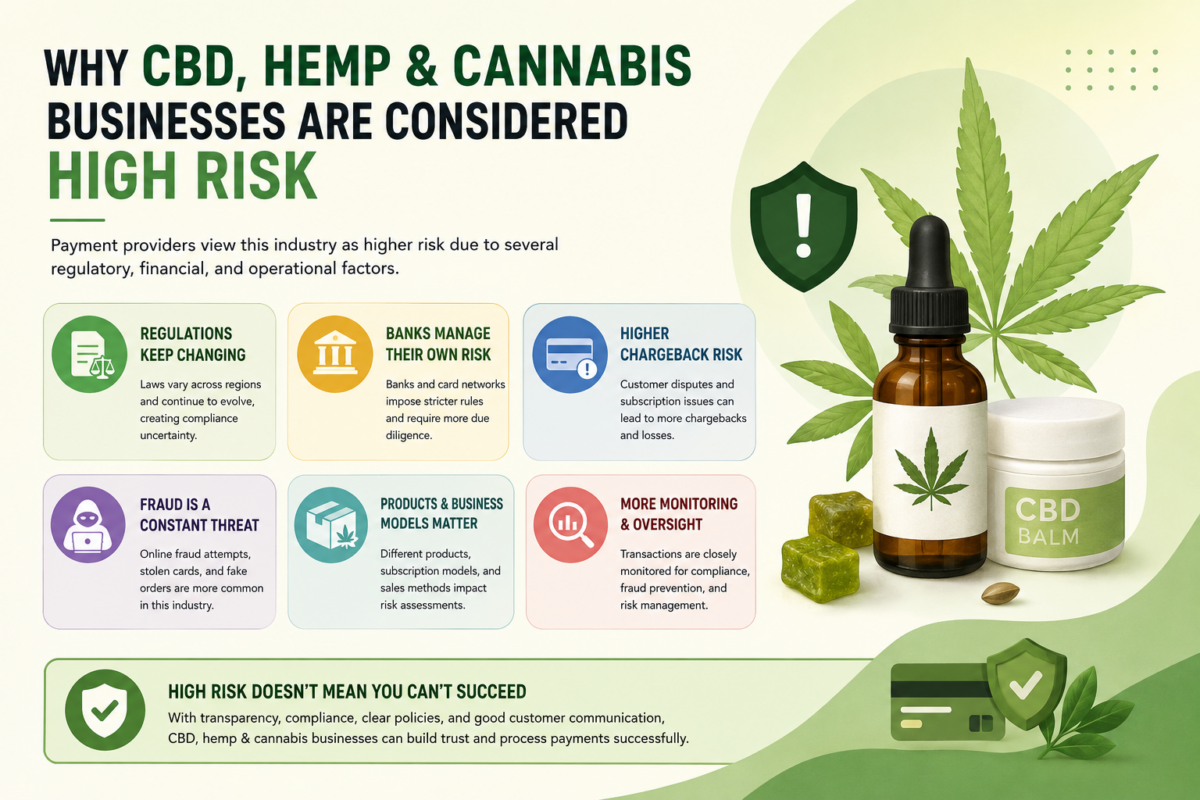
Selling legal CBD, hemp, or cannabis-related products doesn’t always mean it’s easy to accept customer payments.
Many business owners are surprised when they discover that banks and payment providers classify their business as high risk, even if they have a legitimate company, compliant products, and satisfied customers. This classification can affect everything from merchant account approvals to payment processing fees and transaction monitoring.
The good news is that being labeled high risk doesn’t mean your business is untrustworthy. Instead, it reflects how financial institutions assess industries that involve greater operational, regulatory, or financial uncertainty. Understanding why this happens can help you prepare for the payment challenges that often come with operating in the CBD, hemp, and cannabis industry.
What Does “High Risk” Mean in Payment Processing?
A high-risk business is one that payment providers believe has a greater chance of generating financial losses, compliance issues, or payment disputes than businesses in lower-risk industries. This assessment isn’t based solely on your products. Instead, payment providers evaluate the overall level of risk associated with the industry you operate in.
For example, a local stationery shop and an online CBD retailer may process the same number of transactions each month. However, the CBD business is more likely to undergo additional underwriting because of industry-specific factors rather than its sales performance.
Being classified as high risk simply means payment providers take a closer look before deciding to support your business. If you’re new to accepting payments, understanding the broader CBD payment processing ecosystem can help put this classification into context.
Regulations Continue to Change
One of the biggest reasons CBD, hemp, and cannabis businesses are considered high risk is the evolving regulatory landscape.
Rules surrounding these products differ between countries, states, and regions. A product that can be legally sold in one location may face restrictions somewhere else. Payment providers must consider these differences because they are responsible for ensuring their financial partners remain compliant with applicable regulations.
Imagine a wellness company selling hemp-derived CBD oils across multiple states. While most orders may comply with local laws, shipping restrictions or licensing requirements could vary depending on the customer’s location. From a payment provider’s perspective, managing this complexity requires additional oversight. Because regulations continue to evolve, financial institutions often approach the industry more cautiously than traditional retail sectors.
Banks Also Need to Manage Their Own Risk
Payment providers don’t make decisions in isolation.
Behind every transaction are acquiring banks, card networks, and other financial institutions that establish their own risk policies. If a provider supports businesses that generate excessive disputes or compliance issues, it can affect its relationships with banking partners.
For that reason, payment providers often request more information before approving CBD, hemp, or cannabis businesses.
They may review:
- Business registration documents
- Product information
- Website policies
- Compliance records
- Previous payment processing history
These additional reviews aren’t necessarily a sign that something is wrong. They’re simply part of the underwriting process for industries considered higher risk. Businesses that understand these requirements in advance are often better prepared when applying for a merchant account.
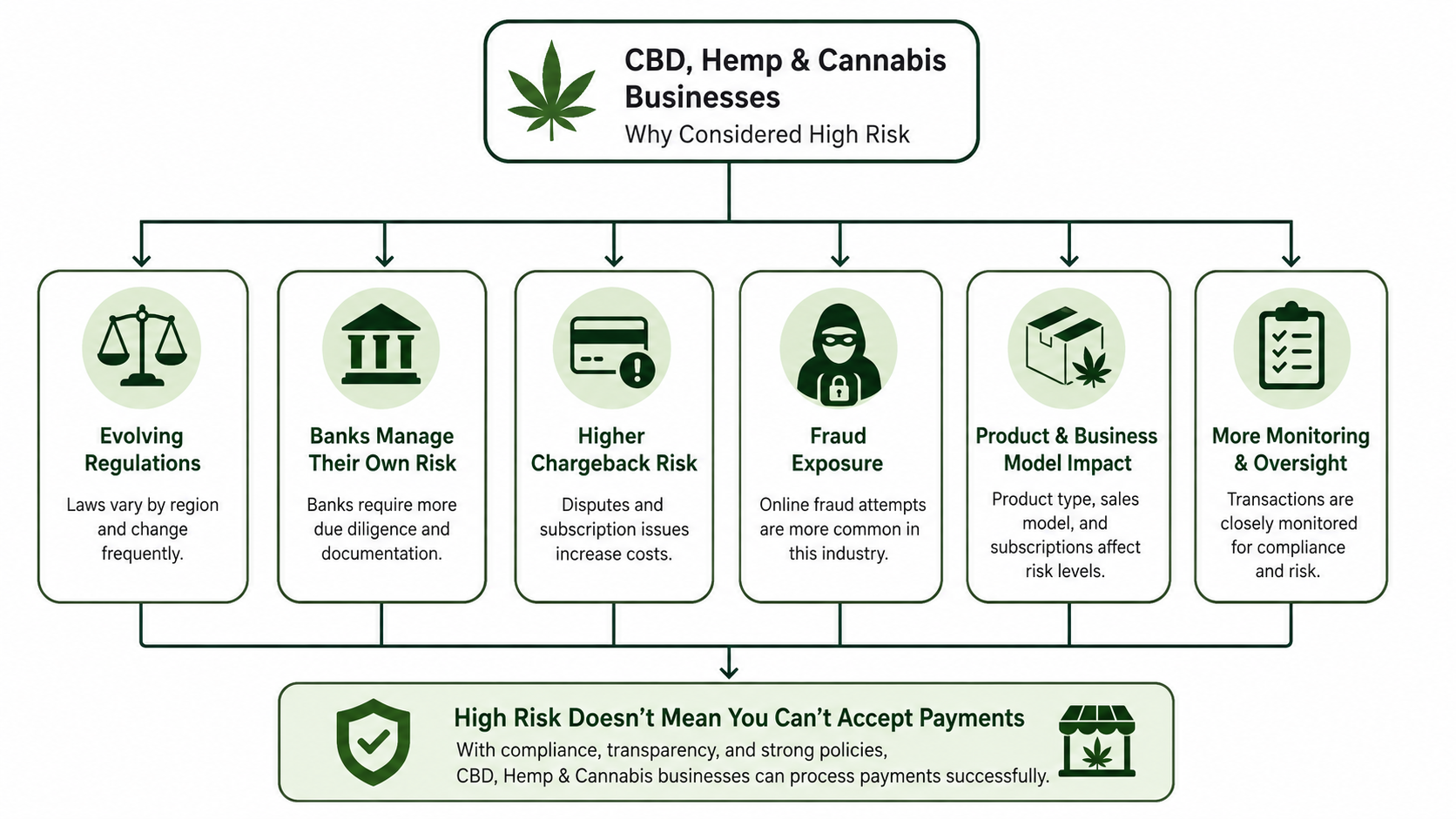
Chargebacks Increase Financial Risk
Another reason the industry receives additional scrutiny is the potential for chargebacks.
A chargeback occurs when a customer disputes a transaction through their card issuer(usually banks) instead of requesting a refund directly from the business.
Consider a customer who purchases a monthly CBD subscription but forgets about the automatic renewal. When they notice the charge on their statement several weeks later, they dispute the payment instead of contacting the merchant.
In another situation, a customer receives a CBD topical cream but believes it wasn’t the product they expected based on the description. Rather than requesting an exchange, they file a payment dispute.
Although these situations don’t always involve fraud, they still create costs for merchants and payment providers. Businesses that maintain low dispute rates are generally viewed as lower risk over time, which is why customer communication and transparent policies are so important.
Fraud Is a Constant Concern
Like many online industries, CBD and hemp businesses are frequent targets for payment fraud. Criminals may attempt to use stolen credit cards, create fake customer accounts, or exploit weaknesses in online checkout systems.
For example, a fraudster could place several high-value orders for CBD wellness products using stolen payment credentials and request express shipping. Days later, the legitimate cardholders report unauthorized transactions, leaving both the merchant and payment provider to deal with the financial consequences.
Because payment providers are responsible for reducing these risks, businesses operating in the industry often undergo additional fraud monitoring and transaction reviews.
Product Categories Influence Risk Assessments
Not every CBD or cannabis-related business is evaluated in exactly the same way. Payment providers often consider factors such as the products being sold, the business model, and how customers make purchases.
For instance, a company selling hemp-derived skincare products may be assessed differently from a business operating a licensed cannabis dispensary or offering recurring CBD subscription boxes. Subscription businesses, in particular, often receive additional scrutiny because recurring billing can lead to more customer disputes if renewal terms aren’t clearly communicated.
These differences help payment providers understand the level of monitoring that may be required after a business is approved.
High Risk Doesn’t Mean You Can’t Accept Payments
Many successful CBD, hemp, and cannabis businesses process payments every day despite operating in a high-risk industry. The key difference is that they understand what payment providers expect and prepare accordingly.
Businesses with transparent websites, clear refund and shipping policies, accurate product information, and organized documentation generally present a stronger application during the approval process. They also tend to build more trust with both customers and payment providers over time. Learning how to get approved for a CBD merchant account is often the next step after understanding why the industry is classified as high risk.
Final Thoughts
Being classified as a high-risk business isn’t a judgment about the quality of your products or the legitimacy of your company. It’s a reflection of how financial institutions manage industries that involve evolving regulations, increased fraud exposure, and higher dispute potential.
Rather than viewing the label as a barrier, business owners should see it as an opportunity to prepare. By understanding how payment providers evaluate risk, maintaining transparent business practices, and staying compliant, CBD, hemp, and cannabis businesses can build stronger payment operations and reduce future challenges.
As you continue building your payment strategy, it also helps to understand the approval process, common payment declines, and the operational challenges businesses face as they grow. These topics are explored in the related guides throughout this series.
Categories
- ACH Payments (10)
- adult payment processing (11)
- AI (9)
- Altcoins (10)
- Banking (10)
- Bitcoin (133)
- Bitcoin ETF (11)
- Bitcoin Price (30)
- Blockchain (50)
- Brokering World Hunger Away (16)
- Business (17)
- card payment processing (10)
- CBD (11)
- CBDC (11)
- coaching business (11)
- COVID-19 (3)
- Crypto ATMs (1)
- Crypto Banking (17)
- Crypto Bill (1)
- Crypto business owner platform (31)
- Crypto Investment (3)
- Crypto Markets (5)
- Crypto Payment (35)
- Crypto Payment Processor (4)
- Crypto Prices (1)
- Crypto Trading (92)
- Cryptocurrency (402)
- Cryptocurrency Exchange (108)
- Data Visualization (2)
- dating platforms (11)
- debt collection payment processing (10)
- Decentralized Finance (7)
- DeFi Payment (9)
- DEX (3)
- Digital Currency (23)
- dropshipping payment processing (12)
- Ethereum (2)
- FAQ (7)
- file sharing payment processing (11)
- Finance (25)
- Financial Equality (4)
- Financial Freedom (8)
- Forex (35)
- hemp (1)
- ICO (2)
- Investment (11)
- IPTV (11)
- Merchant Account (10)
- Mining (3)
- News (66)
- NFTs (2)
- online gambling (11)
- P2P (1)
- Paybito (139)
- PayBitoPro (693)
- PayBitoPro Coin Listing (6)
- PayBitoPro Exchange (2)
- Payment Gateway (40)
- peptide (10)
- Post COVID Digital Transformation (1)
- Press Release (130)
- Privacy & Security (3)
- Real Estate (1)
- Stablecoin (5)
- Technology (15)
- Travel (11)
- Uncategorized (9)
- US Presidential Election (2)
- Utility Coin (1)
- Web3 business (4)
- Web3 Wallets (2)
- White Label Crypto Exchange (8)
Recent Posts
- ACH vs Wire Transfer: Which Payment Method Is Better for Businesses?
- ACH Fraud Prevention: How Businesses Can Secure Bank Account Payments?
- ACH Credit vs ACH Debit: What’s the Difference? With Real Examples
- ACH vs Credit Card: Which Payment Method Is Better for Businesses?
- How Long Do ACH Payments Take? Processing Times, Settlement, and Same Day ACH