IPTV Payment Processing: A Complete Guide to Accepting IPTV Payments
- August 11, 2026
- Soham Guchait
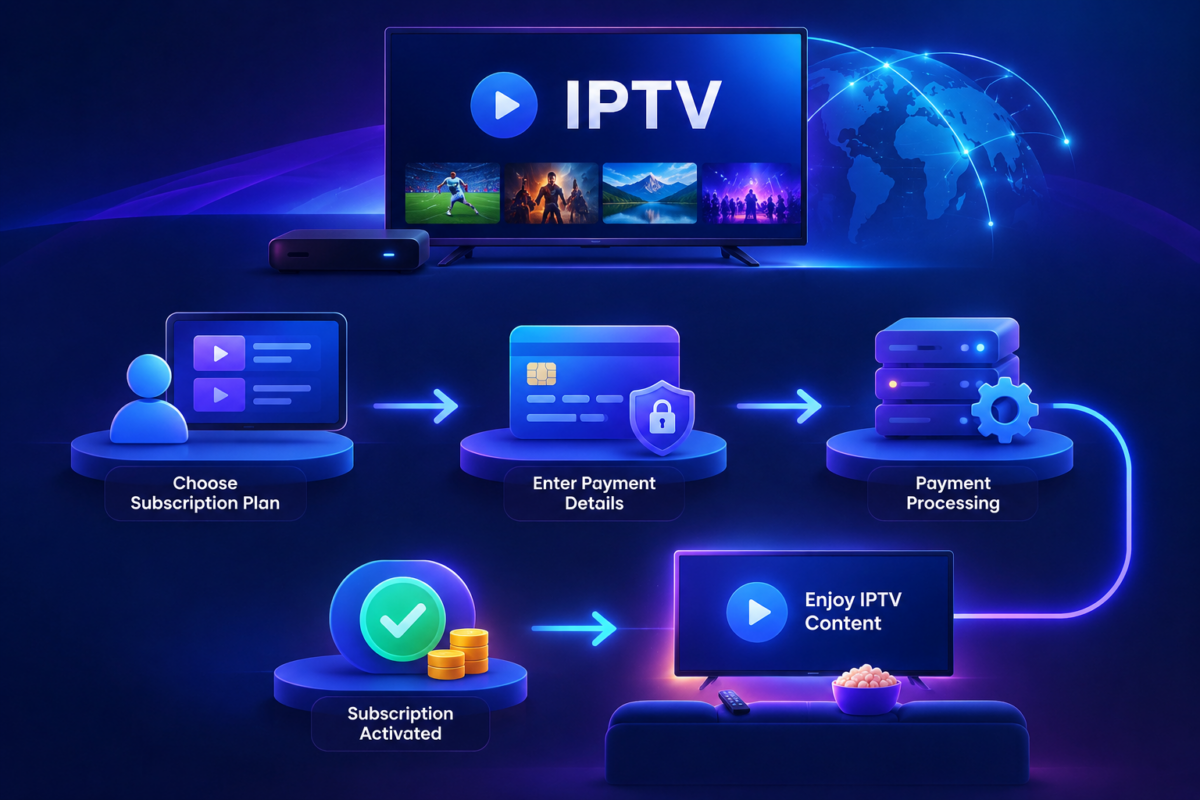
Running an IPTV business requires more than delivering streaming content to customers. Like any subscription-based digital service, an IPTV business depends on a reliable payment system that can accept customer payments, manage recurring subscriptions, process renewals, reduce failed transactions, and handle payment-related risks.
This is where IPTV payment processing becomes an essential part of the business operation.
Unlike a traditional online purchase where a customer pays once and receives a product, IPTV businesses usually operate through recurring subscriptions. A customer may subscribe to a monthly, quarterly, or yearly plan, meaning the payment system must support not only the first transaction but also future billing cycles.
A reliable IPTV payment processing setup helps businesses manage the complete payment journey – from customer checkout and transaction authorization to subscription renewals, refunds, disputes, and settlements.
How IPTV Payment Processing Works?
When a customer purchases an IPTV subscription, the payment process involves multiple systems working together behind the scenes.
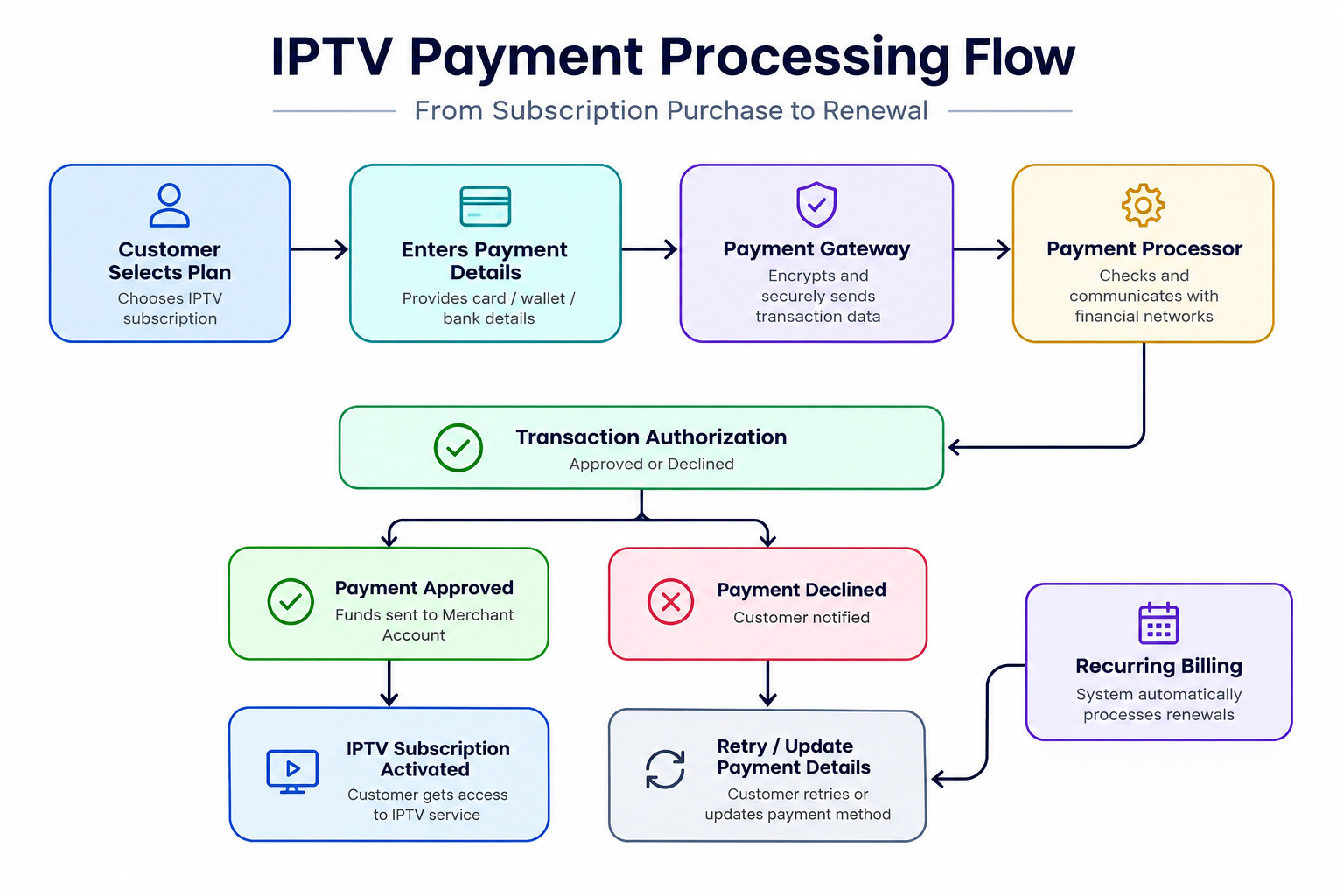
The customer first selects a subscription plan and enters payment details through the business website or checkout page. The payment information is then securely transmitted through the payment infrastructure, where the transaction is reviewed and either approved or declined.
A typical IPTV payment process involves three important components:
- Merchant account: The account structure that allows an approved business to receive payment funds from customer transactions.
- Payment gateway: The technology layer that securely transfers payment information between the customer checkout page and the payment processing system.
- Payment processor: The infrastructure responsible for facilitating transaction authorization and communication between different financial networks.
Although these components often work together, they perform different roles.
For example, when a customer purchases a $20 monthly IPTV subscription, the payment gateway does not simply “take the money.” It securely sends the transaction request, the payment processor communicates with the relevant financial networks, and the merchant account receives the funds after successful processing.
Understanding this process is important because payment problems can happen at different stages. A transaction can fail because of customer information, bank authorization, fraud controls, payment settings, or account-related restrictions.
Why Do IPTV Businesses Need Specialized Payment Processing?
Many IPTV businesses rely on subscription revenue rather than one-time purchases. This makes payment processing more complex because every subscriber creates multiple future payment events.
A customer who signs up today may need to be charged again next month, meaning the payment system must continue working long after the initial transaction.
For example: A customer subscribes to a $15/month IPTV plan. The first payment succeeds, and access is provided. Thirty days later, the system attempts to process the renewal payment. However:
- The customer’s card may have expired.
- The issuing bank may decline the transaction.
- The payment may trigger a security review.
- The recurring authorization may no longer be valid.
The result is a failed renewal, which can directly impact recurring revenue.
This is why IPTV businesses need more than a simple payment page. They need payment infrastructure that can support:
- Subscription billing
- Recurring payment authorization
- Failed payment handling
- Refund management
- Customer payment updates
- Transaction reporting
A payment system should be evaluated based on how well it manages the entire customer lifecycle, not only whether it can process the first payment.
Payment Methods IPTV Businesses Can Accept
The payment methods available to an IPTV business depend on factors such as customer location, business model, payment provider requirements, and supported markets.
Most IPTV businesses consider payment options that make it easier for customers to complete subscription purchases while maintaining reliable transaction approval rates.
Common payment methods may include:
- Card payments for customers who prefer traditional online checkout experiences using credit or debit cards.
- ACH payments (Automated Clearing House) for customers who prefer direct bank-to-bank payments, especially for recurring subscription payments where supported.
- Digital payment methods and wallets that allow customers to complete transactions through supported digital payment platforms like Google Pay and Apple Pay, without manually entering card details.
- Bank-based payment options where available for specific markets and customer preferences.
- Alternative payment methods that support regional payment behaviors and help businesses serve customers across different locations.
For example, an IPTV provider serving customers in multiple countries may discover that customers in different regions prefer different payment methods. A payment method that works well in one country may not provide the same experience elsewhere.
However, adding more payment options does not automatically solve payment problems. Businesses need to evaluate whether those payment methods support:
- Recurring billing
- Refunds
- Transaction tracking
- Customer verification
- International payments
- Reliable settlement
The goal is not to offer every possible payment option. The goal is to offer payment methods that match the business model and customer base.
Why Can IPTV Payment Processing Be Challenging?
Some IPTV businesses experience difficulties when searching for payment solutions because payment providers evaluate businesses based on their individual risk profile.
This does not mean every IPTV business is automatically considered high risk. Payment providers generally review factors such as:
- Business model
- Transaction volume
- Customer disputes
- Geographic markets
- Subscription structure
- Business transparency
- Documentation provided during onboarding
For example, a newly launched IPTV business processing thousands of international transactions immediately may receive more review compared to an established business with predictable transaction history.
Payment providers typically want to understand:
- What services does the business provide?
- How are customers charged?
- How refunds are handled?
- Who owns and operates the business?
- What transaction activity is expected?
For legitimate businesses, transparency plays an important role in creating a stable payment relationship.
Common IPTV Payment Problems
Payment issues can happen even when customers are willing and able to pay. A payment decline does not always mean there is a problem with the customer’s card. Different parts of the payment ecosystem can affect whether a transaction succeeds. Common reasons include:
- Card issuer declines
- Incorrect payment details
- Expired cards
- Fraud detection systems blocking transactions
- Geographic payment restrictions
- Recurring billing failures
For example, imagine an IPTV subscriber who has successfully paid for six months. During the seventh renewal, the payment fails because the customer’s bank declines the transaction.
The solution is not necessarily changing payment providers. The business first needs to understand why the transaction failed. A reliable payment system should provide enough transaction information to help identify whether the issue came from:
- The customer’s payment method
- The issuing bank
- Fraud controls
- Payment configuration
- Subscription settings
Understanding the reason behind payment failures helps businesses improve payment success rates.
Recurring Billing for IPTV Subscriptions
Recurring billing is one of the most important features for IPTV businesses because subscriptions are the foundation of their revenue model. A proper recurring payment system allows businesses to automatically charge customers according to their subscription plan while managing different payment events.
This includes:
- Initial subscription payment
- Renewal payments
- Failed renewal attempts
- Payment method updates
- Subscription cancellations
- Refund processing
For example, an IPTV company with 10,000 subscribers cannot manually contact every customer when a renewal payment fails.
The payment system needs to identify failed transactions, notify customers where appropriate, and provide tools that help recover successful payments. This makes recurring billing an operational requirement rather than just a convenience feature.
Managing IPTV Chargebacks and Payment Disputes
Subscription businesses also need to consider chargebacks. A chargeback happens when a customer disputes a transaction through their bank or card issuer. For IPTV businesses, disputes may happen because:
- Customers do not recognize recurring charges.
- Customers forget about active subscriptions.
- Customers claim they cancelled before renewal.
- Customers are dissatisfied with the service.
Reducing chargebacks requires more than simply fighting disputes after they happen. Businesses should maintain:
- Clear subscription terms
- Accurate billing information
- Customer communication records
- Transaction history
- Refund procedures
A reliable payment infrastructure should help businesses understand transaction activity and maintain records that support dispute management.
International Payment Processing for IPTV Businesses
Many IPTV businesses serve customers across different countries, making international payment processing an important consideration. Accepting international customers introduces additional challenges, including:
- Different currencies
- Cross-border transactions
- Regional payment preferences
- Currency conversion
- Different customer banking systems
For example, an IPTV provider with customers in the United States, Europe, and Asia may need payment infrastructure that supports multiple markets instead of only domestic transactions.
International growth also changes transaction patterns. A business that starts receiving customers from new countries may experience different approval rates, customer behaviors, and compliance requirements. Understanding these factors helps businesses choose payment infrastructure that supports long-term growth.
What Should an IPTV Business Look for in Payment Processing?
The right payment solution depends on the size of the business, subscriber base, customer locations, and future growth plans. Before selecting a payment provider, IPTV businesses should evaluate:
- Whether the solution supports subscription payments.
- Whether the provider understands the business model.
- Which payment methods are available.
- How failed payments are handled.
- How refunds and disputes are managed.
- What documentation is required.
- How settlements and fees work.
- Whether the system can scale with subscriber growth.
A small IPTV business may only need basic subscription payment capabilities.
However, a larger IPTV platform may require advanced features such as automated billing workflows, detailed reporting, multiple payment methods, fraud controls, and international payment support.
Building a Reliable IPTV Payment Infrastructure
IPTV payment processing is not simply about accepting a customer’s card payment.
It involves managing the complete relationship between customers, subscriptions, transactions, payment providers, and business operations. A successful payment setup needs to support:
- Customer acquisition
- Subscription billing
- Payment authorization
- Failed payment recovery
- Dispute management
- International customers
- Business growth
As an IPTV business expands, payment infrastructure becomes a strategic decision. Choosing the right setup requires understanding how merchant accounts, payment gateways, recurring billing, risk management, and settlement processes work together.
For businesses preparing to accept IPTV payments, the next important step is understanding how IPTV merchant accounts work, what requirements are involved, and what factors influence approval.

Categories
- ACH Payments (10)
- adult payment processing (11)
- AI (9)
- Altcoins (10)
- Banking (10)
- Bitcoin (133)
- Bitcoin ETF (11)
- Bitcoin Price (30)
- Blockchain (50)
- Brokering World Hunger Away (16)
- Business (17)
- card payment processing (10)
- CBD (11)
- CBDC (11)
- Chargeback (8)
- coaching business (11)
- COVID-19 (3)
- Crypto ATMs (1)
- Crypto Banking (17)
- Crypto Bill (1)
- Crypto business owner platform (31)
- Crypto Investment (3)
- Crypto Markets (5)
- Crypto Payment (35)
- Crypto Payment Processor (4)
- Crypto Prices (1)
- Crypto Trading (92)
- Cryptocurrency (402)
- Cryptocurrency Exchange (108)
- Data Visualization (2)
- dating platforms (11)
- debt collection payment processing (10)
- Decentralized Finance (7)
- DeFi Payment (9)
- DEX (3)
- Digital Currency (23)
- dropshipping payment processing (12)
- Ethereum (2)
- FAQ (7)
- file sharing payment processing (11)
- Finance (25)
- Financial Equality (4)
- Financial Freedom (8)
- Forex (35)
- hemp (1)
- ICO (2)
- Investment (11)
- IPTV (11)
- Merchant Account (10)
- Mining (3)
- News (66)
- NFTs (2)
- online gambling (11)
- P2P (1)
- Paybito (147)
- PayBitoPro (693)
- PayBitoPro Coin Listing (6)
- PayBitoPro Exchange (2)
- Payment Gateway (48)
- peptide (10)
- Post COVID Digital Transformation (1)
- Press Release (130)
- Privacy & Security (3)
- Real Estate (1)
- Stablecoin (5)
- Technology (15)
- Travel (11)
- Uncategorized (10)
- US Presidential Election (2)
- Utility Coin (1)
- Web3 business (4)
- Web3 Wallets (2)
- White Label Crypto Exchange (8)
Recent Posts
- Payment Gateway vs. Payment Orchestration: What’s the Difference?
- What Is Smart Payment Routing? Strategies to Optimize Payment Performance
- How to Improve Payment Approval Rates for High-Risk Businesses?
- Why Are Online Payments Failing? Common Causes and How to Fix Them
- How to Use Multiple Payment Processors to Reduce Business Disruptions?