File Sharing Payment Processing: A Complete Guide for File Sharing Businesses
- August 12, 2026
- Soham Guchait
Running a file-sharing platform involves more than storing files and giving customers access to them. If the business charges for storage, file transfers, team accounts, premium features, or other digital services, it also needs payment processing that can reliably handle subscriptions, renewals, failed transactions, refunds, disputes, and customer verification.
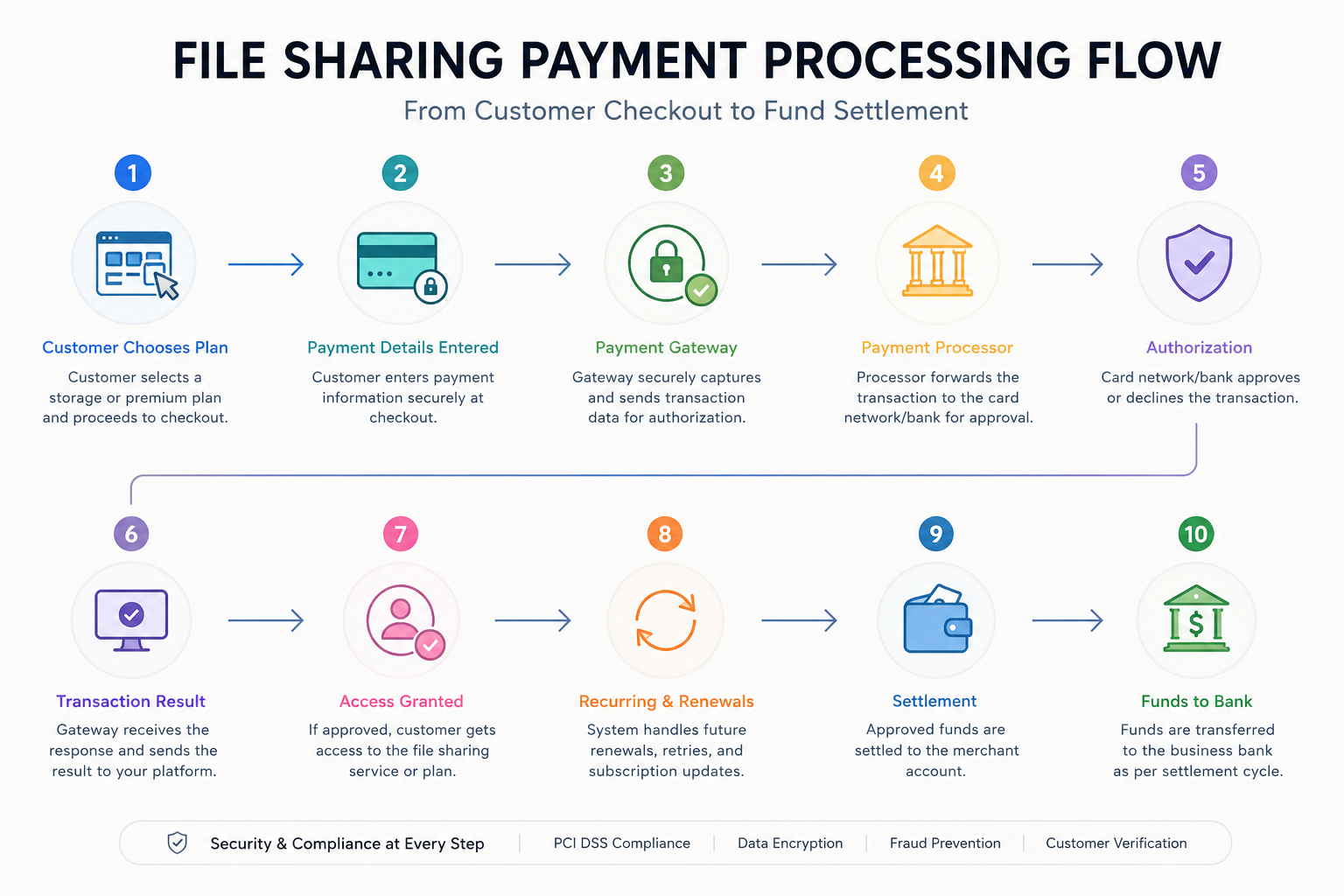
A payment that looks simple at checkout can involve several steps behind the scenes. The payment gateway sends the transaction for authorization, the processor and financial networks handle the payment flow, and approved funds are later settled to the business. If any part of this process fails, customers may be unable to complete a payment, lose access to a paid plan, or experience delays with their subscription.
This makes payment processing part of the core business infrastructure, not simply a checkout feature. The payment setup needs to match the company’s billing model, customer base, transaction volume, target markets, and plans for future growth.
For file-sharing businesses, this is particularly important because many services operate on a subscription model. A reliable payment system must therefore support the entire payment lifecycle, from the initial purchase to recurring billing, payment recovery, refunds, and account access.
How Does Payment Processing Work for a File Sharing Business?
A file-sharing business might offer a $9.99 monthly storage plan, a $29.99 team plan, or an annual business subscription. When a customer chooses a plan, the checkout collects the required payment information and sends the transaction for authorization.
A payment gateway provides the technical connection between the checkout and the payment-processing system. The processor communicates with the relevant financial networks to determine whether the transaction can be authorized. If it succeeds, the funds are subsequently settled to the business according to the provider’s terms.
A merchant account supports the business’s ability to receive card transaction funds, while the gateway securely communicates transaction information. Some payment providers combine several of these functions into one service.
For a subscription-based file-sharing business, payment processing does not stop after the first successful transaction. The system must also support future renewals, payment-method updates, failed-payment recovery, refunds, cancellations, upgrades, and downgrades.
This means payment processing needs to work alongside subscription management, customer accounts, billing systems, and access controls.
Why Do File Sharing Businesses Have Different Payment Needs?
File-sharing businesses generally sell digital services rather than physical products. Customers may pay for storage capacity, larger transfer limits, team collaboration, premium account features, or additional functionality. Because access to these services can be directly connected to payment status, billing problems can quickly become account-management problems.
For example, if a monthly renewal fails, the platform may need to:
- Notify the customer about the failed payment.
- Provide an opportunity to update the payment method.
- Retry the payment when appropriate.
- Provide a defined grace period.
- Restrict or suspend access if payment cannot be recovered.
Cancellations, refunds, upgrades, downgrades, and plan changes also need clear billing rules.
International customers add another layer of complexity. A platform serving several countries may need to consider currencies, regional payment preferences, cross-border transactions, settlement, and differences in payment approval behavior.
Supporting an international card does not automatically provide complete international payment coverage. Payment requirements can vary depending on the target market, business model, transaction size, billing cycle, customer base, and verification requirements.
Merchant Accounts and Payment Gateways
Understanding the relationship between a merchant account and payment gateway is important when setting up online payments.
The merchant account supports receipt of card payments, while the gateway provides the connection through which online transactions are submitted and communicated. However, getting payment processing approved can involve more than entering a company name and bank account. Payment providers may evaluate:
- Business model
- Website and services
- Ownership information
- Expected transaction volume
- Target markets
- Refund and cancellation policies
- Subscription terms
- Other business and compliance information
A file-sharing business should describe its service accurately. If customers are buying cloud storage subscriptions, the business should present that model consistently across its website, application, and payment setup.
Clear and consistent business information helps payment providers understand what they are processing and can also make it easier for customers to recognize legitimate charges.
Choosing Payment Methods for File Sharing Services
The right payment mix depends on customer location, transaction value, and whether the business mainly uses one-time or recurring billing.
Common options may include:
- Credit and debit cards for broad online acceptance and recurring billing where supported.
- ACH or other bank-based payments where they fit the business’s markets and billing model.
- Digital wallets and regional payment methods where they are supported and useful for target customers.
A payment method should not be selected simply because it is available.
Operators should consider whether the method supports the complete payment lifecycle, including recurring billing, refunds, international transactions, authentication, and settlement.
For example, a payment method may work well for one-time purchases but have limited support for recurring subscriptions. Another method may have strong adoption in one country but very little usage in another.
The goal is therefore not to offer the largest possible number of payment methods. It is to provide payment options that are suitable for the business’s customers and markets.
Recurring Payments and Subscription Billing
Recurring billing is central to many file-sharing businesses. A customer may subscribe to a monthly storage plan and expect the service to renew automatically without entering payment details each month.
A reliable recurring-payment setup needs to manage:
- Renewal dates
- Failed payments
- Expired cards
- Payment-method updates
- Retry attempts
- Cancellations
- Refunds
- Plan upgrades and downgrades
Imagine a customer with a $29.99 monthly business plan. The first eleven payments succeed, but the card expires before the twelfth renewal.
The subscription may still appear active in the file-sharing system even though the payment has failed. A well-designed billing process can identify the failed renewal, notify the customer, allow the payment method to be updated, and apply a defined access policy while payment recovery is attempted.
Subscription billing therefore needs to work closely with account management. The business should know exactly when access is activated, extended, restricted, or cancelled based on the customer’s payment and subscription status.
Why Do File Sharing Payments Get Declined?
A declined payment does not always mean a customer’s card is invalid. The issuing bank may decline a transaction because of:
- Insufficient funds
- Expired cards
- Incorrect payment information
- Geographic restrictions
- Bank or issuer risk controls
- Authentication issues
- Processing or gateway configuration problems
Recurring payments create additional failure points. A card that worked successfully during signup may no longer work months later. Businesses should therefore distinguish customer-side payment problems from processing-side problems instead of treating every decline in the same way.
Monitoring decline reasons can reveal important patterns.
For example, if customers in one market suddenly experience a higher rate of failed payments, the issue may require investigation at the payment-provider or regional level rather than simply asking every customer to replace their card.
Understanding payment decline patterns can help file-sharing businesses improve transaction success rates and reduce unnecessary subscription cancellations.
Chargebacks and Fraud Need Separate Strategies
A chargeback and a fraudulent transaction are not the same event.
A chargeback occurs when a customer disputes a completed transaction through their bank or card issuer. Fraud involves unauthorized or deceptive activity, such as stolen payment credentials or account takeover.
File-sharing businesses can reduce unnecessary disputes by making subscription terms clear, displaying renewal information, using recognizable billing descriptors, and providing accessible cancellation and refund processes. Businesses should also maintain appropriate records of what customers purchased and when the transaction occurred. Fraud controls can examine signals such as:
- Unusual transaction velocity
- Repeated payment attempts
- Suspicious account activity
- Multiple accounts
- Inconsistencies in transaction information
However, fraud controls need to be balanced. Overly aggressive rules can block legitimate subscribers and create unnecessary payment declines. The objective is to identify genuinely suspicious activity while minimizing disruption to legitimate customers.
KYC, AML, and Business Verification
Payment providers may verify the business and its owners before approving or maintaining payment processing. Depending on the provider and jurisdiction, this can involve:
- Registration information
- Ownership details
- Identification documents
- Banking information
- Website details
- Expected transaction activity
Verification may also continue after approval. A payment provider may request additional information if the business changes significantly, transaction patterns change, processing volume increases, or further review is required.
Keeping business information, subscription terms, refund policies, and transaction records accurate can make payment operations easier when a review occurs.
What Should a Reliable Payment Setup Handle?
A payment setup should be evaluated as part of the complete revenue operation rather than simply as a checkout tool. A growing file-sharing business should consider whether its payment setup can support:
- One-time and recurring payments, depending on the business model.
- Payment-method updates, failed-renewal recovery, refunds, cancellations, and subscription changes.
- Transaction reporting, settlement visibility, fraud controls, customer authentication, and records needed to investigate disputes.
The payment system should also provide enough visibility for the business to understand what happens after a customer clicks the payment button.
For example, operators should be able to identify whether a transaction was authorized, declined, refunded, disputed, or successfully settled. As transaction volume increases, the business may need stronger reporting, automation, fraud monitoring, additional payment methods, or deeper integrations.
Building Payment Operations That Can Scale
Good file sharing payment processing connects checkout, subscription management, customer accounts, payment processing, fraud controls, refunds, and settlement. A weakness in one area can create problems elsewhere.
For example, a company may successfully increase its subscriber base but discover that its billing operation cannot efficiently recover failed renewals.
Another business may attract international customers but lack the payment methods or settlement arrangements needed to serve those markets effectively.
Scaling payment operations therefore requires planning for the full transaction lifecycle as subscriptions, customers, and transaction volume grow. A payment system that works for a small file-sharing startup may not be sufficient once the business introduces more subscription plans, additional markets, higher transaction volumes, or new payment methods.
The Payment Journey for a File Sharing Business
Understanding the basic payment flow is the starting point for building a reliable payment operation.
From there, businesses need to consider why some file-sharing companies may receive greater payment scrutiny, how merchant-account approval works, and what information needs to be prepared before processing payments.
The payment journey then moves through payment methods, recurring billing, declined transactions, chargebacks, fraud prevention, compliance, refunds, settlement, and eventually advanced payment infrastructure.
Looking at payment processing as a complete lifecycle rather than simply a checkout function helps file-sharing businesses identify potential weaknesses before they affect customers or recurring revenue.
Final Thoughts
File-sharing payment processing is a core part of running a subscription-based digital business. A reliable setup needs to support much more than the initial customer payment.
From merchant-account approval and payment-method selection to recurring billing, failed payments, fraud prevention, chargebacks, refunds, compliance, and settlement, each stage can affect both customer experience and business revenue.
By understanding the complete payment journey and preparing for common payment challenges, file-sharing businesses can create a more reliable payment experience while building an infrastructure that can scale alongside the business.

Categories
- ACH Payments (10)
- adult payment processing (11)
- AI (9)
- Altcoins (10)
- Banking (10)
- Bitcoin (133)
- Bitcoin ETF (11)
- Bitcoin Price (30)
- Blockchain (50)
- Brokering World Hunger Away (16)
- Business (17)
- card payment processing (10)
- CBD (11)
- CBDC (11)
- Chargeback (8)
- coaching business (11)
- COVID-19 (3)
- Crypto ATMs (1)
- Crypto Banking (17)
- Crypto Bill (1)
- Crypto business owner platform (31)
- Crypto Investment (3)
- Crypto Markets (5)
- Crypto Payment (35)
- Crypto Payment Processor (4)
- Crypto Prices (1)
- Crypto Trading (92)
- Cryptocurrency (402)
- Cryptocurrency Exchange (108)
- Data Visualization (2)
- dating platforms (11)
- debt collection payment processing (10)
- Decentralized Finance (7)
- DeFi Payment (9)
- DEX (3)
- Digital Currency (23)
- dropshipping payment processing (12)
- Ethereum (2)
- FAQ (7)
- file sharing payment processing (11)
- Finance (25)
- Financial Equality (4)
- Financial Freedom (8)
- Forex (35)
- hemp (1)
- ICO (2)
- Investment (11)
- IPTV (11)
- Merchant Account (10)
- Mining (3)
- News (66)
- NFTs (2)
- online gambling (11)
- P2P (1)
- Paybito (147)
- PayBitoPro (693)
- PayBitoPro Coin Listing (6)
- PayBitoPro Exchange (2)
- Payment Gateway (48)
- peptide (10)
- Post COVID Digital Transformation (1)
- Press Release (130)
- Privacy & Security (3)
- Real Estate (1)
- Stablecoin (5)
- Technology (15)
- Travel (11)
- Uncategorized (10)
- US Presidential Election (2)
- Utility Coin (1)
- Web3 business (4)
- Web3 Wallets (2)
- White Label Crypto Exchange (8)
Recent Posts
- Payment Gateway vs. Payment Orchestration: What’s the Difference?
- What Is Smart Payment Routing? Strategies to Optimize Payment Performance
- How to Improve Payment Approval Rates for High-Risk Businesses?
- Why Are Online Payments Failing? Common Causes and How to Fix Them
- How to Use Multiple Payment Processors to Reduce Business Disruptions?