How to Get a Merchant Account for a File Sharing Business?
- August 12, 2026
- Soham Guchait

Getting a merchant account for a file-sharing business is an important step toward accepting online payments, but approval is not simply a matter of completing an application. Payment providers need to understand the business, verify its ownership, evaluate its expected transaction activity, and determine whether its payment model fits their requirements.
This is particularly important for file-sharing businesses because many operate through monthly or annual subscriptions. Customers may pay for storage, file-transfer limits, team accounts, or premium features, creating an ongoing payment relationship rather than a single transaction.
The best approach is to prepare the business before applying, provide accurate information, and make sure the website, business documents, and expected payment activity all describe the same business.
What Is a Merchant Account?
A merchant account is part of the infrastructure that allows a business to accept card payments and receive the resulting funds. In a traditional payment setup, the merchant account works alongside a payment gateway and processor to move a transaction from the customer’s checkout through authorization and eventually toward settlement.
For a file-sharing business, this infrastructure sits behind the subscription checkout.
For example, a customer signs up for a $14.99 monthly storage plan. They enter their payment information, the transaction is submitted for authorization, and the subscription is activated after a successful payment. The payment system then needs to support future renewals as well.
This is why a file-sharing company should evaluate its payment processing requirements before choosing how to accept payments.
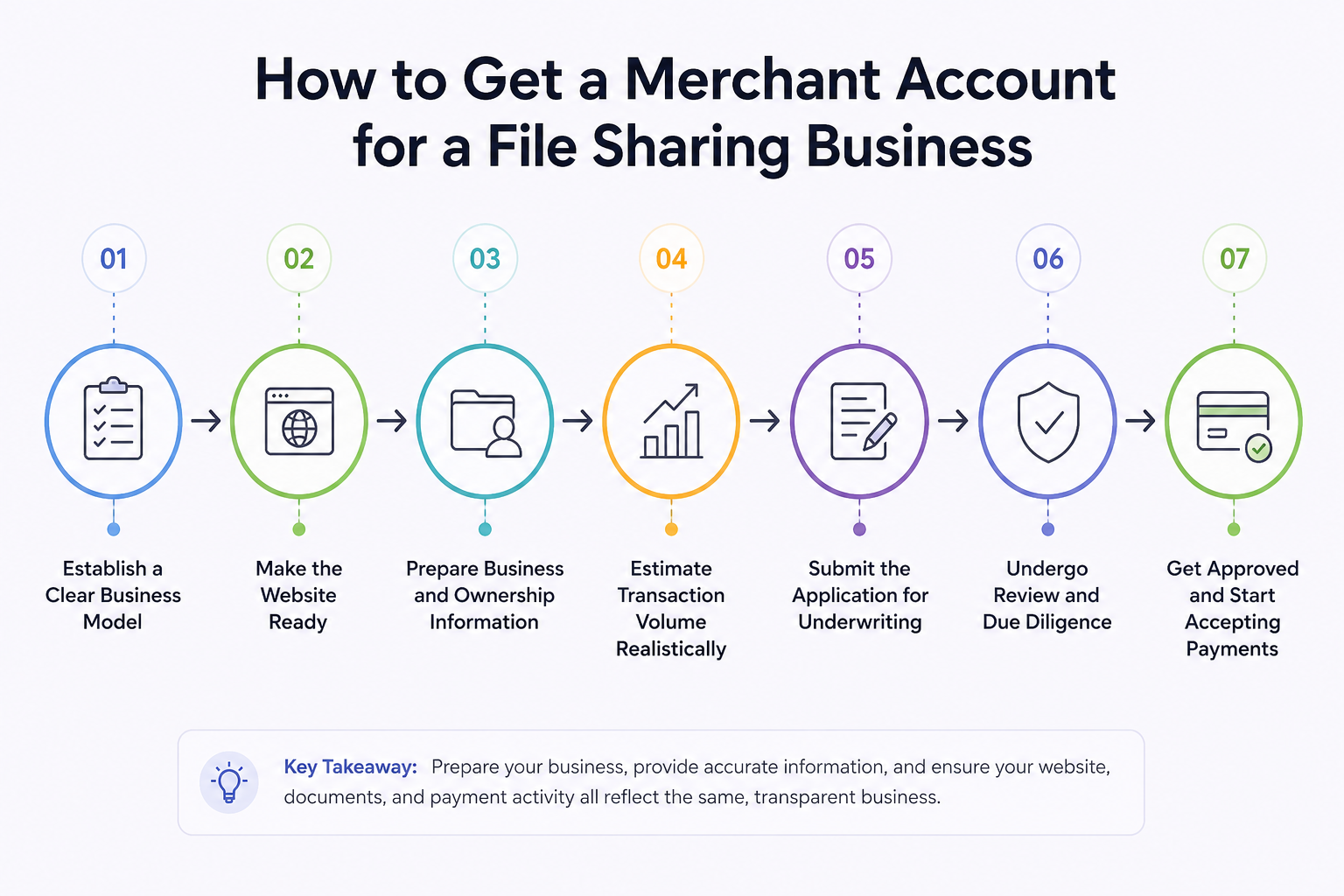
Step 1: Establish a Clear Business Model
Before applying for a merchant account, the company should be able to clearly explain what it sells and how customers pay for it.
A provider may want information about:
- Legal business name and structure
- Business location
- Ownership and management
- Products or services
- Customer locations
- Pricing and billing model
- Expected transaction volume
- One-time and recurring payment activity
A file-sharing business should describe its service specifically. “Technology company” is too broad to explain what customers are purchasing. A better description might be: “A subscription-based cloud storage platform providing personal and business file-sharing services.” The description should match the actual website and transactions.
Step 2: Make the Website Ready
The website is an important part of demonstrating that the business is legitimate and transparent. Before applying, customers should be able to understand what they are purchasing, how much it costs, and what happens after payment. A file-sharing business should clearly present its:
- Pricing and plan details
- Terms and conditions
- Privacy policy
- Refund policy
- Cancellation process
- Subscription and renewal terms
- Customer support information
This becomes especially important when the business uses recurring billing.
Imagine a platform offering a seven-day trial that automatically converts into a $19.99 monthly subscription. The conversion should be clearly disclosed before the customer completes signup. If customers later discover an unexpected recurring charge, the resulting complaints and disputes can create unnecessary payment problems.
Step 3: Prepare Business and Ownership Information
The provider will generally need to verify that the business exists and identify the people behind it.
Depending on the business structure and jurisdiction, this may include company registration documents, tax information, identification documents, ownership details, business address information, and bank-account information.
A company with several beneficial owners should make its ownership structure clear rather than providing information about only one person. These checks form part of the broader KYC and AML requirements for file-sharing businesses, although the exact requirements vary by provider and jurisdiction. Being prepared also helps when the provider asks follow-up questions during underwriting.
Step 4: Estimate Transaction Volume Realistically
The payment provider needs to understand how much transaction activity the business expects to generate.
Consider a new file-sharing platform planning to launch with 1,000 subscribers at an average monthly price of $12. Its expected transaction volume will be substantially different from an established business serving 50,000 customers. The estimate should be based on a realistic business plan.
A company should not report an artificially high processing volume simply to appear larger. If the actual transaction activity later differs significantly from the original estimate, the provider may request clarification. Existing businesses can also provide previous processing statements when requested. These records can show actual transaction patterns, average transaction sizes, refunds, and chargebacks.
Step 5: Submit the Application for Underwriting
Once the business information is prepared, the application can be submitted.
Underwriting is the process through which the provider evaluates the business before deciding whether to support its payment activity. The review may consider the business model, ownership, financial information, expected sales, processing history, customer base, and potential payment risks.
For a file-sharing business, the provider may also want to understand how subscriptions work, how customers receive access, and how refunds and cancellations are handled. The application should therefore be complete and accurate rather than relying on the provider to discover important information later.
What Happens After Applying?
There are several possible outcomes.
The provider may approve the application, request additional information, place the application under further review, or decline it.
A request for more documents does not automatically mean that the business has done something wrong. Payment providers may need clarification about ownership, financial activity, business operations, or expected transaction volume before completing their review.
For example, a new company without processing history may be asked to explain its projected sales. An established company with a sudden increase in transaction volume may be asked to explain the change. The important point is to respond with accurate information rather than trying to change the description of the business to obtain approval.
Why File Sharing Businesses May Receive Additional Scrutiny?
File-sharing businesses can have characteristics that require careful payment-risk assessment.
Subscription billing creates recurring transactions. Digital service delivery means there is no physical product being shipped. International customers can introduce cross-border payment considerations. Rapid growth can also change transaction patterns. These factors do not mean that a legitimate file-sharing business cannot obtain payment processing.
They simply mean the provider may want a clearer understanding of how the business operates and how it manages payments. This is why understanding why file-sharing payment processing may be considered high risk can help a business prepare for the underwriting process.
What Can Cause an Application to Be Rejected?
There is no universal rejection reason, and each provider applies its own requirements. However, problems can arise when the information provided is incomplete, inconsistent, difficult to verify, or outside the provider’s supported business model.
For example, a company may state that it expects $10,000 in monthly transactions but later begin processing $100,000 without an explanation. Another business may advertise subscriptions on its website while failing to disclose recurring billing terms.
Inconsistencies can create additional questions during underwriting. The solution is not to hide the business model. The business should accurately explain what it sells and provide documentation that supports the information in the application.
A Practical Example
Suppose a file-sharing startup is preparing to launch a $9.99 monthly personal plan and a $29.99 business plan.
Before applying for payment processing, the founders register the company, prepare ownership documents, establish a business bank account, publish clear pricing and subscription terms, and estimate their expected transaction volume.
They also document their refund and cancellation procedures.
During underwriting, the provider asks how subscriptions are billed and how customers can cancel. Because the business has already documented these processes, it can answer clearly and consistently. The preparation reduces uncertainty and gives the provider a clearer picture of the business.
Getting Approved Is Only the First Step
Obtaining a merchant account does not complete the payment setup.
The business still needs to connect its checkout to the appropriate payment infrastructure, configure recurring billing where applicable, determine which payment methods for file-sharing businesses make sense for its customers, and establish processes for refunds, failed payments, fraud, and chargebacks.
As the subscriber base grows, payment requirements can become more complex. A business may eventually need stronger reporting, additional payment methods, automated payment recovery, fraud controls, or deeper integrations. The most reliable approach is therefore to treat merchant-account approval as the beginning of payment operations rather than the end.
A legitimate file-sharing business that clearly explains its business model, prepares its documentation, maintains transparent customer policies, and provides realistic transaction information is in a much stronger position to navigate the application and build a payment setup that can support long-term growth.

Categories
- ACH Payments (10)
- adult payment processing (11)
- AI (9)
- Altcoins (10)
- Banking (10)
- Bitcoin (133)
- Bitcoin ETF (11)
- Bitcoin Price (30)
- Blockchain (50)
- Brokering World Hunger Away (16)
- Business (17)
- card payment processing (10)
- CBD (11)
- CBDC (11)
- Chargeback (8)
- coaching business (11)
- COVID-19 (3)
- Crypto ATMs (1)
- Crypto Banking (17)
- Crypto Bill (1)
- Crypto business owner platform (31)
- Crypto Investment (3)
- Crypto Markets (5)
- Crypto Payment (35)
- Crypto Payment Processor (4)
- Crypto Prices (1)
- Crypto Trading (92)
- Cryptocurrency (402)
- Cryptocurrency Exchange (108)
- Data Visualization (2)
- dating platforms (11)
- debt collection payment processing (10)
- Decentralized Finance (7)
- DeFi Payment (9)
- DEX (3)
- Digital Currency (23)
- dropshipping payment processing (12)
- Ethereum (2)
- FAQ (7)
- file sharing payment processing (11)
- Finance (25)
- Financial Equality (4)
- Financial Freedom (8)
- Forex (35)
- hemp (1)
- ICO (2)
- Investment (11)
- IPTV (11)
- Merchant Account (10)
- Mining (3)
- News (66)
- NFTs (2)
- online gambling (11)
- P2P (1)
- Paybito (147)
- PayBitoPro (693)
- PayBitoPro Coin Listing (6)
- PayBitoPro Exchange (2)
- Payment Gateway (48)
- peptide (10)
- Post COVID Digital Transformation (1)
- Press Release (130)
- Privacy & Security (3)
- Real Estate (1)
- Stablecoin (5)
- Technology (15)
- Travel (11)
- Uncategorized (10)
- US Presidential Election (2)
- Utility Coin (1)
- Web3 business (4)
- Web3 Wallets (2)
- White Label Crypto Exchange (8)
Recent Posts
- Payment Gateway vs. Payment Orchestration: What’s the Difference?
- What Is Smart Payment Routing? Strategies to Optimize Payment Performance
- How to Improve Payment Approval Rates for High-Risk Businesses?
- Why Are Online Payments Failing? Common Causes and How to Fix Them
- How to Use Multiple Payment Processors to Reduce Business Disruptions?