Chargeback Prevention for File Sharing Businesses
- August 12, 2026
- Soham Guchait
A customer subscribes to a file-sharing platform, uses the service for several weeks, and then notices a recurring charge on their bank statement. They do not recognize the billing name, forget that the subscription renews automatically, or believe they had already cancelled the service. Instead of contacting the business, they contact their bank and dispute the transaction.
For a subscription-based file-sharing business, situations like this can create unnecessary chargebacks. These disputes are often connected to broader payment processing challenges that companies face as their subscriber base grows.
A chargeback occurs when a cardholder disputes a transaction through their card issuer. The reasons can vary from suspected fraud and an unrecognized charge to a cancelled subscription, a missing refund, or dissatisfaction with the service. Chargebacks cannot always be eliminated. However, many disputes can be reduced by improving billing transparency, cancellation processes, customer communication, transaction records, and payment operations.
Why Do File Sharing Businesses Get Chargebacks?
File-sharing businesses have several characteristics that can make payment disputes particularly important to manage.
Unlike a physical product, a file-sharing service is delivered digitally. A customer may receive access to storage immediately after payment and continue using the account without any physical delivery taking place.
Subscriptions also create recurring transactions. A customer might sign up once and then be charged every month or year until the subscription is cancelled. Common dispute situations include:
- A customer does not recognize the recurring charge.
- A customer believes they cancelled before the renewal.
- A refund was requested but was not processed.
- A customer claims the payment was unauthorized.
- A customer expected a different price after a trial or promotion.
- A customer continues using the service but later disputes previous charges.
These situations are different from a simple payment decline. A declined payment occurs before a transaction is successfully completed, while a chargeback generally involves a completed transaction that the customer later disputes.
Make Subscription Terms Clear Before Payment
One of the most effective ways to reduce subscription-related disputes is to make the billing arrangement clear before the customer pays. A file-sharing platform should clearly explain:
- The subscription price
- Billing frequency
- Whether the subscription renews automatically
- Trial or introductory pricing
- What happens when a trial ends
- Cancellation procedures
- Refund conditions
Clear payment expectations also become important when selecting the best payment methods for file-sharing businesses because different payment methods can have different customer experiences, authorization flows, and billing considerations.
Suppose a platform offers a seven-day free trial followed by a $19.99 monthly subscription. If the customer sees the $19.99 charge later but does not remember agreeing to automatic billing, the business may face a dispute even though the payment technically followed the subscription terms. The problem is therefore not necessarily the payment itself. It can be a communication problem that began during signup. Customers should understand what they are agreeing to before their payment information is submitted.
Make Cancellation Easy to Complete
A complicated cancellation process can create unnecessary disputes. If a customer wants to cancel a file-sharing subscription but cannot find the cancellation option, they may eventually contact their bank instead of the business. A straightforward cancellation process gives the customer a way to stop future recurring payments without escalating the issue. This is particularly important for subscription businesses because card networks recognize disputes involving recurring charges after a customer has cancelled or withdrawn permission to be charged.
For example, imagine a customer submits a cancellation request on March 3, but the business continues billing them on March 10 because the request was not processed correctly.
Even if the customer had originally authorized the subscription, the later charge can become difficult to defend. Cancellation requests should therefore be recorded and acted upon promptly.
Use a Recognizable Billing Descriptor
A customer may know the name of the file-sharing service but see a completely different name on their card statement.
This can lead to an “I don’t recognize this charge” dispute.
The billing descriptor is the information that appears on a customer’s payment statement to help identify the merchant. Making it recognizable can reduce confusion, particularly for recurring subscriptions.
For example, suppose customers sign up for a service called “CloudVault,” but their statement displays an unfamiliar legal company name. A customer who does not recognize that name may assume the transaction is fraudulent. The business should therefore ensure that its billing information is consistent and understandable, subject to the requirements of its payment provider and card network. Maintaining accurate transaction information is also part of building a reliable payment operation, especially when businesses evaluate payment processing.
Send Useful Subscription and Renewal Notifications
Customer communication should continue after the initial purchase.
For recurring file-sharing subscriptions, confirmation and renewal notifications can remind customers what service they are paying for and when the next charge will occur. This can be especially useful for annual plans.
Imagine a customer pays $199 for a one-year business storage plan. Twelve months later, the renewal appears unexpectedly on their statement. If the customer received a clear reminder before the renewal, they have an opportunity to review the subscription and cancel if they no longer need it.
Payment-industry guidance commonly recommends clear billing communication and renewal reminders as part of subscription-dispute prevention. The objective is not to overwhelm customers with messages. It is to give them useful information at the points where confusion is most likely.
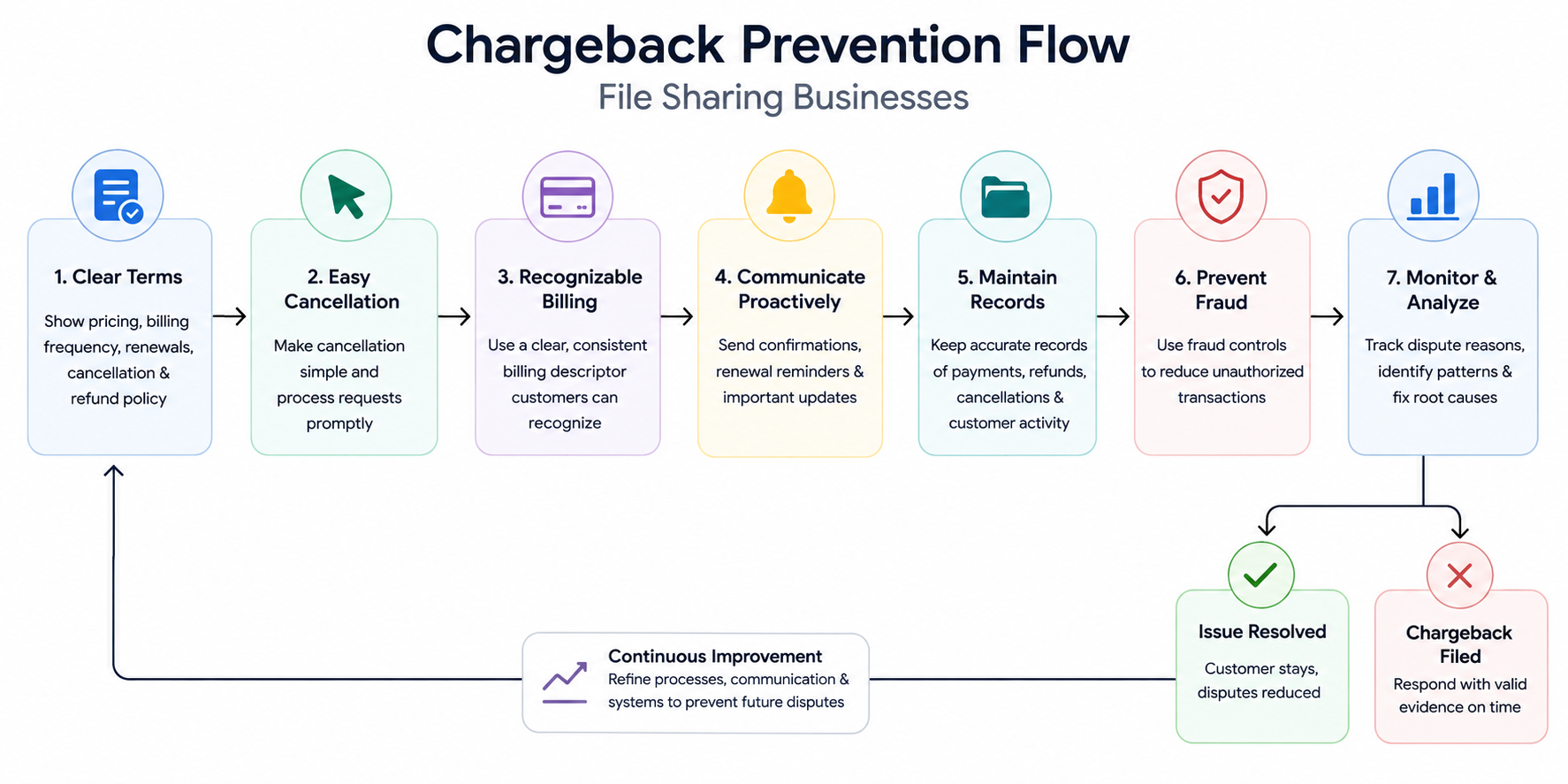
Keep Refunds and Cancellation Records
A clear refund process can prevent a customer complaint from becoming a chargeback.
Suppose a customer accidentally renews a $49.99 plan and immediately asks for a refund. If the business approves the refund but fails to process or document it correctly, the customer may still see the original charge and dispute it. The business should maintain records showing:
- The customer’s subscription
- Payment date and amount
- Cancellation request
- Refund request
- Refund status
- Customer communications
- Relevant account activity
These records can also become important if a legitimate dispute is formally filed.
Keep Evidence of Digital Service Delivery
File-sharing businesses should consider how they demonstrate that a customer received and used the service. Because there is no physical package being delivered, useful records may include account activation, subscription status, login activity, storage usage, file-transfer activity, plan changes, and relevant customer communications.
Consider a customer who disputes a $29.99 monthly charge by claiming they never used the file-sharing service.
If the business has records showing that the account was activated, the customer logged in repeatedly, uploaded files, and continued using the storage plan, those records may help the business evaluate and respond to the dispute. The exact evidence that is useful depends on the dispute type and the rules of the relevant card network and payment provider. Merchants should provide accurate evidence when challenging a dispute.
Distinguish Chargebacks From Fraud
Chargebacks and fraud are closely connected, but they are not identical.
A fraudulent transaction may involve stolen payment credentials or an account takeover. A chargeback is the dispute process that can follow when a cardholder challenges a transaction.
There is also “friendly fraud” where a legitimate transaction is disputed by the cardholder, sometimes because they do not recognize the purchase or misunderstand the transaction.
This distinction matters because different problems require different solutions. If a file-sharing business is experiencing stolen-card activity, stronger fraud controls may be necessary.
If most disputes involve customers claiming they do not recognize recurring charges, improving billing descriptors and subscription communication may have a greater impact.

Categories
- ACH Payments (10)
- adult payment processing (11)
- AI (9)
- Altcoins (10)
- Banking (10)
- Bitcoin (133)
- Bitcoin ETF (11)
- Bitcoin Price (30)
- Blockchain (50)
- Brokering World Hunger Away (16)
- Business (17)
- card payment processing (10)
- CBD (11)
- CBDC (11)
- Chargeback (8)
- coaching business (11)
- COVID-19 (3)
- Crypto ATMs (1)
- Crypto Banking (17)
- Crypto Bill (1)
- Crypto business owner platform (31)
- Crypto Investment (3)
- Crypto Markets (5)
- Crypto Payment (35)
- Crypto Payment Processor (4)
- Crypto Prices (1)
- Crypto Trading (92)
- Cryptocurrency (402)
- Cryptocurrency Exchange (108)
- Data Visualization (2)
- dating platforms (11)
- debt collection payment processing (10)
- Decentralized Finance (7)
- DeFi Payment (9)
- DEX (3)
- Digital Currency (23)
- dropshipping payment processing (12)
- Ethereum (2)
- FAQ (7)
- file sharing payment processing (11)
- Finance (25)
- Financial Equality (4)
- Financial Freedom (8)
- Forex (35)
- hemp (1)
- ICO (2)
- Investment (11)
- IPTV (11)
- Merchant Account (10)
- Mining (3)
- News (66)
- NFTs (2)
- online gambling (11)
- P2P (1)
- Paybito (147)
- PayBitoPro (693)
- PayBitoPro Coin Listing (6)
- PayBitoPro Exchange (2)
- Payment Gateway (48)
- peptide (10)
- Post COVID Digital Transformation (1)
- Press Release (130)
- Privacy & Security (3)
- Real Estate (1)
- Stablecoin (5)
- Technology (15)
- Travel (11)
- Uncategorized (10)
- US Presidential Election (2)
- Utility Coin (1)
- Web3 business (4)
- Web3 Wallets (2)
- White Label Crypto Exchange (8)
Recent Posts
- Payment Gateway vs. Payment Orchestration: What’s the Difference?
- What Is Smart Payment Routing? Strategies to Optimize Payment Performance
- How to Improve Payment Approval Rates for High-Risk Businesses?
- Why Are Online Payments Failing? Common Causes and How to Fix Them
- How to Use Multiple Payment Processors to Reduce Business Disruptions?