How to Get a Forex Merchant Account: Requirements, Documents, and Approval Process
- August 13, 2026
- Soham Guchait
A Forex broker can have a functioning trading platform, an established business model, and customers ready to deposit funds, yet still face a major operational hurdle: Getting approved for payment processing.
A Forex merchant account allows a brokerage to accept electronic payments from traders through supported payment channels. However, obtaining one is not simply a matter of completing an online application. Payment providers and acquiring institutions need to understand the broker’s business model, ownership, markets, regulatory position, expected transaction activity, and potential payment risks before deciding whether and how to support the business.
For Forex businesses, understanding the requirements in advance can make the application process more organized and reduce avoidable delays.
What Is a Forex Merchant Account?
A Forex merchant account is a payment-processing arrangement that enables a Forex broker or trading platform to accept payments from customers through approved payment methods.
It is important to distinguish a merchant account from a payment gateway. The merchant account is associated with the business’s ability to receive and settle card or other eligible payment transactions, while the gateway provides the technology that transmits payment information and transaction requests between the customer, merchant, and payment infrastructure.
A broker may use cards, bank transfers, digital wallets, or other payment methods depending on its markets and the provider’s capabilities.
The merchant account therefore forms one part of a larger Forex payment processing environment that can also include fraud controls, transaction monitoring, settlement, reporting, withdrawals, and reconciliation.
Why Is Getting a Forex Merchant Account Different?
Forex businesses can receive additional underwriting scrutiny because payment providers may consider factors such as chargeback exposure, fraud risk, international transactions, regulatory considerations, and the financial nature of the customer relationship.
This does not mean every Forex broker receives the same decision. Risk assessment is business-specific, and providers can apply different underwriting criteria. The payment network environment can also matter. Mastercard, for example, has specific rules addressing certain high-risk securities merchants, including particular CFD and foreign-exchange activities.
As a result, a broker should approach the application as a business and risk assessment, rather than treating it like a standard online-store payment application.
What Documents Are Required for a Forex Merchant Account?
There is no single universal document list for every Forex merchant account. Requirements can vary according to the provider, jurisdiction, business structure, processing model, and risk assessment. However, an applicant should generally be prepared to provide information across several areas.
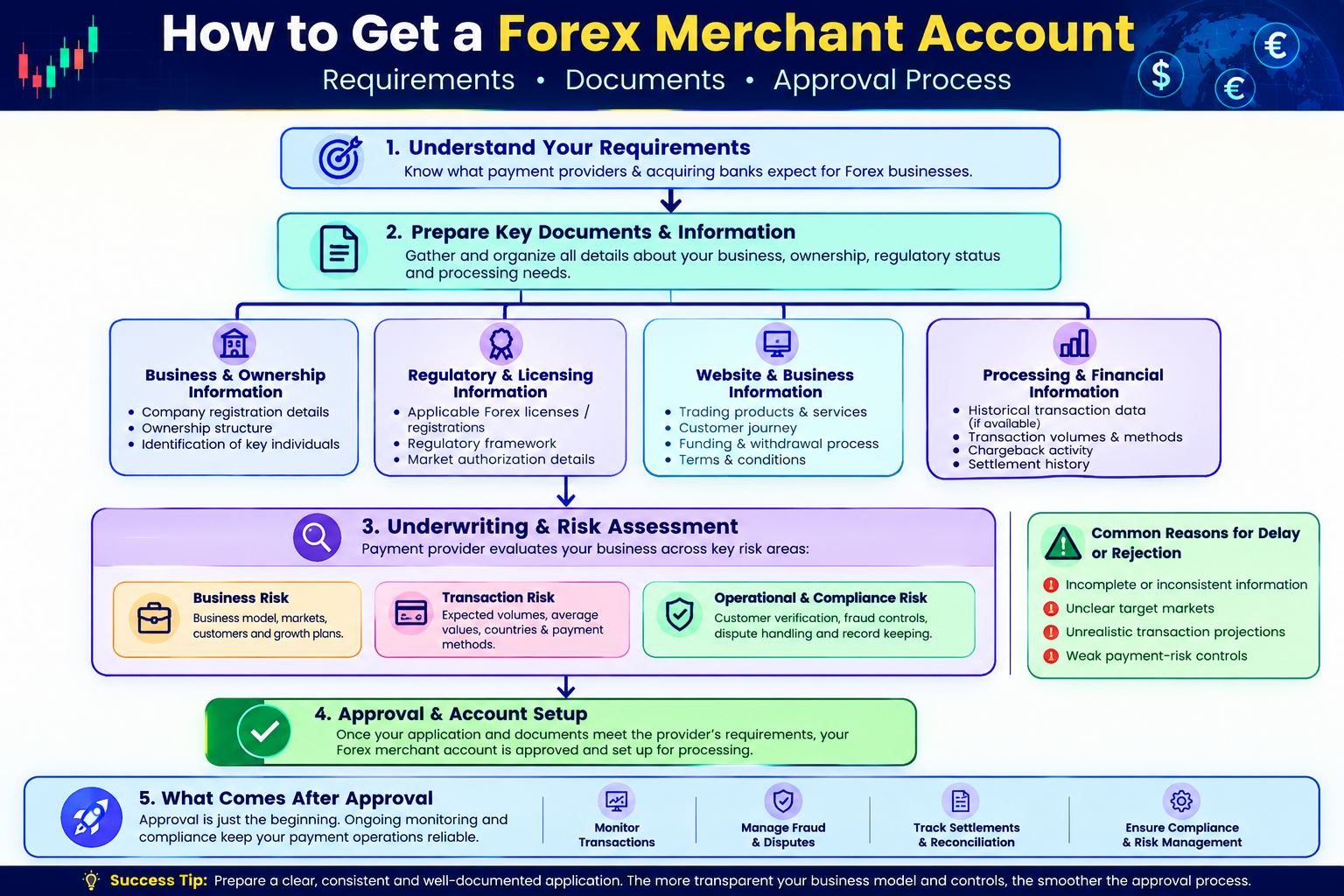
1. Business and Ownership Information
The provider needs to establish who owns and operates the business. This can include company registration information, registered business details, ownership information, identification documents for relevant individuals, and information about the company’s operating structure.
The purpose is not simply administrative. Ownership transparency helps the provider understand the legal entity applying for payment processing and the people responsible for the business.
2. Regulatory and Licensing Information
Where the broker’s activities are subject to licensing or regulatory requirements, the provider may request evidence of the applicable authorization or registration.
The exact requirements depend on the broker’s jurisdiction, business model, products, and target markets. A license requirement that applies to one Forex business should not automatically be treated as a universal requirement for every broker worldwide. The application should therefore clearly explain which regulatory framework applies to the business and where it operates.
3. Website and Business Information
The broker’s website is an important part of the underwriting picture because it shows what the business actually offers customers.
A provider may need to understand the trading products offered, customer journey, funding process, withdrawal process, applicable terms, and other information presented to customers.
The information submitted in the application should be consistent with what customers see on the website. A mismatch between the stated business model and the public-facing operation can create questions during underwriting.
4. Processing and Financial Information
An established broker may be asked to provide historical processing information. This can help an underwriter understand the business’s actual transaction behavior rather than relying entirely on projections.
Relevant information may include previous processing volumes, transaction counts, chargeback activity, payment methods, average transaction values, and settlement history, depending on the provider’s requirements.
A new broker naturally has less historical data. In that situation, the provider may place greater emphasis on the business plan, expected volumes, ownership, regulatory position, target markets, and planned payment flows.
What Does a Payment Provider Look at During Underwriting?
Submitting documents is only the beginning. The provider then evaluates whether the proposed payment relationship is commercially and operationally acceptable. A Forex application may be assessed across three broad areas:
- Business risk: What does the broker offer, where does it operate, who are its customers, and how does it acquire them?
- Transaction risk: What payment volumes are expected, what are the average transaction values, which countries and currencies are involved, and what payment methods will be used?
- Operational and compliance risk: How does the broker handle customer verification, transaction monitoring, fraud controls, withdrawals, disputes, and record keeping?
The provider may also consider the broker’s processing history where one exists. This assessment explains why two businesses operating in the same broad Forex industry can receive different underwriting outcomes.
What Can Cause a Forex Merchant Account Application to Be Delayed or Rejected?
A rejected application is not necessarily caused by one missing document. Sometimes the problem is that the overall business profile is unclear or inconsistent. Common issues can include:
Incomplete or inconsistent information
If the legal entity, website, ownership information, business description, and application details do not match, the provider may need clarification before proceeding.
Unclear target markets
A broker intending to serve customers internationally should be able to explain its intended geographic markets and payment requirements. International exposure can affect risk assessment and available payment routes.
Unrealistic transaction projections
Suppose a newly launched broker projects $10 million in monthly card volume despite having no processing history, a small customer base, and limited operating history. An underwriter may reasonably ask how those figures were calculated.
Projections should therefore be supported by a credible business model rather than selected simply because they represent an attractive processing volume.
Weak payment-risk controls
A broker should understand how customer verification, fraud monitoring, transaction records, and dispute management fit into its payment operation. This connects directly with KYC and AML requirements for Forex payment processing and the broader need for effective fraud prevention.
How Long Does Forex Merchant Account Approval Take?
There is no universal approval timeline.
The process can range from relatively straightforward onboarding to a more detailed underwriting review. The duration can depend on the completeness of the application, the complexity of the business, the jurisdictions involved, the required documentation, and whether additional information is requested.
Claims that every Forex merchant account can be approved within a fixed number of hours or days should therefore be treated cautiously. A broker can reduce unnecessary delays by preparing its documentation and business information before submitting the application.
How to Prepare for a Forex Merchant Account Application?
The strongest preparation is consistency.
Before applying, a broker should be able to clearly explain how money enters and leaves the business, who its customers are, which markets it serves, what payment methods it expects to use, and how it manages payment-related risks.
For example, consider a new Forex broker planning to serve retail customers in several countries. Before approaching a provider, it should have a clear picture of its corporate structure, regulatory position, website, expected transaction volumes, customer geography, payment methods, and withdrawal workflow. That gives an underwriter something concrete to evaluate instead of forcing the provider to make assumptions.
What Happens After Approval?
Approval does not mean payment risk disappears. Once processing begins, the broker’s actual transaction activity becomes part of its ongoing payment profile. Significant changes in processing volume, customer geography, payment patterns, or business operations may require additional review.
The broker also needs to monitor successful and failed transactions, disputes, fraud indicators, settlements, and reconciliation.
For example, if a broker suddenly doubles its transaction volume without the payment relationship being structured for that growth, the resulting activity may require additional assessment.
This is why choosing the right payment processor for a Forex broker involves more than comparing transaction fees. Reliability, geographic coverage, payment methods, risk controls, settlement, reporting, and scalability all matter.
Final Thoughts
Getting a Forex merchant account requires more than submitting company documents and waiting for approval. The provider needs to understand the business, its ownership, regulatory environment, customers, markets, expected transaction activity, and approach to payment risk.
A well-prepared application presents these details clearly and consistently. It also recognizes that merchant-account approval is only the beginning of payment operations. Once live, the broker still needs to manage transaction reliability, fraud, chargebacks, withdrawals, compliance, settlement, and reconciliation.
For a Forex business preparing to accept customer deposits, the practical sequence is clear: understand the underwriting requirements, prepare accurate documentation, explain the payment model, and build the supporting controls before processing begins. The next consideration is then which payment methods are most suitable for Forex brokers and trading platforms and how each affects deposits, withdrawals, customer experience, and operational complexity.
Categories
- ACH Payments (10)
- adult payment processing (11)
- AI (9)
- Altcoins (10)
- Banking (10)
- Bitcoin (133)
- Bitcoin ETF (11)
- Bitcoin Price (30)
- Blockchain (50)
- Brokering World Hunger Away (16)
- Business (17)
- card payment processing (10)
- CBD (11)
- CBDC (11)
- coaching business (11)
- COVID-19 (3)
- Crypto ATMs (1)
- Crypto Banking (17)
- Crypto Bill (1)
- Crypto business owner platform (31)
- Crypto Investment (3)
- Crypto Markets (5)
- Crypto Payment (35)
- Crypto Payment Processor (4)
- Crypto Prices (1)
- Crypto Trading (92)
- Cryptocurrency (402)
- Cryptocurrency Exchange (108)
- Data Visualization (2)
- dating platforms (11)
- debt collection payment processing (10)
- Decentralized Finance (7)
- DeFi Payment (9)
- DEX (3)
- Digital Currency (23)
- dropshipping payment processing (12)
- Ethereum (2)
- FAQ (7)
- file sharing payment processing (11)
- Finance (25)
- Financial Equality (4)
- Financial Freedom (8)
- Forex (35)
- hemp (1)
- ICO (2)
- Investment (11)
- IPTV (11)
- Merchant Account (10)
- Mining (3)
- News (66)
- NFTs (2)
- online gambling (11)
- P2P (1)
- Paybito (139)
- PayBitoPro (693)
- PayBitoPro Coin Listing (6)
- PayBitoPro Exchange (2)
- Payment Gateway (40)
- peptide (10)
- Post COVID Digital Transformation (1)
- Press Release (130)
- Privacy & Security (3)
- Real Estate (1)
- Stablecoin (5)
- Technology (15)
- Travel (11)
- Uncategorized (9)
- US Presidential Election (2)
- Utility Coin (1)
- Web3 business (4)
- Web3 Wallets (2)
- White Label Crypto Exchange (8)
Recent Posts
- ACH vs Wire Transfer: Which Payment Method Is Better for Businesses?
- ACH Fraud Prevention: How Businesses Can Secure Bank Account Payments?
- ACH Credit vs ACH Debit: What’s the Difference? With Real Examples
- ACH vs Credit Card: Which Payment Method Is Better for Businesses?
- How Long Do ACH Payments Take? Processing Times, Settlement, and Same Day ACH