Merchant Account Underwriting: What It Is and How It Works?
- August 14, 2026
- Soham Guchait
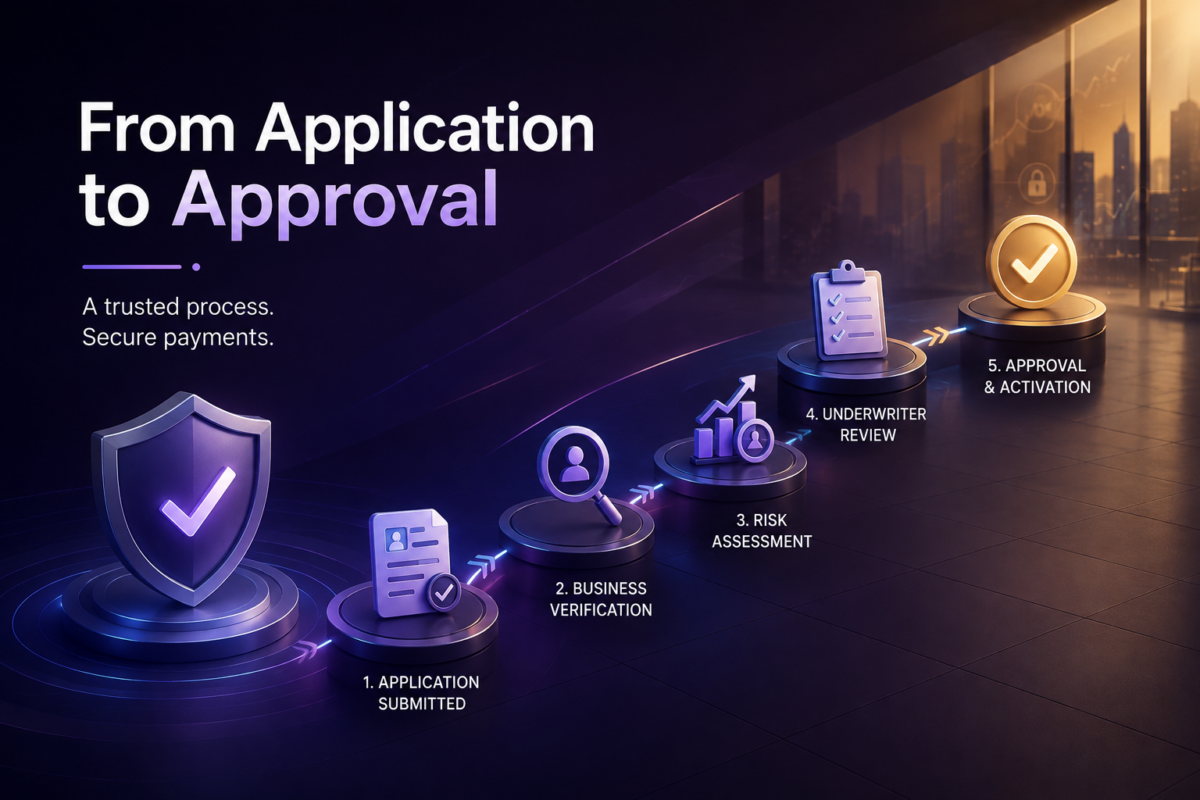
Submitting a merchant account application does not automatically mean a business is ready to process card payments. Before approval, the provider or acquiring institution needs to understand what the business does, who owns it, how it expects to process payments, and what financial risk could arise from those transactions.
That review is known as Merchant Account Underwriting.
Underwriting exists because card processing creates potential exposure beyond the moment a customer pays. A transaction can later be refunded or disputed, and chargebacks can create losses if a merchant cannot meet its obligations. The FDIC identifies merchant credit risk as a significant consideration for acquiring institutions and notes that sound approval and monitoring processes are used to manage it. For a business owner, understanding what happens during underwriting can make the approval process much easier to navigate.
What Is Merchant Account Underwriting?
Merchant account underwriting is the process of evaluating a business before establishing a card-processing relationship. If the application is approved, the merchant is typically assigned a Merchant ID (MID), a unique identifier used to identify the business within the payment-processing system. The underwriter is essentially trying to answer one question:
What does this business’s payment activity look like, and what risks could that activity create?
That involves much more than checking whether a company is legally registered. The Office of the Comptroller of the Currency (OCC) says merchant underwriting should consider factors including the validity of the business, its creditworthiness, sales history, business activity, and processing history. The depth of review should also correspond to the level of risk involved.
For example, consider two businesses that each expect to process $100,000 a month. One sells $50 products and expects thousands of transactions. Another sells $10,000 products and expects only a handful of transactions. Their monthly volume is identical, but the financial exposure associated with an individual transaction is very different. An underwriter therefore looks at the shape of the payment activity, not simply the monthly total.
What Do Providers Check During Merchant Account Underwriting?
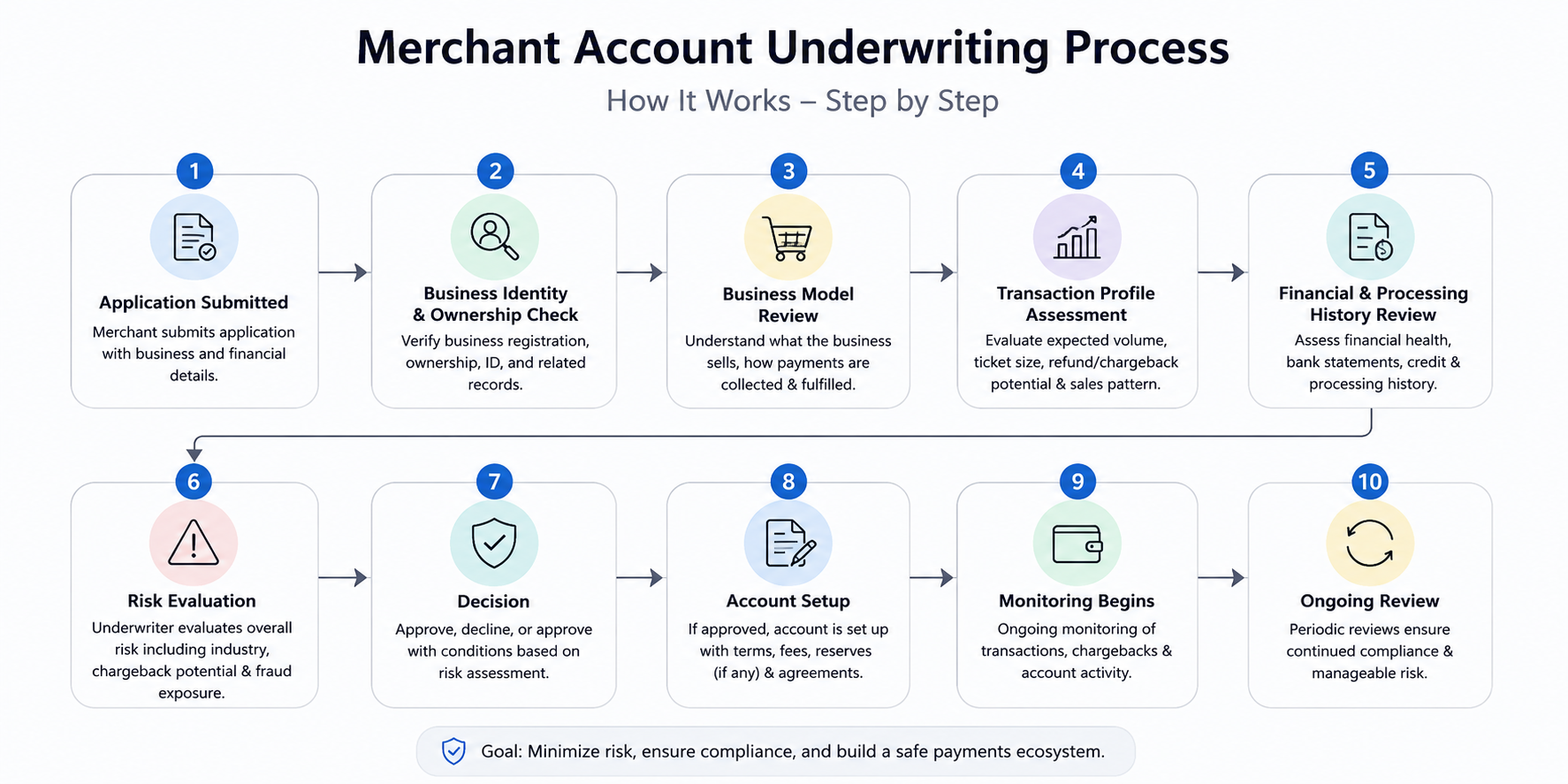
There is no universal checklist that applies identically to every merchant. A newer business, an established retailer, and a business with unusually large transactions may all receive different levels of review. However, several areas commonly matter.
Business identity and ownership
The first step is establishing that the business is legitimate and determining who is responsible for it. An application may be checked against business registration information, ownership records, identification documents, and other available records. The OCC’s merchant-processing guidance specifically identifies background checks, business verification, and information about the principal of the business as components of sound underwriting.
Consistency is important here.
Suppose a company’s application lists one legal entity, its bank account uses another name, and its website presents a different business identity. There may be a perfectly reasonable explanation, but the underwriter now has to investigate the discrepancy. The easier the business is to verify, the clearer the underwriting picture becomes.
Business model and what the company sells
An underwriter needs to understand how the business actually makes money. This includes the products or services being sold, how customers purchase them, how payments are collected, and when the customer receives what they paid for. This matters because the timing between payment and fulfillment can affect risk.
For example, a customer paying $2,000 today for a product shipped tomorrow creates a different exposure from a customer paying $2,000 today for a service that will not be delivered for six months. The business model also needs to correspond with its merchant category and processing activity. OCC guidance specifically calls for adequate understanding of the merchant’s business and appropriate classification.
Expected transaction volume and ticket size
Projected payment activity is another major consideration. An application might ask about expected monthly processing volume, average transaction value, and sometimes the maximum transaction amount. Consider this example:
Business A: $100,000 monthly volume, $100 average transaction
Business B: $100,000 monthly volume, $10,000 average transaction
Business B has far fewer transactions, but each transaction represents substantially greater exposure.
The underwriter may therefore want to understand why the transaction size is high, whether the sales pattern is realistic, and whether the business has the financial capacity to handle refunds or disputes. Projected figures should be realistic rather than chosen simply because they look favorable on an application.
Financial condition and processing history
Financial information helps an underwriter determine whether the business has the resources and operating history to support its expected payment activity. Depending on the circumstances, the review can include financial statements, business bank statements, credit information, and previous processing statements.
Existing merchants have an additional advantage: Their processing history can demonstrate what their payment activity actually looks like. Previous statements may reveal:
- Monthly processing volume and transaction patterns
- Refund and chargeback activity
- Changes in processing volume
- Average transaction characteristics
Why Do Chargebacks Matter So Much?
Chargebacks are particularly important because the merchant may be responsible for the resulting financial obligation even after a transaction has been processed.
Imagine an online business processes $200,000 in sales during a month. If customers later dispute a significant number of those transactions, the merchant could face obligations after the original sales have already been recorded. This is why an underwriter may look not only at whether chargebacks occurred, but also at their frequency, pattern, and possible causes.
A business with a previous chargeback problem is not necessarily identical to one with an ongoing chargeback problem. The context matters.
For example, suppose an ecommerce merchant experienced unusually high disputes during one period because its fulfillment process broke down. If the business subsequently changed its fulfillment operations and its later processing history improved, that information provides useful context for the review.
What Happens If an Underwriter Needs More Information?
Additional questions are not automatically a rejection. If information in the application is incomplete or does not clearly explain the business, the reviewer may request supporting documents or clarification. For instance, an online business may be asked to explain:
- How are products sourced and fulfilled?
- Why is its projected processing volume significantly higher than its current sales?
- How are customers billed?
- How refunds and cancellations are handled?
The most useful response is an accurate one. Trying to make the business appear different from what it actually is can create more uncertainty if the supporting documents tell another story. This is also why preparing the documents needed for a merchant account before submitting an application can reduce unnecessary back-and-forth.
Why Do Some Businesses Receive More Detailed Underwriting?
Merchant underwriting is generally risk-based, meaning the depth of review can depend on the characteristics of the merchant. A small business with modest, predictable transaction activity may require less analysis than a business processing large volumes or transactions with greater potential exposure.
For example, Forex brokers and Peptide businesses may receive more detailed underwriting because their transaction patterns, customer activity, and potential exposure can be more complex than those of a typical retail business.
This does not mean that a more detailed review guarantees rejection. It means the provider needs more information before it can understand and manage the relationship appropriately. Businesses with unusual transaction patterns, substantial volume, limited operating history, or other risk indicators may therefore encounter more questions.
What Happens After Approval?
Approval establishes the merchant’s processing relationship, but underwriting does not necessarily end there. Payment activity can continue to be monitored after the account is opened. Transaction volume, chargebacks, returns, and unusual activity can provide new information about the merchant’s actual risk profile.
That matters because a business can change considerably after its initial approval.
For example, a merchant originally approved for $50,000 in monthly processing may eventually grow to several hundred thousand dollars. That change may require the provider to reassess the account because the scale and potential exposure are now different.
This ongoing perspective is one reason businesses should understand their actual processing activity rather than treating underwriting as a one-time formality. Regulatory guidance emphasizes both initial due diligence and ongoing monitoring of merchant-processing relationships.
The Bottom Line
Merchant account underwriting is essentially a detailed assessment of a business and the risks associated with its payment activity.
Providers may examine the company’s identity, ownership, business model, financial condition, processing history, transaction size, expected volume, and chargeback exposure. The depth of the review depends on the characteristics of the business and the risks associated with its payment activity.
The most effective approach is straightforward: Provide Accurate Information, Maintain Consistent Documentation, Understand your Transaction Profile, and be ready to Explain how the Business Operates. When those pieces are clear, underwriting becomes less of a mysterious approval hurdle and more of what it is intended to be: a structured assessment of the business’s payment-processing risk.

Categories
- ACH Payments (10)
- adult payment processing (11)
- AI (9)
- Altcoins (10)
- Banking (10)
- Bitcoin (133)
- Bitcoin ETF (11)
- Bitcoin Price (30)
- Blockchain (50)
- Brokering World Hunger Away (16)
- Business (17)
- card payment processing (10)
- CBD (11)
- CBDC (11)
- Chargeback (8)
- coaching business (11)
- COVID-19 (3)
- Crypto ATMs (1)
- Crypto Banking (17)
- Crypto Bill (1)
- Crypto business owner platform (31)
- Crypto Investment (3)
- Crypto Markets (5)
- Crypto Payment (35)
- Crypto Payment Processor (4)
- Crypto Prices (1)
- Crypto Trading (92)
- Cryptocurrency (402)
- Cryptocurrency Exchange (108)
- Data Visualization (2)
- dating platforms (11)
- debt collection payment processing (10)
- Decentralized Finance (7)
- DeFi Payment (9)
- DEX (3)
- Digital Currency (23)
- dropshipping payment processing (12)
- Ethereum (2)
- FAQ (7)
- file sharing payment processing (11)
- Finance (25)
- Financial Equality (4)
- Financial Freedom (8)
- Forex (35)
- hemp (1)
- ICO (2)
- Investment (11)
- IPTV (11)
- Merchant Account (10)
- Mining (3)
- News (66)
- NFTs (2)
- online gambling (11)
- P2P (1)
- Paybito (147)
- PayBitoPro (693)
- PayBitoPro Coin Listing (6)
- PayBitoPro Exchange (2)
- Payment Gateway (48)
- peptide (10)
- Post COVID Digital Transformation (1)
- Press Release (130)
- Privacy & Security (3)
- Real Estate (1)
- Stablecoin (5)
- Technology (15)
- Travel (11)
- Uncategorized (10)
- US Presidential Election (2)
- Utility Coin (1)
- Web3 business (4)
- Web3 Wallets (2)
- White Label Crypto Exchange (8)
Recent Posts
- Payment Gateway vs. Payment Orchestration: What’s the Difference?
- What Is Smart Payment Routing? Strategies to Optimize Payment Performance
- How to Improve Payment Approval Rates for High-Risk Businesses?
- Why Are Online Payments Failing? Common Causes and How to Fix Them
- How to Use Multiple Payment Processors to Reduce Business Disruptions?