What Is a Merchant ID (MID)? How It Works in Payment Processing?
- August 14, 2026
- Soham Guchait
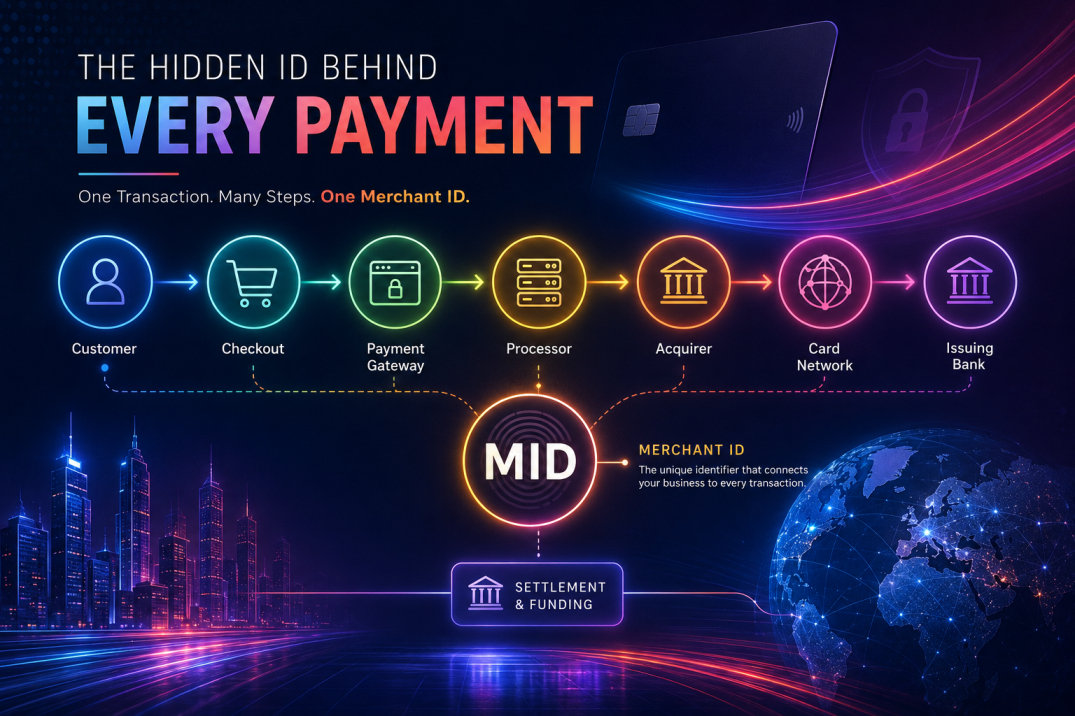
A business can have a merchant account, a payment gateway, a processor, and a business bank account – and still encounter a small identifier called a Merchant ID, or MID, when setting up payments or troubleshooting a transaction.
The MID is easy to overlook because customers never see it during checkout. Behind the scenes, however, it helps identify the merchant account associated with payment activity and allows transactions and related processing records to be connected to the correct merchant.
In simple terms, a merchant ID is an identifier for a merchant within the payment-processing system. It should not be confused with a business bank-account number, tax ID, or payment gateway account ID. The exact format and how it is assigned can vary by payment model and provider.
What Is a Merchant ID?
A Merchant Identification Number (MID) is a unique identifier associated with a merchant’s payment-processing relationship.
In a traditional acquiring arrangement, the MID is associated with the merchant account and helps payment systems identify which merchant a transaction belongs to. It can also be used when processing settlements, refunds, chargebacks, fees, and other account-level activity.
A useful analogy is a mailing address.
If a customer sends a payment into a large payment network, the system needs to know which merchant should ultimately be associated with that transaction. The MID helps provide that identification within the processing environment. The important distinction is that the MID identifies the payment-processing relationship, not the merchant’s ordinary bank account.
For example, a business might have:
- A business bank account for holding operating funds
- A merchant account for card-payment processing
- A MID associated with that merchant account
- A payment gateway used to accept online payments
These identifiers and accounts work together, but they serve different purposes.
How Does a Merchant ID Work?
The easiest way to understand a MID is to follow a card transaction.
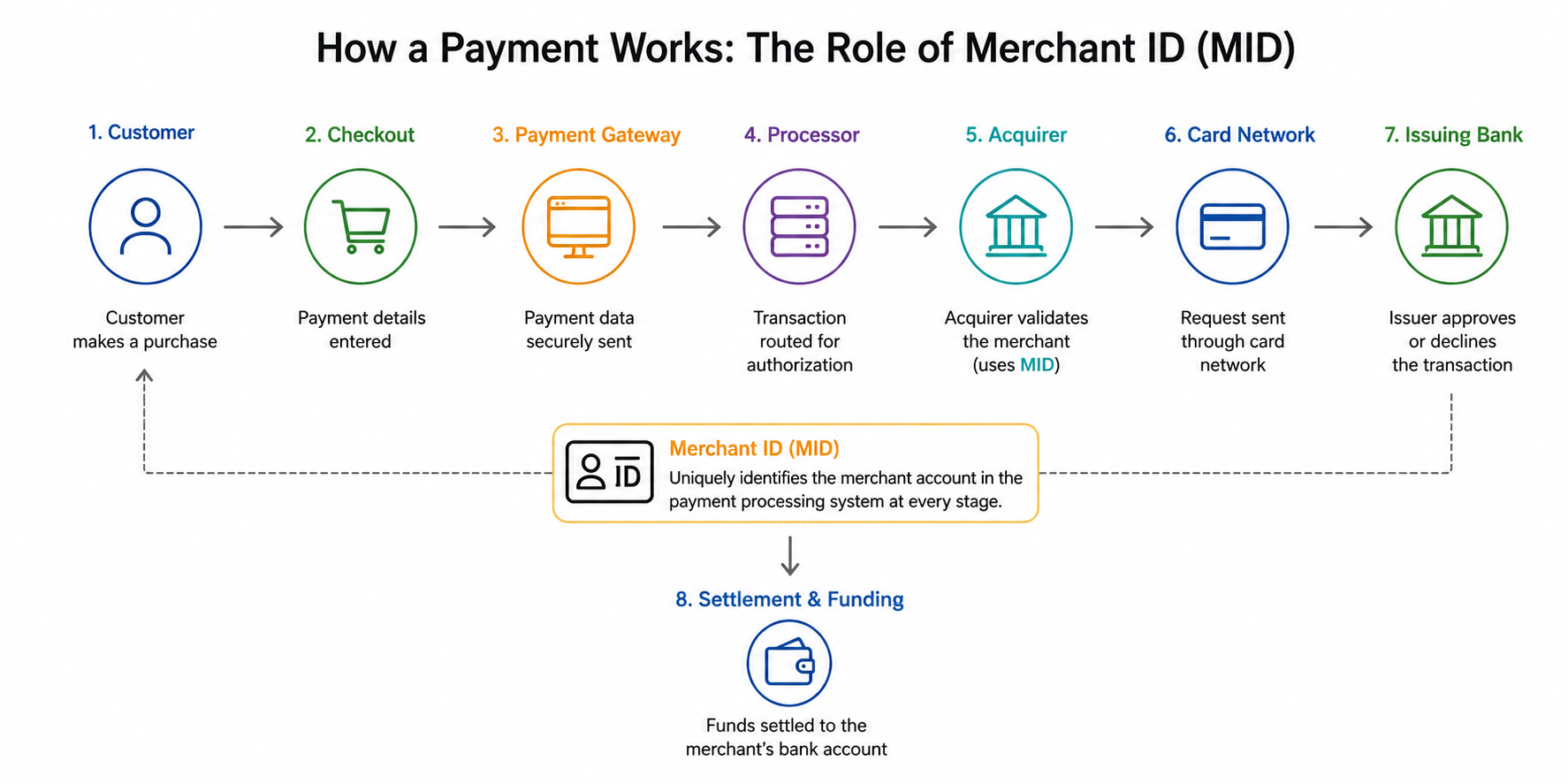
Imagine a customer purchases a $300 product from an online store. The customer enters their card details and submits the payment. The transaction information is sent into the payment-processing system, where different participants handle authorization and subsequent settlement. The merchant’s MID is associated with the merchant side of that transaction.
A simplified flow looks like this:
Customer → Checkout → Gateway → Processor → Acquirer → Card Network → Issuing Bank
If the issuing bank approves the transaction, the payment continues through the appropriate processing and settlement stages. The merchant identifier helps the acquiring and processing systems associate the transaction with the correct merchant relationship. This is why a MID is more than an arbitrary number. It provides an identity for the merchant within the payment-processing infrastructure.
Why Is a Merchant ID Important?
The MID becomes particularly useful when a business needs to identify a transaction or resolve a payment-processing issue.
Suppose a business contacts its processor because a settlement is missing. The support team may need to determine exactly which merchant account and processing relationship the transaction belongs to. Likewise, if a business is investigating a refund or chargeback, the relevant merchant identifier can help connect that activity to the appropriate processing account.
A MID can therefore be relevant to:
- Transaction processing and routing
- Settlement and funding records
- Refund and chargeback tracking
- Processing statements and account support
Merchant ID vs. Merchant Account
A merchant account and a merchant ID are closely related, but they are not the same thing.
The merchant account is the financial arrangement that allows the business to accept and settle card transactions. The MID is the identifier associated with that processing relationship.
Think of it this way:
Merchant account = The Payment-Processing Account
Merchant ID = The Identifier used to Identify that Account Within the Processing System
This distinction becomes easier to understand when looking at the broader role of merchant accounts. The merchant account provides the underlying financial structure for card acceptance, while the MID helps systems recognize which merchant relationship a transaction belongs to.
Merchant ID vs. Bank Account Number
A MID is also different from a business bank-account number. A bank-account number identifies the account held at a financial institution where the business keeps its funds. A MID identifies the merchant’s payment-processing relationship.
For example, a business could receive card payments through one merchant account while having those settled into a separate business bank account. The payment-processing system needs the MID to identify the merchant relationship; the banking system uses the bank-account details to identify where the funds should ultimately be deposited. Confusing the two can cause unnecessary problems when setting up payment infrastructure.
Merchant ID vs. Terminal ID
Another identifier that often causes confusion is the Terminal ID, or TID.
The two are related but serve different purposes. A MID generally identifies the merchant or merchant account, while a TID can identify a particular terminal or transaction source associated with that merchant.
For example, a retailer could have one merchant account but operate several physical card terminals. Each terminal may have its own identifier while transactions remain associated with the merchant’s broader MID.
How Do Businesses Get a Merchant ID?
In a traditional merchant-account arrangement, the MID is generally established as part of setting up the merchant’s processing relationship. The business typically does not create the number itself.
The exact process depends on the acquiring bank, processor, or payment model involved.
This is an important area where payment infrastructure has evolved. Not every business using a modern payment platform necessarily receives or directly manages a traditional, bank-issued MID in the same way. Some full-service payment providers operate using their own merchant-account structure and may give businesses another internal identifier instead.
So if a business cannot find a traditional MID in its dashboard, that does not automatically mean something is wrong. The payment model may simply use a different account structure.
Where Can You Find Your Merchant ID?
If a business has a traditional merchant account, the MID may appear in its payment-processing documentation or account information. Common places to check include:
- Merchant-processing statements
- Processor or merchant-services account documentation
- Payment-system configuration records
- Support or account-management portals
For example, a monthly processing statement may display the merchant identifier alongside other account information. If the business operates several payment channels or merchant accounts, it is especially important to determine which MID belongs to which processing relationship rather than assuming every payment activity uses the same identifier.
Can a Business Have More Than One Merchant ID?
Yes. A business can have multiple MIDs depending on how its payment-processing relationships are structured. This can happen when a business has different acquiring relationships, operates separate business lines, or maintains distinct processing arrangements for different channels or locations.
Consider a retailer with both physical stores and a separate e-commerce operation. Depending on its payment setup, the business may have different merchant identifiers associated with different processing environments.
Multiple MIDs can make reporting and reconciliation more detailed because transaction activity needs to be tracked according to the relevant processing relationship. It also means that businesses should maintain clear internal records of which MID corresponds to which operation.
Why Businesses Sometimes Need Their MID?
Most customers will never need to know a merchant’s MID. For the business itself, however, the number can become important during payment operations.
Suppose an ecommerce company notices that its expected settlement has not arrived. Instead of simply telling support that “a payment is missing”, the business can provide the relevant account and transaction information, including the MID where appropriate. The same principle applies when investigating:
A refund → A chargeback → A settlement discrepancy → A transaction-routing problem → A processing-account configuration issue
The MID helps narrow the investigation to the correct merchant relationship. This becomes particularly useful as a business grows and its payment infrastructure becomes more complex.
How the MID Fits Into the Larger Payment System?
The MID makes more sense when viewed alongside the other components of card processing. A typical transaction involves the merchant, gateway, processor, acquiring side, card network, and issuing bank. Each performs a different function.
The merchant account provides the financial relationship for accepting payments, while the MID identifies that merchant relationship within the processing environment. That is why understanding how merchant accounts work with payment processing is useful before trying to understand MIDs in isolation.
Likewise, the MID’s role becomes clearer when you understand the distinction between a merchant account and payment processor. The processor facilitates transaction processing, while the merchant identifier helps connect the transaction activity to the appropriate merchant relationship.
The Bottom Line
A Merchant ID (MID) is a unique identifier associated with a business’s payment-processing relationship. It helps processing systems identify the merchant connected to transactions and related activities such as settlement, refunds, and chargebacks. The simplest way to remember the distinction is:
Merchant account = The Financial Processing Relationship
MID = The Identifier for that Relationship
Bank account = Where the Business Ultimately Holds its Funds
Once those three concepts are separated, many of the technical details behind payment processing become easier to understand. A MID may look like just another account number, but within the payment ecosystem, it helps connect transactions to the correct merchant and processing relationship.

Categories
- ACH Payments (10)
- adult payment processing (11)
- AI (9)
- Altcoins (10)
- Banking (10)
- Bitcoin (133)
- Bitcoin ETF (11)
- Bitcoin Price (30)
- Blockchain (50)
- Brokering World Hunger Away (16)
- Business (17)
- card payment processing (10)
- CBD (11)
- CBDC (11)
- Chargeback (8)
- coaching business (11)
- COVID-19 (3)
- Crypto ATMs (1)
- Crypto Banking (17)
- Crypto Bill (1)
- Crypto business owner platform (31)
- Crypto Investment (3)
- Crypto Markets (5)
- Crypto Payment (35)
- Crypto Payment Processor (4)
- Crypto Prices (1)
- Crypto Trading (92)
- Cryptocurrency (402)
- Cryptocurrency Exchange (108)
- Data Visualization (2)
- dating platforms (11)
- debt collection payment processing (10)
- Decentralized Finance (7)
- DeFi Payment (9)
- DEX (3)
- Digital Currency (23)
- dropshipping payment processing (12)
- Ethereum (2)
- FAQ (7)
- file sharing payment processing (11)
- Finance (25)
- Financial Equality (4)
- Financial Freedom (8)
- Forex (35)
- hemp (1)
- ICO (2)
- Investment (11)
- IPTV (11)
- Merchant Account (10)
- Mining (3)
- News (66)
- NFTs (2)
- online gambling (11)
- P2P (1)
- Paybito (147)
- PayBitoPro (693)
- PayBitoPro Coin Listing (6)
- PayBitoPro Exchange (2)
- Payment Gateway (48)
- peptide (10)
- Post COVID Digital Transformation (1)
- Press Release (130)
- Privacy & Security (3)
- Real Estate (1)
- Stablecoin (5)
- Technology (15)
- Travel (11)
- Uncategorized (10)
- US Presidential Election (2)
- Utility Coin (1)
- Web3 business (4)
- Web3 Wallets (2)
- White Label Crypto Exchange (8)
Recent Posts
- Payment Gateway vs. Payment Orchestration: What’s the Difference?
- What Is Smart Payment Routing? Strategies to Optimize Payment Performance
- How to Improve Payment Approval Rates for High-Risk Businesses?
- Why Are Online Payments Failing? Common Causes and How to Fix Them
- How to Use Multiple Payment Processors to Reduce Business Disruptions?