How to Get a Merchant Account: Requirements and Application Process
- August 14, 2026
- Soham Guchait
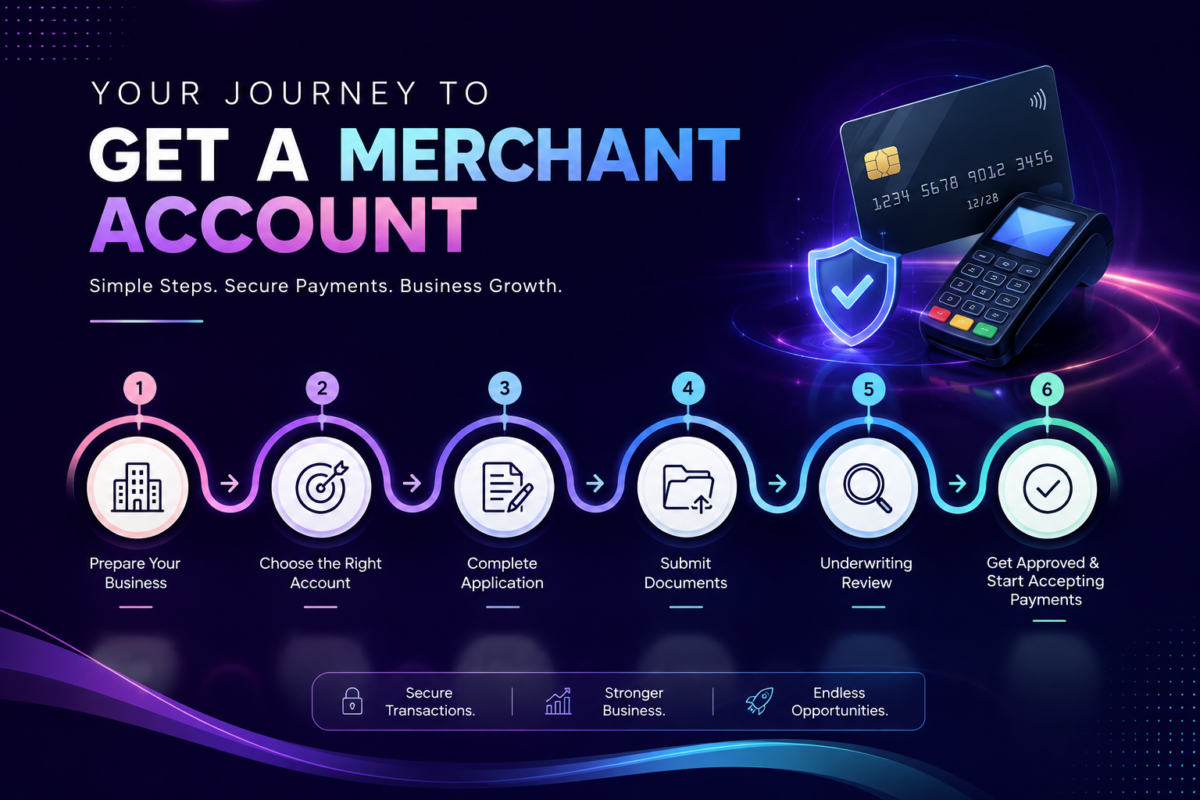
Getting a merchant account is not simply a matter of filling out a form and waiting for approval. Before a business can begin accepting card payments through a traditional merchant-account arrangement, the provider or acquiring institution generally needs to understand who owns the business, what it sells, how it operates, and what its expected payment activity looks like.
That process is important because card payments create financial exposure for the parties involved. Transactions can be refunded, disputed, or charged back, while businesses may receive funds before the underlying sale is fully completed. For this reason, merchant-account applications normally involve business verification, documentation, and some form of risk assessment.
The good news is that the process becomes much easier when you understand what happens at each stage and prepare the right information beforehand.
What Do You Need to Get a Merchant Account?
Before applying, a business generally needs to establish that it is a legitimate operating entity and provide enough information for the provider to understand its payment activity.
Requirements vary depending on the provider, business type, location, transaction model, and risk profile. However, an application commonly involves information such as:
- Legal business name, business structure, address, and contact information
- Tax identification information and ownership details
- Government-issued identification for relevant owners or authorized individuals
- Business bank-account information for settlement
- Financial or bank statements
- Previous payment-processing statements, if the business already accepts cards
Some businesses may also need licenses, tax documents, financial statements, supplier information, or other evidence related to their particular operations. For an online business, the website itself can also become part of the review. The provider may need to understand what the business sells, how customers place orders, what products or services cost, and how refunds, shipping, and customer support are handled.
This is why getting the documents required for a merchant account ready before submitting an application can make the process considerably more straightforward.
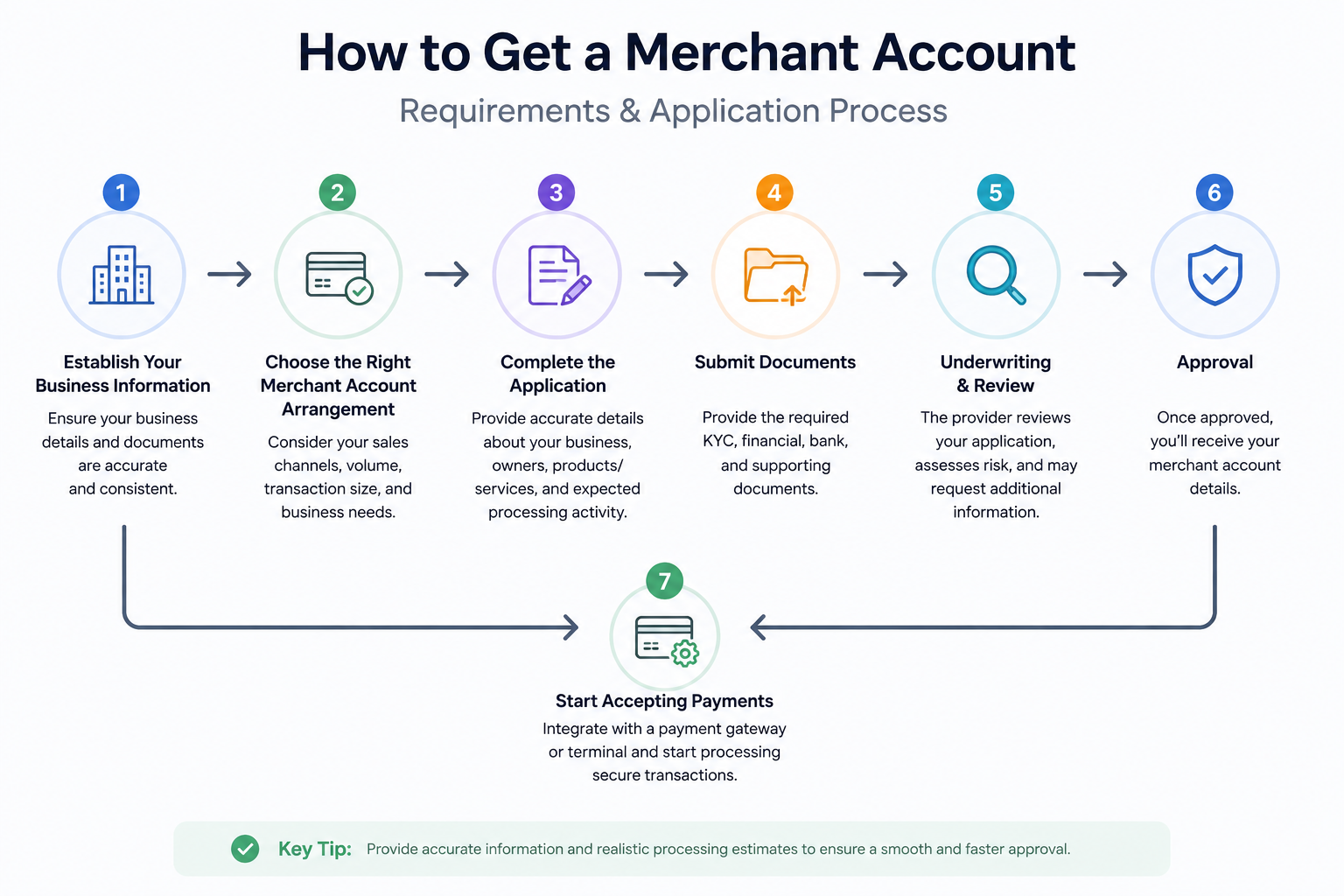
Step 1: Establish Your Business Information
The first part of the process is making sure the basic information about the business is consistent and easy to verify. A merchant application may ask for the company’s legal name, business address, tax identification number, ownership structure, and information about the people responsible for the account.
The information should match the supporting documentation.
For example, imagine a company operates under the legal name ABC Digital LLC, but its application uses a different legal name, its bank account is under another entity, and its website identifies yet another business. Even if the differences have an innocent explanation, they can create additional questions during review.
Accuracy matters because underwriting is partly about establishing that the business applying for the account is the same business represented by its supporting records. Businesses that are not yet familiar with the broader concept can first review what a merchant account is and how it fits into payment processing. Understanding that foundation makes the application process easier to put into context.
Step 2: Choose the Right Merchant Account Arrangement
Not every business has the same payment requirements. Before applying, consider how customers actually pay the business. An ecommerce company may process transactions entirely online, while a physical retailer may primarily use card terminals. Another business may need both online and in-person acceptance.
Other factors can include expected monthly volume, average transaction size, currencies, recurring payments, and the types of products or services being sold. This matters because the provider needs to understand the environment in which the merchant account will operate.
For example, a business expecting to process $20,000 per month from 400 transactions has a very different transaction profile from one expecting $200,000 from 20 transactions. Looking only at total monthly volume would miss an important part of the picture. The application should therefore describe the business’s expected activity realistically rather than using numbers simply because they appear more favorable.
Step 3: Complete the Merchant Account Application
Once the business has selected an appropriate arrangement, the next step is completing the application. Applications commonly request details about the business, its owners, expected processing activity, sales channels, and products or services. Some providers may also ask about existing processing relationships and previous payment history. This is one stage where rushing can create unnecessary problems.
Suppose a business estimates that it will process $50,000 per month but begins processing $500,000 shortly after approval. That difference may raise questions because actual activity is substantially different from what was originally represented. A better approach is to provide a reasonable estimate based on the business’s sales projections and operating history.
Step 4: Submit Supporting Documents
The application is only part of the review. Supporting documents allow the provider to verify the information submitted and assess the business more thoroughly. The exact list varies, but documents can be used to verify several different things:
- Business existence: Formation documents and registrations help establish that the company exists and identify its ownership.
- Financial condition: Bank statements and financial records can provide insight into the company’s financial position and cash flow.
- Processing history: Previous merchant statements can show transaction volume, refunds, and chargeback activity when a business already accepts cards.
- Settlement account: Bank documentation confirms where payment proceeds are intended to be deposited.
- Business model: A website, product information, contracts, licenses, or other records can help explain what the company actually sells.
These documents are not simply paperwork for its own sake. They give the reviewer evidence with which to compare the information in the application.
Step 5: Go Through Underwriting
After the application and documents are submitted, the account may enter underwriting.
Underwriting is essentially a risk-assessment process. The reviewer evaluates whether the business is suitable for the proposed payment arrangement and whether its expected activity is consistent with the provider’s risk tolerance.
The Office of the Comptroller of the Currency describes merchant underwriting as involving factors such as the validity of the business, creditworthiness, sales history, business type, and expected activity. Its guidance also notes that underwriting depth can vary according to the level of risk. This explains why two businesses can submit applications that look similar on the surface and still experience different review processes.
A business with a straightforward operating history and predictable transaction pattern may require relatively limited review. Another business with unusual transaction characteristics, substantial volume, limited history, or greater potential exposure may receive a more detailed assessment.
If the provider requests additional information, that does not automatically mean the application has been rejected. It can simply mean the reviewer needs more evidence before making a decision.
Step 6: Respond to Additional Questions
One of the most overlooked parts of getting a merchant account is what happens after the initial submission. An underwriter may ask for clarification about the business model, transaction volume, suppliers, fulfillment process, previous processing history, or financial records.
For example, an ecommerce business selling physical products may be asked how orders are fulfilled and how long customers typically wait for delivery. A subscription business may need to explain its billing structure and cancellation process.
The best response is straightforward: provide the requested information accurately and make sure it agrees with the original application. Inconsistencies can create more questions and extend the review.
Step 7: Approval and Account Setup
If the application passes the review, the business can move toward account setup and payment integration. Approval does not necessarily mean the business can immediately process a live transaction. Depending on the setup, additional configuration may be required for the payment gateway, terminal, ecommerce checkout, or other payment technology.
Testing is important because the merchant needs to confirm that transactions are being transmitted correctly and that the resulting funds are being directed to the intended settlement account.
This is also where the distinction between approval and first transaction becomes important. A business can be approved for a merchant account while still having technical or operational steps to complete before accepting its first live payment.
What Can Delay Merchant Account Approval?
There is no universal approval timeline because the process depends on the business and the provider. A straightforward application with complete information can move faster than one requiring extensive additional review.
Common causes of delays include:
- Missing or outdated documentation
- Inconsistent information across the application and supporting records
- Unclear descriptions of products or services
- Significant differences between projected and historical transaction activity
- Additional underwriting or compliance questions
Risk-based underwriting can also mean that businesses with more complex profiles receive deeper scrutiny. This is why preparation is often more useful than simply trying to find the fastest application process.
A Simple Example of the Full Process
Consider a small ecommerce company that has been operating for two years and wants to begin accepting credit cards. The business first gathers its formation documents, tax information, bank details, owner identification, and recent financial records. It estimates that it will process approximately $40,000 per month with an average transaction of $100.
It submits the application along with the requested documents.
During underwriting, the reviewer examines the company’s business model and financial information and asks for clarification about its fulfillment process. The business provides the requested information. Once the review is complete, the account is approved.
The business then completes its payment integration, runs test transactions, and begins accepting live card payments. The entire process can therefore be viewed as:
Prepare → Apply → Document → Underwrite → Clarify → Approve → Set Up → Test → Process
The exact requirements and timing can vary, but the basic logic remains the same.
How to Improve Your Chances of a Smooth Application?
The goal should not be to make a business appear artificially low-risk. It should be to give the reviewer an accurate and complete picture of how the business operates. Before submitting an application, check that the legal, financial, banking, and website information tells the same story.
It is also useful to understand what happens during merchant account underwriting, because the questions asked during that stage are directly connected to how providers evaluate payment risk.
Finally, keep copies of the submitted application and supporting documents. If questions arise later, having the original information available makes it easier to provide consistent answers.
Final Takeaway
Getting a merchant account involves more than submitting an application. A business needs to establish its identity, explain its payment activity, provide supporting documentation, and pass an underwriting review before the account can be fully activated.
The strongest preparation is straightforward: Know your Business, Understand your Expected Transaction Activity, Organize your Documentation, and Provide Consistent Information.
Once approved, there may still be technical setup and testing before the first live payment. Understanding each stage – from application through first transaction – helps businesses plan realistically and avoid confusing approval with immediate payment acceptance.

Categories
- ACH Payments (10)
- adult payment processing (11)
- AI (9)
- Altcoins (10)
- Banking (10)
- Bitcoin (133)
- Bitcoin ETF (11)
- Bitcoin Price (30)
- Blockchain (50)
- Brokering World Hunger Away (16)
- Business (17)
- card payment processing (10)
- CBD (11)
- CBDC (11)
- Chargeback (8)
- coaching business (11)
- COVID-19 (3)
- Crypto ATMs (1)
- Crypto Banking (17)
- Crypto Bill (1)
- Crypto business owner platform (31)
- Crypto Investment (3)
- Crypto Markets (5)
- Crypto Payment (35)
- Crypto Payment Processor (4)
- Crypto Prices (1)
- Crypto Trading (92)
- Cryptocurrency (402)
- Cryptocurrency Exchange (108)
- Data Visualization (2)
- dating platforms (11)
- debt collection payment processing (10)
- Decentralized Finance (7)
- DeFi Payment (9)
- DEX (3)
- Digital Currency (23)
- dropshipping payment processing (12)
- Ethereum (2)
- FAQ (7)
- file sharing payment processing (11)
- Finance (25)
- Financial Equality (4)
- Financial Freedom (8)
- Forex (35)
- hemp (1)
- ICO (2)
- Investment (11)
- IPTV (11)
- Merchant Account (10)
- Mining (3)
- News (66)
- NFTs (2)
- online gambling (11)
- P2P (1)
- Paybito (147)
- PayBitoPro (693)
- PayBitoPro Coin Listing (6)
- PayBitoPro Exchange (2)
- Payment Gateway (48)
- peptide (10)
- Post COVID Digital Transformation (1)
- Press Release (130)
- Privacy & Security (3)
- Real Estate (1)
- Stablecoin (5)
- Technology (15)
- Travel (11)
- Uncategorized (10)
- US Presidential Election (2)
- Utility Coin (1)
- Web3 business (4)
- Web3 Wallets (2)
- White Label Crypto Exchange (8)
Recent Posts
- Payment Gateway vs. Payment Orchestration: What’s the Difference?
- What Is Smart Payment Routing? Strategies to Optimize Payment Performance
- How to Improve Payment Approval Rates for High-Risk Businesses?
- Why Are Online Payments Failing? Common Causes and How to Fix Them
- How to Use Multiple Payment Processors to Reduce Business Disruptions?