How Are Card Payments Protected? EMV, Tokenization, 3D Secure and PCI DSS Explained
- August 18, 2026
- Soham Guchait
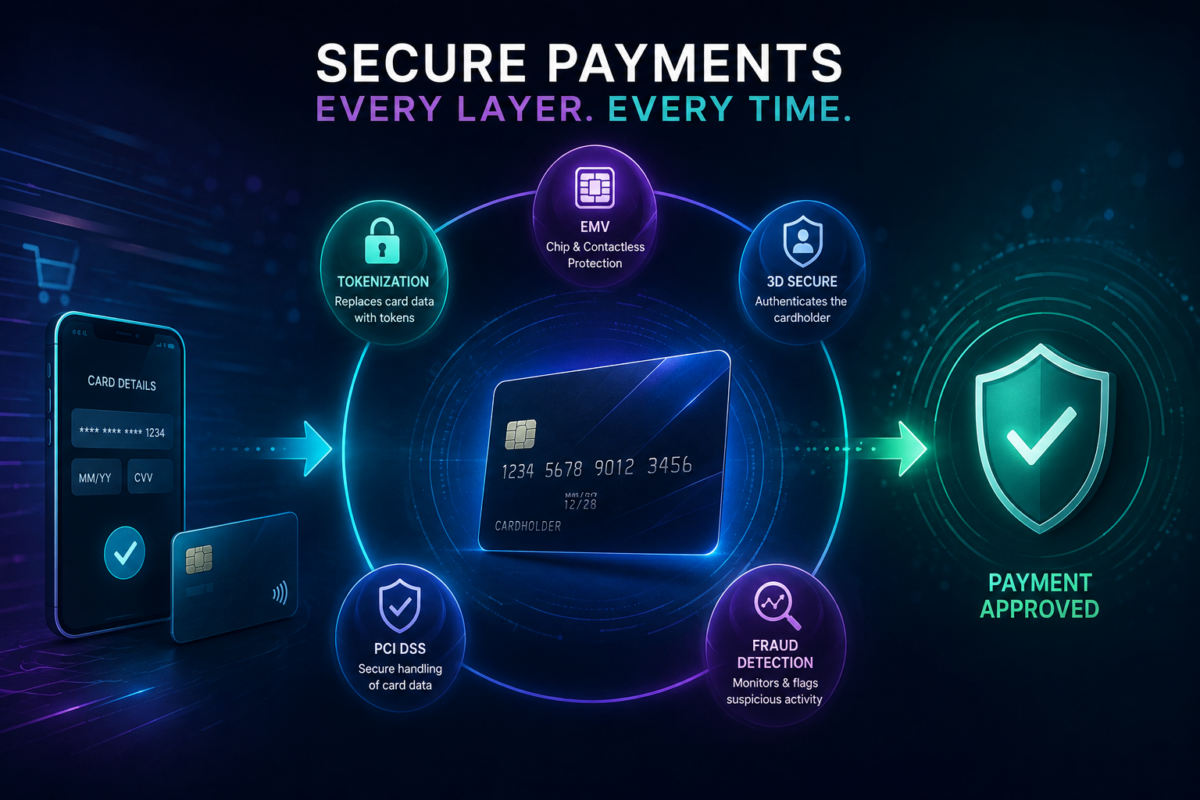
Every time a customer enters card details online or taps a card at a payment terminal, several security measures work behind the scenes to protect the transaction. That protection does not come from one technology. Card payment security is built from multiple layers, with each one addressing a different type of risk.
EMV technology helps protect physical card transactions. Tokenization replaces sensitive card numbers with alternative values. 3D Secure adds an authentication layer to many online transactions. PCI DSS establishes security requirements for environments that handle payment card data. Fraud controls add another layer by identifying transactions that appear suspicious. These technologies are connected, but they do different jobs. Understanding that distinction is important because secure card payments are not created by simply adding one security feature.
Why Is Card Payment Security Important?
A card transaction contains valuable financial information. If payment credentials are stolen or improperly exposed, they can potentially be used for unauthorized transactions. The risks are particularly different depending on how a payment is made. A customer tapping a card at a physical terminal presents a different security environment from someone entering card information into an ecommerce checkout.
For example, suppose a customer purchases a $1,000 laptop online. The merchant needs to determine not only whether the card can be used for the purchase, but also whether the person making the transaction is likely to be the legitimate cardholder.
A secure payment environment therefore needs to address several questions:
- Can the payment data be protected?
- Can the transaction be authenticated?
- Can stolen payment information be made less useful to attackers?
- Can suspicious activity be identified?
- Can businesses handle cardholder data according to the required security standards?
Different technologies answer different questions.
How EMV Protects Card Payments?
EMV refers to a set of specifications used for chip-based payment cards and compatible payment devices. EMV technology is particularly important for card-present transactions, including chip and contactless payments.
Instead of relying solely on information stored on a magnetic stripe, EMV chip transactions can generate transaction-specific data that helps prevent certain forms of counterfeit-card fraud.
Imagine a customer walks into a store and inserts their chip card into a payment terminal. The terminal communicates with the chip and processes the transaction using EMV specifications. The information generated for the transaction is designed to provide stronger security than simply transmitting static card information.
Contactless payments use related EMV technologies and can also incorporate device-based verification. EMVCo describes chip and contactless technologies as part of the broader security framework used to protect card payments.
This is one reason a physical card transaction should not be viewed as simply “sending the card number to the bank”.
What EMV Does Not Do?
EMV is not a universal solution for every payment-security problem. Its primary role is associated with securing chip and contactless payment transactions. It does not replace online authentication, tokenization, PCI DSS controls, or fraud monitoring.
For example, an ecommerce customer can make a purchase without ever presenting a physical EMV chip to a merchant. Other security mechanisms therefore become more important. This distinction becomes especially relevant when comparing physical and online payment environments.
What Is Payment Tokenization?
Payment tokenization replaces sensitive card information, such as the primary account number (PAN), with a substitute value called a token. The token can then be used in the payment process without exposing the underlying card number in the same way.
EMVCo explains that payment tokens can be constrained to specific uses, such as a particular merchant, device, or payment scenario. This can reduce the value of compromised payment information to an attacker.
Consider an online retailer that stores a customer’s card for future purchases. Instead of repeatedly exposing the customer’s actual card number to the merchant’s systems, a token can be used to represent the payment credential. If the token is designed for a limited context, stealing it may be significantly less useful than stealing the underlying card number.
Tokenization vs Encryption
Tokenization and encryption are often mentioned together, but they are not the same thing.
Encryption transforms data into a protected form that can be converted back into its original form using the appropriate cryptographic mechanism.
Tokenization substitutes the sensitive value with another value that represents it within a payment environment.
Both can contribute to payment security, but they solve different problems. Tokenization can be particularly useful for reducing the exposure of actual card numbers within payment workflows. EMVCo notes that payment tokens can be used across in-store, ecommerce, and remote payment environments.
How 3D Secure Protects Online Card Payments?
3D Secure, commonly referred to as 3DS, is designed to add an authentication layer to card-not-present transactions. When a customer makes an online purchase, the issuer can evaluate the transaction and determine whether additional authentication is needed. For a low-risk transaction, the customer may complete the payment without seeing an additional challenge.
Being a transaction that requires stronger verification, the customer could be asked to confirm their identity through a method such as a one-time passcode, biometric verification, or another authentication mechanism supported by the issuer.
For example, imagine a customer is purchasing an expensive electronic device from a new merchant. The payment system sends relevant transaction information through the 3DS process. The issuer evaluates the transaction and may determine that additional authentication is appropriate. The customer then completes the requested verification before the transaction continues. This creates an additional layer between “someone has the card details” and “the transaction is approved”.
Does 3D Secure Authenticate Every Payment?
Not necessarily. Modern 3DS implementations can support risk-based authentication, meaning transactions can be evaluated using available information and only some transactions require an active customer challenge.
This is important for the customer experience.
If every legitimate transaction required a lengthy authentication process, online checkout could become unnecessarily difficult. A risk-based approach can allow lower-risk transactions to proceed with less friction while applying stronger verification when appropriate.
The W3C describes 3DS as providing an additional security layer for cases where stronger validation of the cardholder may be needed. So 3D Secure should not be understood simply as “the OTP screen that appears during checkout”. It is an authentication framework that can operate with different levels of customer interaction.
What Is PCI DSS?
PCI DSS, or the Payment Card Industry Data Security Standard, is a security standard designed to protect payment card data. Unlike EMV or 3D Secure, PCI DSS is not a transaction technology that approves or authenticates an individual payment. Instead, it establishes security requirements for organizations and systems that store, process, or transmit cardholder data.
That distinction is essential.
If a business uses tokenization, it does not automatically become exempt from all PCI DSS responsibilities. The actual scope depends on how payment data flows through the business’s systems and how the tokenization solution is implemented.
Similarly, using 3D Secure does not replace the need for appropriate security controls around systems that handle payment information. PCI DSS therefore operates at a different layer from transaction technologies such as EMV and 3DS.
How PCI DSS, Tokenization and 3D Secure Work Together?
Imagine an ecommerce business selling electronics.
A customer enters their card information during checkout.
- PCI DSS provides the security framework governing how the business and relevant systems handle cardholder data.
- Tokenization can reduce exposure of the actual card number by replacing it with a payment token.
- 3D Secure can add authentication when the transaction requires additional verification.
- Fraud controls can evaluate the transaction for suspicious characteristics.
These mechanisms can work together, but none of them replaces the others. This is the central idea behind modern card payment security: Different layers address different risks.
What Role Does Fraud Detection Play?
Fraud detection adds another important layer. A payment can contain valid card information and still be suspicious.
For example, suppose a customer normally makes small purchases from one country. A transaction suddenly appears for $5,000 from an unfamiliar location and device. The payment system or issuer may identify the transaction as unusual and subject it to additional checks or decline it. Fraud detection can use transaction characteristics, historical patterns, device information, and other signals to estimate whether a payment appears legitimate.
This is different from authentication.
Authentication asks, “Is this person likely to be the legitimate cardholder?”
Fraud detection asks, “Does this transaction look suspicious?”
The two can complement each other.
How These Security Layers Fit Into One Payment?
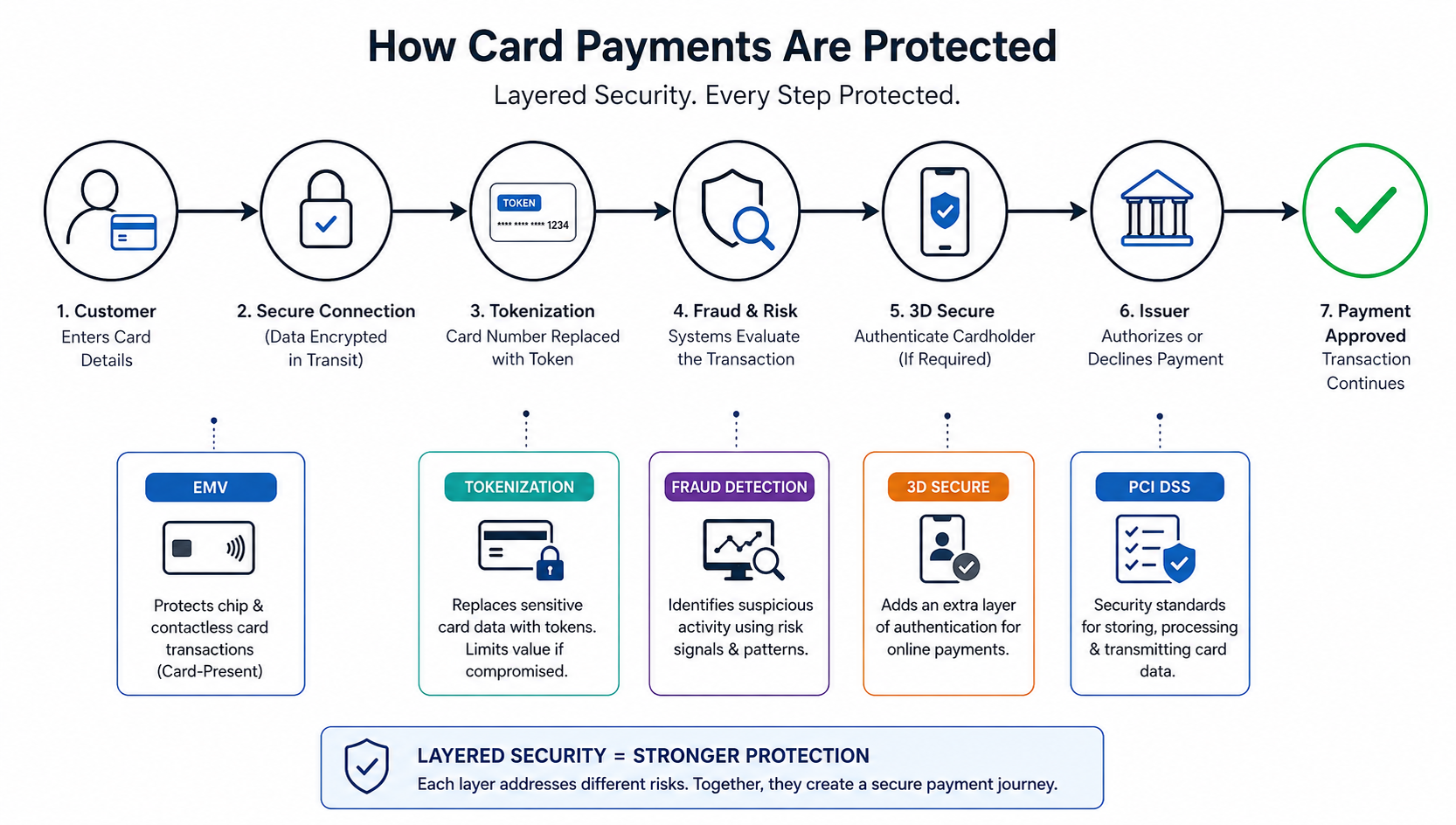
A simplified online card transaction might look like this:
Customer enters card details
↓
Secure connection protects data in transit
↓
Tokenization may replace the card number
↓
Fraud and risk systems evaluate the transaction
↓
3D Secure may authenticate the cardholder
↓
Issuer authorizes or declines the payment
↓
Transaction continues through the normal payment lifecycle
Not every transaction will use every layer in exactly this order. The specific flow depends on the payment environment, merchant setup, issuer, network, and transaction characteristics. The important point is that security is distributed across the payment ecosystem rather than being handled by one technology.
Card Security for Physical vs Online Payments
The security approach also changes depending on whether the card is physically present. For a chip or contactless transaction, EMV technology provides important security capabilities at the point of sale.
For an online purchase, the physical card is absent. The payment environment therefore relies more heavily on tools such as tokenization, authentication, fraud detection, and other security controls. This connects directly with the difference between card-present and card-not-present transactions. A business that accepts both types of payments should not assume that one security strategy works identically for both.
Does Tokenization Make Card Payments Completely Safe?
No.
Tokenization can reduce the exposure and usefulness of sensitive payment information, but it does not eliminate every security risk. A compromised customer account, fraudulent login, malicious software, weak access controls, or other attack can still create problems.
Similarly, EMV can improve the security of chip and contactless transactions but does not prevent every form of payment fraud.
3D Secure can add authentication, but not every fraudulent transaction is necessarily stopped by authentication alone.
PCI DSS provides security requirements, but compliance itself is not a guarantee that a business can never experience a breach.
The strongest approach is therefore LAYERED SECURITY, where different controls address different weaknesses.
The Bottom Line
Card payment security is a layered system, not a single technology.
EMV helps protect chip and contactless card transactions. Tokenization replaces sensitive card numbers with alternative payment values that can be limited to specific contexts. 3D Secure adds an authentication layer for online transactions when additional verification is appropriate. PCI DSS provides security requirements for environments handling payment card data. Fraud controls add another layer for identifying suspicious activity.
The most important distinction is that these technologies solve different problems.
A secure payment environment does not simply choose one of them. It combines appropriate controls so that payment data, transactions, and cardholders are protected at different stages of the payment journey. For businesses, understanding these individual roles makes it much easier to evaluate payment security without treating every security technology as if it does the same job.

Categories
- ACH Payments (10)
- adult payment processing (11)
- AI (9)
- Altcoins (10)
- Banking (10)
- Bitcoin (133)
- Bitcoin ETF (11)
- Bitcoin Price (30)
- Blockchain (50)
- Brokering World Hunger Away (16)
- Business (17)
- card payment processing (10)
- CBD (11)
- CBDC (11)
- Chargeback (8)
- coaching business (11)
- COVID-19 (3)
- Crypto ATMs (1)
- Crypto Banking (17)
- Crypto Bill (1)
- Crypto business owner platform (31)
- Crypto Investment (3)
- Crypto Markets (5)
- Crypto Payment (35)
- Crypto Payment Processor (4)
- Crypto Prices (1)
- Crypto Trading (92)
- Cryptocurrency (402)
- Cryptocurrency Exchange (108)
- Data Visualization (2)
- dating platforms (11)
- debt collection payment processing (10)
- Decentralized Finance (7)
- DeFi Payment (9)
- DEX (3)
- Digital Currency (23)
- dropshipping payment processing (12)
- Ethereum (2)
- FAQ (7)
- file sharing payment processing (11)
- Finance (25)
- Financial Equality (4)
- Financial Freedom (8)
- Forex (35)
- hemp (1)
- ICO (2)
- Investment (11)
- IPTV (11)
- Merchant Account (10)
- Mining (3)
- News (66)
- NFTs (2)
- online gambling (11)
- P2P (1)
- Paybito (147)
- PayBitoPro (693)
- PayBitoPro Coin Listing (6)
- PayBitoPro Exchange (2)
- Payment Gateway (48)
- peptide (10)
- Post COVID Digital Transformation (1)
- Press Release (130)
- Privacy & Security (3)
- Real Estate (1)
- Stablecoin (5)
- Technology (15)
- Travel (11)
- Uncategorized (10)
- US Presidential Election (2)
- Utility Coin (1)
- Web3 business (4)
- Web3 Wallets (2)
- White Label Crypto Exchange (8)
Recent Posts
- Payment Gateway vs. Payment Orchestration: What’s the Difference?
- What Is Smart Payment Routing? Strategies to Optimize Payment Performance
- How to Improve Payment Approval Rates for High-Risk Businesses?
- Why Are Online Payments Failing? Common Causes and How to Fix Them
- How to Use Multiple Payment Processors to Reduce Business Disruptions?