What Is Card Payment Authorization? How Approval and Declines Work?
- August 18, 2026
- Soham Guchait
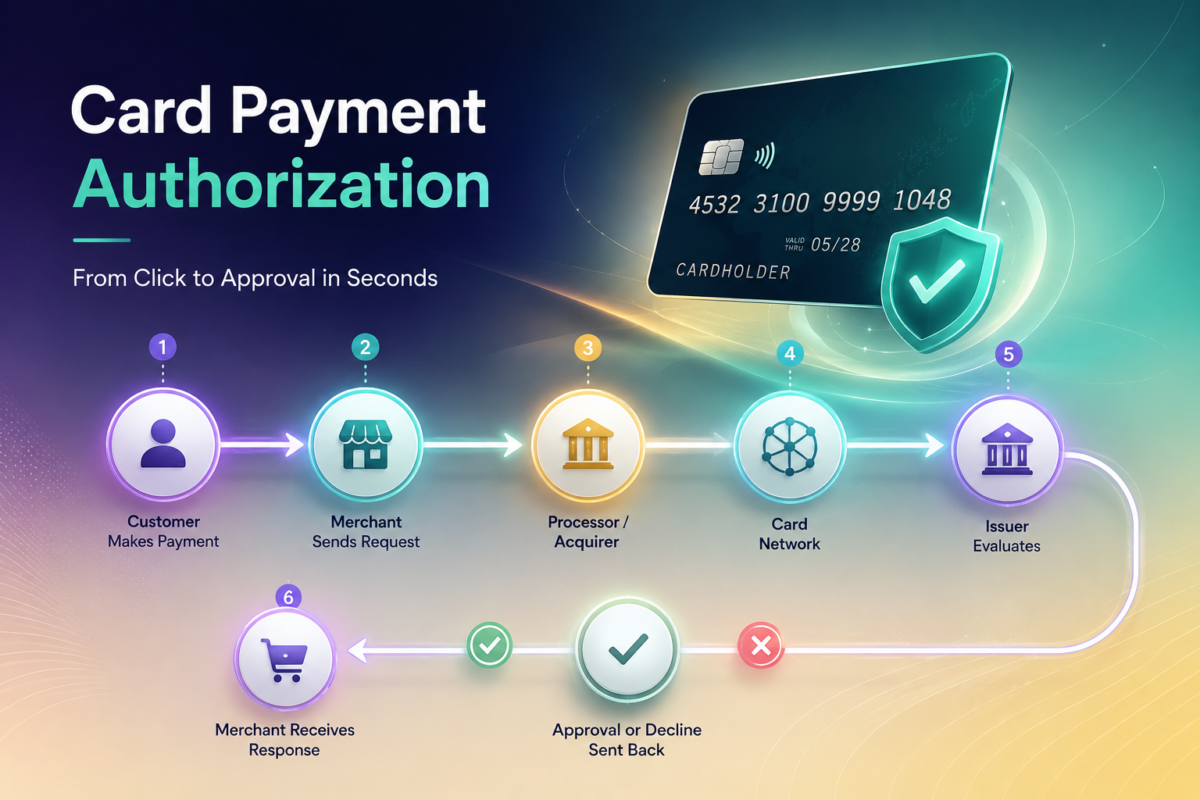
When a customer clicks “Pay” at checkout or taps a card at a payment terminal, the transaction does not immediately move money from the customer to the business. First, the card payment goes through an authorization process.
Card payment authorization is the stage where the card issuer evaluates a transaction and decides whether it can be approved. The issuer checks information such as the validity of the card, available funds or credit, transaction details, and signals that may indicate fraud. If the transaction passes these checks, the issuer sends an approval response back through the payment system.
For businesses, understanding authorization matters because an approved payment is not the same thing as a captured or settled payment. Authorization is essentially the system asking: “Can this transaction be approved?”
What Is Card Payment Authorization?
Card payment authorization is the process used to determine whether a debit or credit card transaction should be approved or declined.
When an authorization request reaches the cardholder’s issuing bank, the issuer evaluates the transaction against its own account, security, and risk checks. If approved, the issuer generally places the approved amount on hold against the customer’s available balance or credit. The actual transfer of funds happens later through capture and settlement.
This distinction is important:
- Authorization = Approval to Proceed
- Capture = Request to Collect the Authorized Transaction
- Settlement = Movement of Funds through the Payment System
A transaction can therefore be authorized without ultimately being settled. For example, an order may be canceled after authorization, or an authorization may expire before capture.
How Does Card Payment Authorization Work?
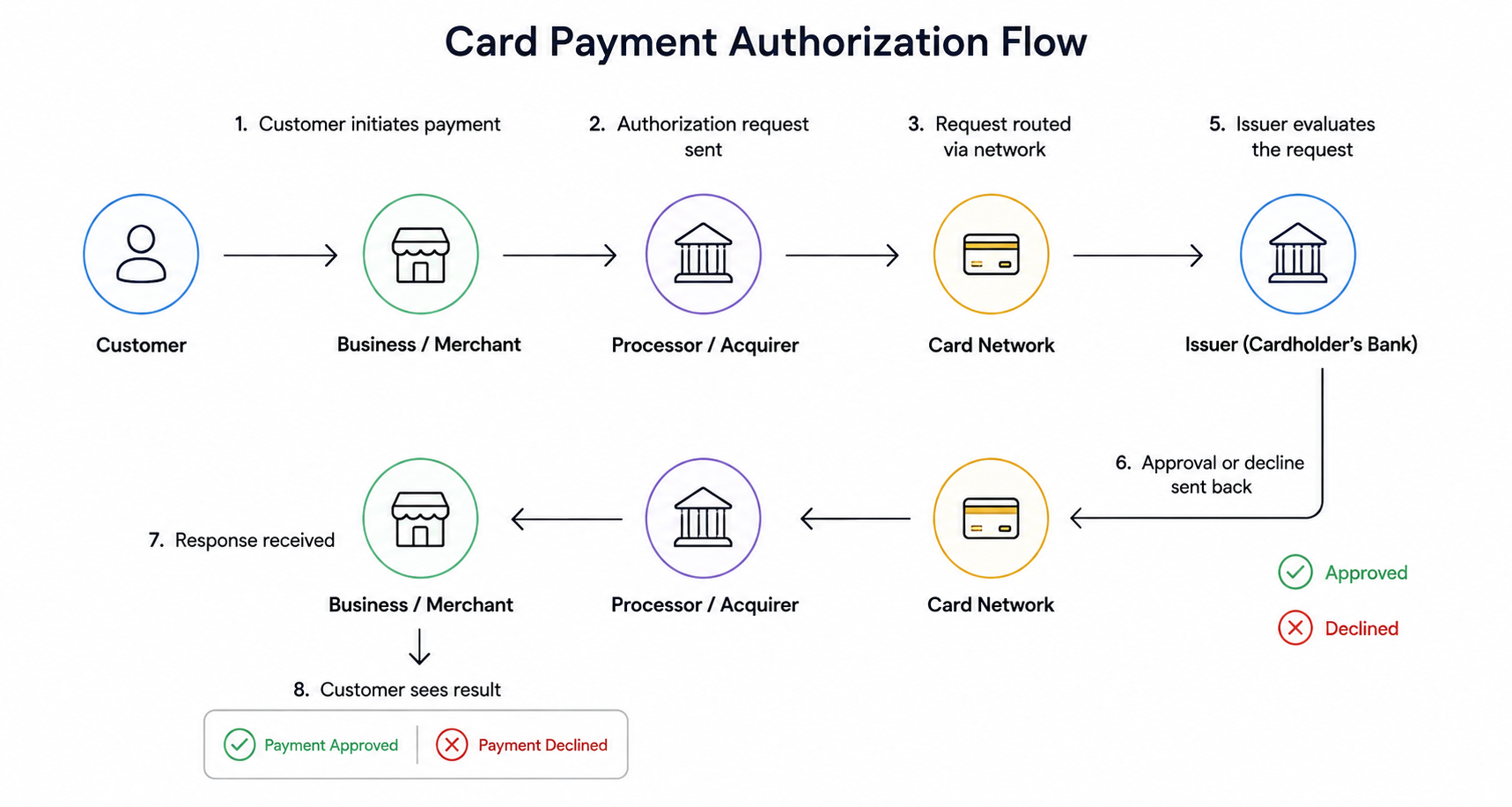
Although authorization happens within seconds in most ordinary transactions, several participants exchange information behind the scenes. The process generally follows this path:
Customer → Business → Processor/Acquirer → Card Network → Issuer → Card Network → Acquirer/Processor → Business
The customer first initiates the transaction, either by inserting, tapping, or swiping a card or by entering card details during an online checkout. The business’s payment infrastructure creates an authorization request containing relevant transaction information.
The request is passed to the acquiring side of the payment system and routed through the appropriate card network to the customer’s issuing bank. The card network acts as the communication layer between the acquiring and issuing sides.
The issuer then evaluates the request. Depending on the transaction and issuer, the checks can include:
- Whether the card or account is valid and usable?
- Whether sufficient available funds or credit exist?
- Whether transaction information is consistent with the account?
- Whether the transaction presents potential fraud or security concerns?
- Whether the card or account has restrictions that prevent the purchase?
If the issuer approves the transaction, an authorization response is returned through the network and acquiring side to the business. A decline response is returned if the issuer does not approve it.
The important point is that the merchant does not independently decide whether the card has enough available credit or funds. The issuing bank ultimately makes the authorization decision.
Example: A $150 Online Purchase
Imagine a customer purchases a $150 camera from an online store. At checkout, the customer submits their card details. The business’s payment system sends an authorization request for $150. The request travels through the relevant payment infrastructure to the cardholder’s issuing bank.
The issuer checks whether the card is valid, whether at least $150 in available credit or funds is available, and whether the transaction appears acceptable based on its security controls.
If the issuer approves it, the customer may see “Payment successful” while the $150 is effectively reserved against their available balance or credit. The merchant has received authorization, but the $150 has not necessarily been transferred to the merchant’s bank account yet.
The merchant can then proceed with capture, after which the transaction enters the clearing and settlement stages. This is why a customer can see a payment as pending even though the merchant has already received an authorization response.
What Information Is Evaluated During Authorization?
Authorization is not simply a check of whether a customer’s account contains enough money. The issuer receives transaction data and uses it as part of its decision-making process. Exactly what is evaluated varies by issuer, card type, transaction environment, and payment setup.
For an online purchase, for example, the authorization request can contain transaction amount, card information or tokenized credentials, merchant information, and authentication-related data. Additional transaction signals can help the issuer determine whether the payment looks legitimate. This helps explain why a customer can have sufficient funds and still receive a decline.
A transaction might be declined because the issuer identifies a security concern, the card is restricted, the payment details are incorrect, or another authorization condition has not been satisfied. For businesses, this makes authorization more nuanced than simply asking whether a customer “has enough money”.
Why Do Card Payments Get Declined During Authorization?
A declined card payment means the authorization request was not approved. The reason can originate from the customer’s account, the transaction information, security controls, or technical problems. Common causes include insufficient available funds or credit, expired or restricted cards, incorrect payment information, suspected fraud, and technical errors.
Consider a customer who normally shops from California but suddenly attempts a high-value purchase from another country. Even if the card has enough available credit, the issuer may treat the unusual transaction as a potential security risk and decline it.
Similarly, an online transaction can fail because the customer entered an incorrect expiration date or other card information. Not every decline therefore means the customer lacks funds.
Authorization vs Authentication: Are They the Same?
No. Authorization and authentication are related but different.
Authentication is about establishing or verifying that the person attempting the transaction is the legitimate cardholder. Authorization is the issuer’s decision about whether the transaction itself can proceed.
For example, an online purchase may trigger an additional authentication step before the issuer completes its authorization decision. Technologies such as 3D Secure can be involved in this process, particularly for card-not-present transactions. So a simplified sequence can look like:
Payment attempt → Authentication when required → Authorization decision → Capture → Settlement
The two concepts should not be treated as interchangeable. Authentication can provide additional evidence about the customer’s identity, while authorization determines whether the transaction is approved. This distinction becomes particularly important when examining the broader security controls used in card payments.
What Is an Authorization Hold?
When an issuer approves a transaction, it may place a temporary hold against the customer’s available funds or credit.
Suppose a customer has $800 available and makes a $200 card purchase. After authorization, the customer’s available amount may effectively be reduced by that $200 while the transaction remains pending. The merchant does not necessarily receive the $200 at that moment. Instead, the hold helps ensure that the amount remains available for the authorized transaction until the next stages of processing occur.
Authorization holds are especially noticeable in situations where the final amount is not immediately known, such as hotels, car rentals, restaurants, and some delivery services. An initial amount may be authorized and later adjusted when the final transaction amount is determined.
Authorization Does Not Mean the Merchant Has Been Paid
One of the most important concepts in card payment processing is that approval is not the same as payment settlement.
A successful authorization tells the merchant that the issuer has approved the transaction under the conditions of the authorization. The transaction still needs to move through subsequent processing stages before funds are ultimately settled.
This distinction is particularly important for businesses managing cash flow. A payment shown as approved at checkout does not necessarily mean the corresponding funds are already available in the merchant’s bank account.
What Does an Authorization Code Mean?
When a transaction is approved, the authorization response can include an authorization code associated with that approval. The code helps identify the issuer’s approval response within the transaction process. It should not be confused with a guarantee that the merchant has already received the funds.
If the issuer declines the transaction, the response can instead contain a decline or error code. These codes can help payment systems and businesses understand how the transaction was rejected, although the level of detail available can vary between payment providers and issuers.
Why Card Payment Authorization Matters to Businesses?
Authorization sits at a critical point in the card payment lifecycle. It determines whether a transaction can move forward, while also providing issuers with an opportunity to evaluate financial and security risks.
For businesses, a poor authorization experience can mean legitimate customers are unable to complete purchases. At the same time, authorization controls are necessary because issuers must protect cardholders and accounts from unauthorized transactions.
The goal is therefore not simply to approve as many payments as possible. A reliable payment process needs to approve legitimate transactions while appropriately rejecting transactions that should not proceed. Understanding this stage also makes it easier to diagnose payment problems. When a transaction fails, knowing whether the problem occurred during authorization, capture, or settlement can prevent businesses from treating every payment failure as the same issue.
The Bottom Line
Card payment authorization is the issuer’s decision on whether a card transaction can proceed. It happens before capture and settlement and typically takes only seconds.
The process involves multiple parties, including the merchant, acquiring side, card network, and issuing bank. The issuer evaluates the transaction using available account information and security signals before returning an approval or decline. Most importantly, remember the three-stage distinction:
Authorization approves → Capture initiates collection → Settlement moves the funds.
Once that distinction is clear, the rest of the card payment lifecycle becomes much easier to understand.

Categories
- ACH Payments (10)
- adult payment processing (11)
- AI (9)
- Altcoins (10)
- Banking (10)
- Bitcoin (133)
- Bitcoin ETF (11)
- Bitcoin Price (30)
- Blockchain (50)
- Brokering World Hunger Away (16)
- Business (17)
- card payment processing (10)
- CBD (11)
- CBDC (11)
- Chargeback (8)
- coaching business (11)
- COVID-19 (3)
- Crypto ATMs (1)
- Crypto Banking (17)
- Crypto Bill (1)
- Crypto business owner platform (31)
- Crypto Investment (3)
- Crypto Markets (5)
- Crypto Payment (35)
- Crypto Payment Processor (4)
- Crypto Prices (1)
- Crypto Trading (92)
- Cryptocurrency (402)
- Cryptocurrency Exchange (108)
- Data Visualization (2)
- dating platforms (11)
- debt collection payment processing (10)
- Decentralized Finance (7)
- DeFi Payment (9)
- DEX (3)
- Digital Currency (23)
- dropshipping payment processing (12)
- Ethereum (2)
- FAQ (7)
- file sharing payment processing (11)
- Finance (25)
- Financial Equality (4)
- Financial Freedom (8)
- Forex (35)
- hemp (1)
- ICO (2)
- Investment (11)
- IPTV (11)
- Merchant Account (10)
- Mining (3)
- News (66)
- NFTs (2)
- online gambling (11)
- P2P (1)
- Paybito (147)
- PayBitoPro (693)
- PayBitoPro Coin Listing (6)
- PayBitoPro Exchange (2)
- Payment Gateway (48)
- peptide (10)
- Post COVID Digital Transformation (1)
- Press Release (130)
- Privacy & Security (3)
- Real Estate (1)
- Stablecoin (5)
- Technology (15)
- Travel (11)
- Uncategorized (10)
- US Presidential Election (2)
- Utility Coin (1)
- Web3 business (4)
- Web3 Wallets (2)
- White Label Crypto Exchange (8)
Recent Posts
- Payment Gateway vs. Payment Orchestration: What’s the Difference?
- What Is Smart Payment Routing? Strategies to Optimize Payment Performance
- How to Improve Payment Approval Rates for High-Risk Businesses?
- Why Are Online Payments Failing? Common Causes and How to Fix Them
- How to Use Multiple Payment Processors to Reduce Business Disruptions?