Why Do Card Payments Get Declined? Common Reasons and What Happens Next
- August 18, 2026
- Soham Guchait
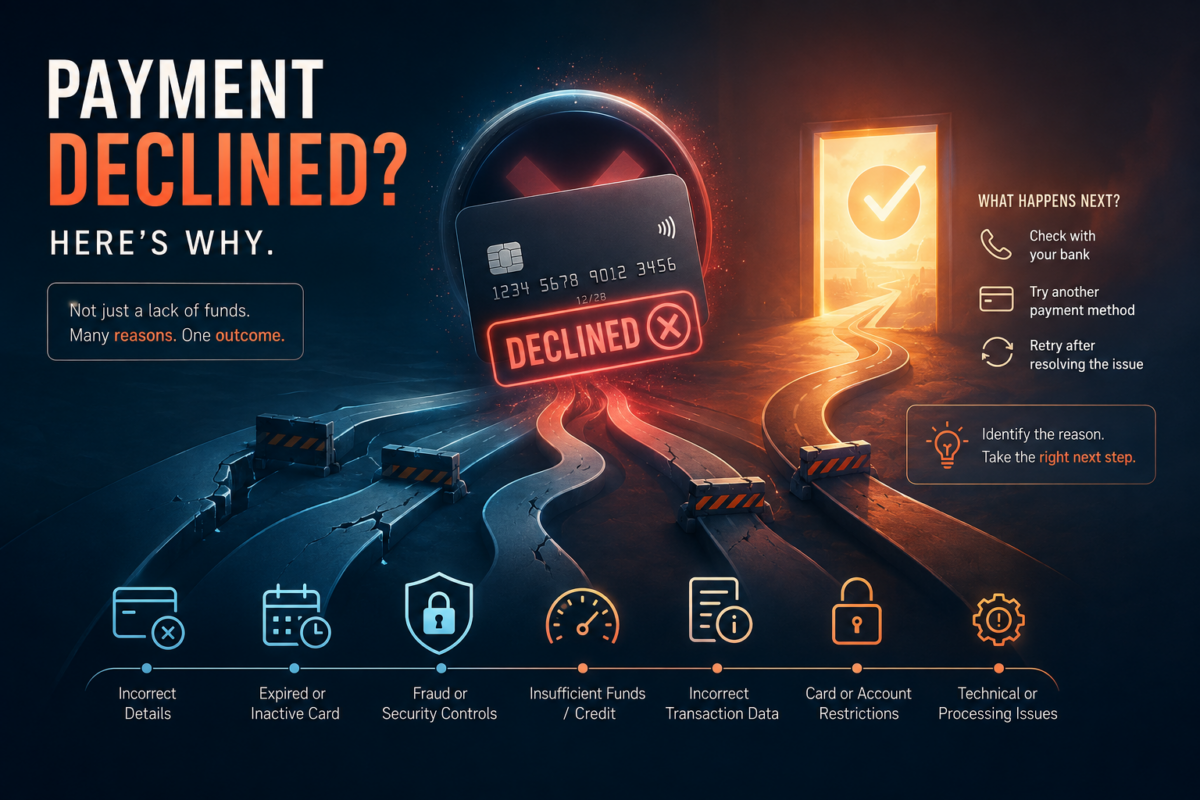
A customer reaches the checkout, enters their card details, clicks Pay, and suddenly sees: “Your card was declined”. For a customer, it can be confusing. For a business, it can mean a lost sale.
A card payment declined message does not always mean the customer has insufficient funds. A transaction can be declined because of incorrect card information, an expired card, issuer security controls, unusual transaction activity, processing problems, or restrictions associated with the card or account.
The important thing is to understand where and why the payment failed. Card payment declines can involve the issuing bank, the transaction information, fraud controls, or the payment-processing infrastructure. This article explains the most common reasons card payments are declined, what happens during a decline, and what businesses and customers can do next.
What Does It Mean When a Card Payment Is Declined?
A card payment is declined when the authorization request does not receive approval.
When a customer attempts to pay, the transaction is sent through the card payment infrastructure toward the cardholder’s issuing bank. The issuer evaluates the transaction and returns an approval or decline response. If the response is a decline, the transaction cannot proceed normally to the next stages of the payment lifecycle.
For example, imagine a customer is purchasing a $300 laptop online. The customer has enough available credit, but the issuer detects unusual activity associated with the transaction and declines it. The customer may see a generic message such as “Payment declined”, even though the underlying reason may be more specific. This is why a declined payment should not automatically be interpreted as “the customer has no money”.
How Does a Card Payment Get Declined?
Most card payment declines occur during the authorization stage.
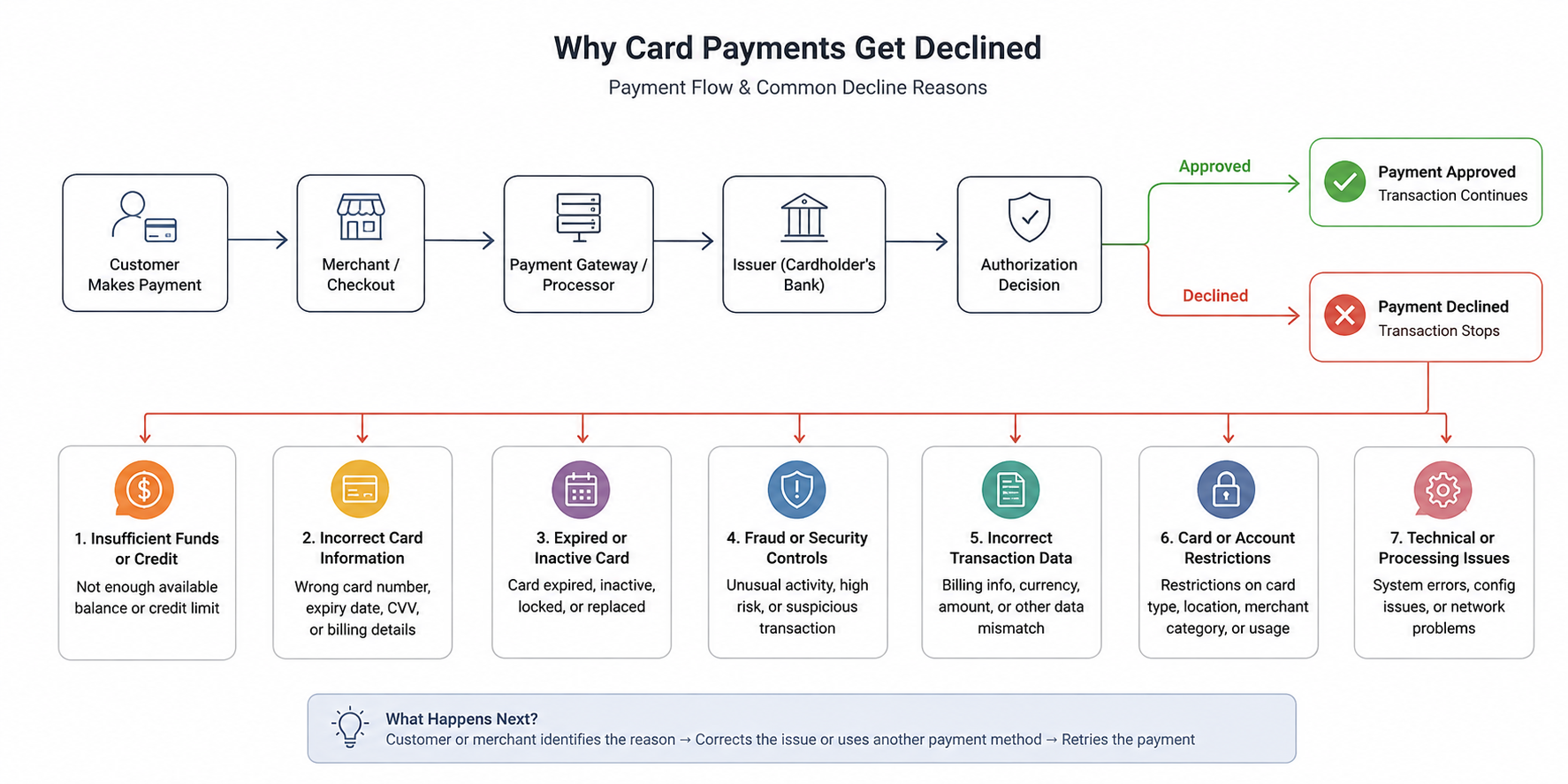
The authorization process evaluates whether a particular transaction should be approved. The issuer can consider the card’s status, available funds or credit, transaction information, and security or fraud signals. A simplified flow looks like this:
Customer attempts payment → Authorization request → Issuer checks transaction → Approval or decline → Merchant receives response
If the issuer approves the request, the transaction can continue through the later stages of card processing. And, If the issuer declines it, the merchant receives a decline response and the transaction does not proceed normally.
Understanding this distinction is useful because authorization, capture, and settlement are different stages. A decline during authorization is not the same thing as a transaction failing during settlement. For readers who want to understand exactly how that approval decision is made, the authorization stage involves considerably more than simply checking the customer’s balance.
Common Reasons Why Card Payments Get Declined
There is no single reason behind every declined card payment. Different transactions can fail for completely different reasons.
Insufficient Funds or Available Credit
One of the simplest explanations is that the customer does not have enough available funds or credit to complete the transaction.
Suppose a customer’s debit account has $80 available and they attempt to make a $120 purchase. The issuer can decline the transaction because the available balance is insufficient. Credit cards work similarly, although the relevant factor is generally available credit rather than the customer’s bank-account balance.
Importantly, available funds and the customer’s actual balance are not always identical. Previous pending transactions or authorization holds can reduce what is currently available.
Incorrect Card Information
Online transactions can be declined when the information submitted during checkout does not match what the issuer expects. A customer might enter the wrong card number, expiration date, security code, or other required information.
For example, someone may have received a replacement card but accidentally use the old expiration date saved in their browser. The card itself may be valid, but the transaction information is incorrect. Correcting the information and attempting the transaction again may resolve the problem.
Expired or Inactive Card
A card that has expired cannot normally be used for a new transaction. Customers may also encounter problems if a card has been replaced, temporarily locked, or otherwise restricted by the issuer.
This can be particularly common with cards stored in digital wallets or saved on ecommerce websites. A customer may continue using previously stored information after receiving a replacement card.
Fraud or Security Controls
Issuers continuously monitor card transactions for activity that could indicate fraud. A transaction may look unusual because of its location, amount, merchant, frequency, or other characteristics.
Consider a customer who normally makes small domestic purchases but suddenly attempts a large international transaction. Even if sufficient funds are available, the issuer may decline the transaction because the activity appears unusual.
Security controls are not designed to make payments difficult. They are intended to protect cardholders and financial accounts, which means a legitimate transaction can sometimes be rejected when it resembles potentially fraudulent activity.
Incorrect Transaction Data
Payment requests contain transaction information that must be processed correctly.
Problems with the data submitted during authorization can result in a decline. This can include incorrect billing information, transaction details, currency information, or other payment data depending on the transaction environment. This is particularly relevant to ecommerce businesses because customers enter payment information remotely rather than presenting a physical card.
Card or Account Restrictions
An issuer may place restrictions on a card or account that prevent certain transactions from being completed.
For example, a card could be restricted for particular transaction types, geographic locations, merchant categories, or international usage. A customer may therefore have enough available credit and a perfectly valid card but still receive a decline because the transaction does not satisfy the account’s current restrictions.
Technical or Processing Problems
Not every failed payment is caused by the customer’s card. A transaction can also encounter technical problems while moving through the payment-processing environment.
Communication failures, incorrect configuration, unavailable services, or other processing issues can prevent an authorization request from being completed successfully.
This distinction matters for businesses because repeatedly asking customers to try another card will not solve a problem that actually originates within the merchant’s payment infrastructure.
Why Can a Card Be Declined Even When There Is Enough Money?
This is one of the most confusing situations for customers.
A customer checks their account, sees sufficient funds, and wonders why the payment was rejected. The explanation is that available funds are only one part of the authorization decision.
An issuer can decline a transaction because of security controls, card restrictions, incorrect information, transaction characteristics, or other conditions even when enough money is available.
For example, suppose a customer has $5,000 available on their card and attempts a $400 purchase. The amount itself is affordable, but the transaction takes place in an unusual location and differs significantly from the customer’s normal spending pattern. The issuer may decline it as a precaution. This is why businesses should avoid telling customers that every decline is caused by insufficient funds.
What Is the Difference Between an Issuer Decline and a Processing Failure?
Not all payment failures originate from the same place.
An issuer decline occurs when the issuing bank does not approve the authorization request.
A processing or technical failure can occur when the transaction cannot be successfully handled by the payment infrastructure.
The customer may see a similar error message in both situations, but the appropriate response can be completely different. If the issuer declines the payment because of a security decision, the customer may need to contact their bank or use another payment method. And, if the problem is technical, the merchant or its payment provider may need to investigate the transaction. This distinction is particularly important for businesses trying to reduce unnecessary payment failures.
Card-Present and Online Payments Can Behave Differently
The transaction environment can also influence how a payment is evaluated. When a customer physically presents a card at a point-of-sale terminal, the transaction has access to information and security mechanisms that may not be available in the same way for an online transaction.
An ecommerce purchase is generally a card-not-present transaction, meaning the physical card is not presented to the merchant. This can introduce different authentication and fraud considerations.
For example, a customer might successfully use a card at a local store but have an online transaction declined because the online purchase generates different risk signals. The card itself has not necessarily become unusable. The issuer may simply be evaluating the two transactions differently.
What Should a Customer Do After a Card Payment Is Declined?
The best response depends on the reason for the decline. For straightforward problems, the customer can first verify that the card details, expiration date, and security information were entered correctly. They can also check their available balance or credit and confirm that the card has not expired or been restricted.
If everything appears correct, contacting the card issuer can provide more information about the decline. Trying another payment method can also help determine whether the problem is specific to one card. However, repeatedly submitting the same transaction is not always the best approach, particularly when a security system may be involved.
Can a Declined Card Payment Be Retried?
Yes, but the appropriate response depends on why the transaction was declined. If a customer entered an incorrect expiration date, correcting it may allow the transaction to succeed. Also, if the issuer has declined the transaction because of a suspected security issue, repeatedly submitting the same payment may not resolve the underlying problem.
Likewise, if a merchant is experiencing a technical processing failure, asking customers to retry without investigating the underlying issue can create frustration without solving anything. The goal should be to identify the type of failure first, then choose the appropriate response.
The Bottom Line
A card payment declined message does not automatically mean that a customer has insufficient funds.
Payments can be declined because of incorrect card information, expired cards, insufficient available funds or credit, account restrictions, unusual transaction activity, fraud controls, or technical problems. The most important distinction is identifying where the failure occurred.
If the issuer declined the authorization, the customer may need to resolve an issue with their card or account. If the transaction failed because of incorrect data or a technical processing problem, the merchant may need to investigate its payment setup.
Once businesses understand the difference between issuer decisions and processing failures, a declined transaction becomes more than just an error message. It becomes a specific point in the payment lifecycle that can be investigated, explained, and, in many cases, resolved.

Categories
- ACH Payments (10)
- adult payment processing (11)
- AI (9)
- Altcoins (10)
- Banking (10)
- Bitcoin (133)
- Bitcoin ETF (11)
- Bitcoin Price (30)
- Blockchain (50)
- Brokering World Hunger Away (16)
- Business (17)
- card payment processing (10)
- CBD (11)
- CBDC (11)
- Chargeback (8)
- coaching business (11)
- COVID-19 (3)
- Crypto ATMs (1)
- Crypto Banking (17)
- Crypto Bill (1)
- Crypto business owner platform (31)
- Crypto Investment (3)
- Crypto Markets (5)
- Crypto Payment (35)
- Crypto Payment Processor (4)
- Crypto Prices (1)
- Crypto Trading (92)
- Cryptocurrency (402)
- Cryptocurrency Exchange (108)
- Data Visualization (2)
- dating platforms (11)
- debt collection payment processing (10)
- Decentralized Finance (7)
- DeFi Payment (9)
- DEX (3)
- Digital Currency (23)
- dropshipping payment processing (12)
- Ethereum (2)
- FAQ (7)
- file sharing payment processing (11)
- Finance (25)
- Financial Equality (4)
- Financial Freedom (8)
- Forex (35)
- hemp (1)
- ICO (2)
- Investment (11)
- IPTV (11)
- Merchant Account (10)
- Mining (3)
- News (66)
- NFTs (2)
- online gambling (11)
- P2P (1)
- Paybito (147)
- PayBitoPro (693)
- PayBitoPro Coin Listing (6)
- PayBitoPro Exchange (2)
- Payment Gateway (48)
- peptide (10)
- Post COVID Digital Transformation (1)
- Press Release (130)
- Privacy & Security (3)
- Real Estate (1)
- Stablecoin (5)
- Technology (15)
- Travel (11)
- Uncategorized (10)
- US Presidential Election (2)
- Utility Coin (1)
- Web3 business (4)
- Web3 Wallets (2)
- White Label Crypto Exchange (8)
Recent Posts
- Payment Gateway vs. Payment Orchestration: What’s the Difference?
- What Is Smart Payment Routing? Strategies to Optimize Payment Performance
- How to Improve Payment Approval Rates for High-Risk Businesses?
- Why Are Online Payments Failing? Common Causes and How to Fix Them
- How to Use Multiple Payment Processors to Reduce Business Disruptions?