How Does Card Payment Processing Work? From Checkout to Settlement
- August 18, 2026
- Soham Guchait
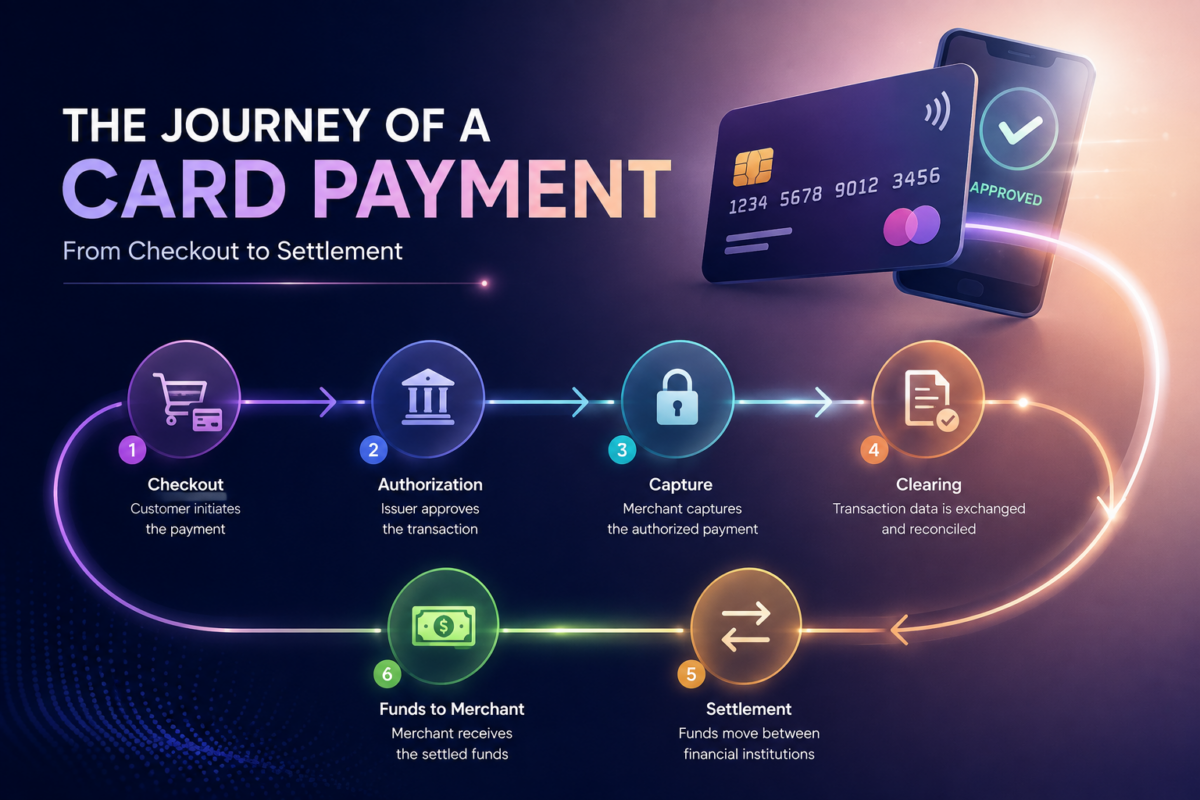
A customer taps a card, enters payment details online, or uses a digital wallet at checkout. Within seconds, the transaction may appear complete. But what actually happens between clicking “Pay” and the merchant receiving the money?
A card payment passes through several systems and financial institutions before it reaches its final stage. The transaction must be submitted, authorized, captured, cleared, and settled. Each stage has a different purpose, and understanding the sequence makes it much easier to understand payment failures, processing costs, security, and settlement times.
This guide follows a typical card transaction from the moment a customer initiates payment to the point where the merchant receives the funds.
What Happens When a Customer Makes a Card Payment?
Consider a customer purchasing a $200 product from an online store. The customer enters their card information and clicks the payment button. The merchant’s checkout system collects the information required to process the transaction and sends it into the relevant payment infrastructure.
At this point, the merchant is not simply sending $200 directly to the customer’s bank. The transaction has to travel through the card-payment ecosystem so that the appropriate institutions can determine whether it should be approved and subsequently completed.
The first major stage is authorization.
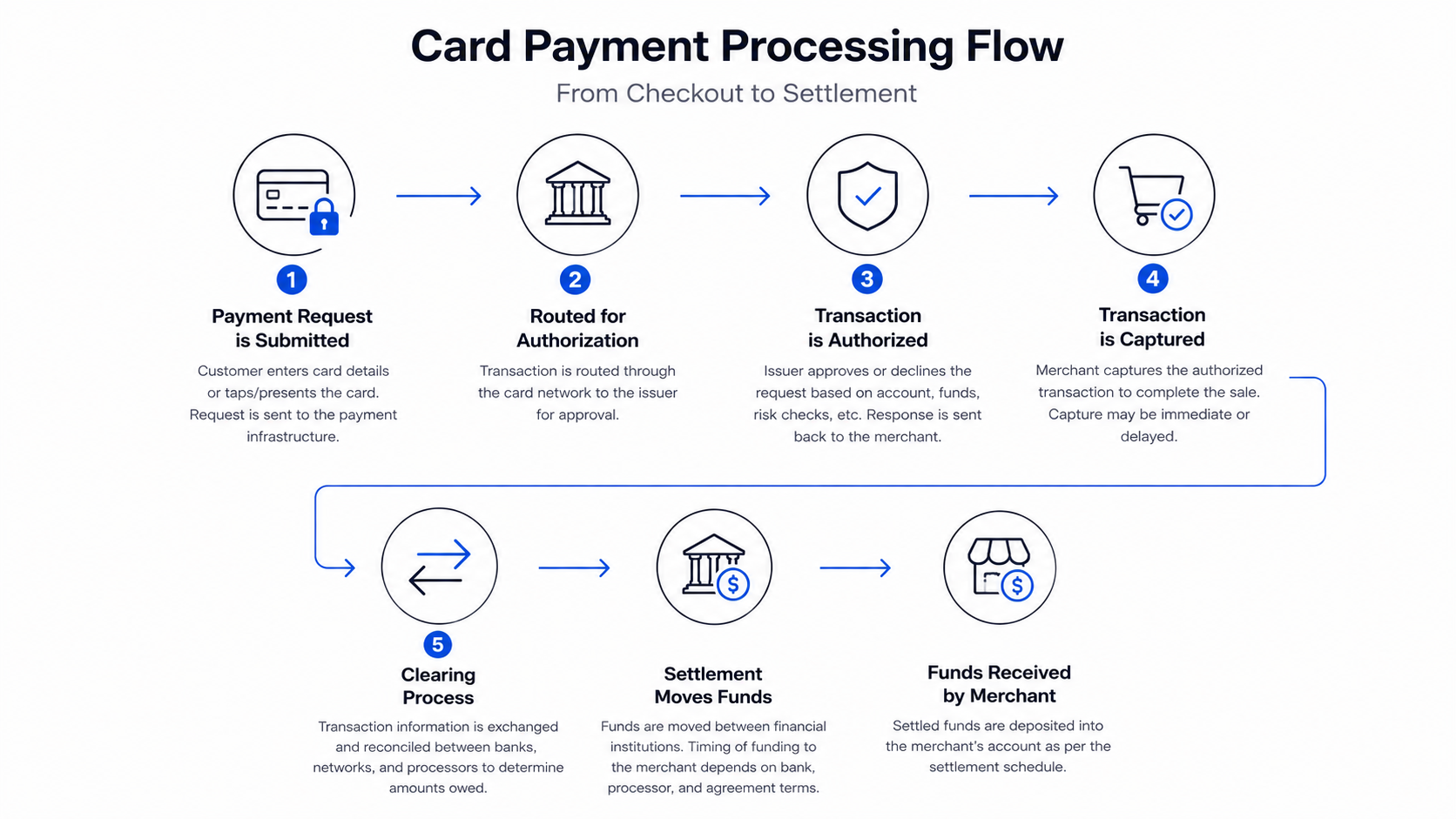
1. The Payment Request is Submitted
The transaction begins when the customer initiates payment.
- For an online purchase, this might involve entering card details into a checkout page.
- For an in-person transaction, the customer might tap, insert, or otherwise present the card at a payment terminal.
The payment request contains information needed to identify the transaction, such as the amount, merchant information, and relevant payment credentials.
In an online transaction, a payment gateway may be involved in securely transmitting the payment information from the merchant’s checkout environment into the processing infrastructure. The gateway’s role is important, but it is only one part of the overall card payment process.
2. The Transaction is Routed for Authorization
The transaction then moves through the appropriate processing infrastructure and card network toward the card issuer.
The issuer is the financial institution that issued the customer’s card. It evaluates the authorization request and determines whether the transaction can be approved. The decision can depend on factors such as the status of the account, available funds or credit, transaction information, and applicable risk controls.
The issuer sends an approval or decline response back through the transaction path. This entire decision happens quickly, but it is one of the most important parts of the transaction.
A useful distinction here is that authorization is not the same as payment settlement. An approved transaction means the transaction has been authorized to proceed; it does not necessarily mean that the merchant already has the money. Understanding card payment authorization in more detail is important because authorization decisions can also explain why apparently valid transactions are sometimes declined.
What Happens After a Card Payment Is Approved?
An approved transaction still has more stages to complete.
3. The Transaction is Captured
After authorization, the merchant can submit the transaction for completion through capture. Capture indicates that the merchant intends to complete the authorized transaction.
For some businesses, capture may happen almost immediately after authorization. In other situations, there can be a delay between authorization and capture.
For example, consider a hotel that places an authorization against a customer’s card when they check in. The final amount may not be known until checkout. The merchant may therefore handle authorization and capture at different points. This distinction is important because an authorization can exist without the transaction having reached its final financial stage.
4. Transaction Information Enters Clearing
Once transactions have been captured, the relevant transaction information goes through clearing. Clearing involves the exchange and reconciliation of transaction information between the institutions involved in processing the payment. The records associated with the transaction are used to determine what amounts are owed between the relevant parties.
At this stage, the transaction is moving beyond the initial approval decision and toward the financial completion of the payment.
Clearing is therefore different from authorization. Authorization answers, in effect, “Can this transaction proceed?” Clearing deals with the records and obligations associated with transactions that are being completed.
5. Settlement Moves the Funds
The next major stage is Settlement. It involves the movement of funds between the financial institutions participating in the transaction.
The merchant does not necessarily receive the funds at the exact moment settlement occurs. The timing of actual merchant funding can depend on the applicable arrangements, transaction type, market, and other operational factors. This is why a customer can see an approved payment almost immediately while the merchant’s available balance changes later.
For a deeper look at what happens during the post-authorization stages, capture, clearing and settlement should be understood as separate but connected parts of the transaction lifecycle.
A Card Payment Example From Start to Finish
Take a customer purchasing a $200 laptop from an online store. The customer enters their card details and submits the payment.
The merchant’s checkout environment sends the transaction into the payment infrastructure. The transaction is routed through the relevant systems toward the card issuer.
The issuer evaluates the request and approves it. While, the customer sees a successful payment message.
From the customer’s perspective, the transaction appears finished. Behind the scenes, however, the merchant still needs to complete the transaction lifecycle. The transaction is captured, its records proceed through clearing, and settlement takes place between the relevant financial institutions.
Eventually, the merchant receives the applicable funds according to its funding arrangement. The important point is that the customer’s experience and the payment system’s lifecycle are not the same thing. The customer experiences a few seconds at checkout. The payment infrastructure handles a sequence of events that can continue after the approval message appears.
What If the Card Payment Is Declined?
Not every transaction reaches capture and settlement.
Suppose the same $200 transaction is submitted, but the issuer declines the authorization. The transaction does not simply move forward to capture because the authorization stage has not been successfully completed. The reason for the decline can vary. It may relate to the account, transaction information, available funds or credit, security controls, or other issuer decisions.
There is also an important distinction between an issuer decline and a technical payment failure. A transaction can fail because the issuer does not approve it, but it can also encounter a technical problem somewhere in the payment path.
That is why businesses need to understand where a transaction failed rather than treating every unsuccessful payment as the same problem. For a more detailed troubleshooting approach, why card payments are declined is a separate topic worth examining because different decline situations can require very different responses.
Where Do Payment Fees Enter the Process?
Card payment processing also involves costs, although there is not necessarily one single fee attached to every transaction. Depending on the arrangement and transaction, costs can include interchange-related charges, network fees, and other processing or provider charges.
For example, if a customer makes a $200 purchase, the merchant does not necessarily keep the entire transaction amount as its net proceeds. Applicable processing costs are accounted for according to the relevant pricing and settlement arrangements. The exact cost structure can vary by market, card type, transaction characteristics, merchant category, provider, and contractual arrangement.
How Is the Transaction Protected?
Security controls can operate at different points throughout the card payment lifecycle.
Depending on the transaction environment, technologies and standards such as EMV, tokenization, authentication mechanisms, and PCI DSS requirements can play different roles in protecting payment information and reducing fraud risk.
For example, a card-present transaction and an online card-not-present transaction do not expose the payment system to exactly the same risks. The security mechanisms used can therefore differ. The important point is that card payment security is not one single technology. It is a combination of controls designed to protect payment information, authenticate transactions, and reduce different types of fraud.
The Complete Card Payment Processing Flow
The entire journey can be simplified into the following sequence:
Customer initiates payment
↓
Payment information is submitted
↓
Authorization request is routed
↓
Issuer approves or declines
↓
Approved transaction is captured
↓
Transaction information is cleared
↓
Funds are settled
↓
Merchant receives funds
Each stage answers a different question.
- Authorization: Can the transaction proceed?
- Capture: Does the merchant want to complete the authorized transaction?
- Clearing: What transaction records and obligations need to be reconciled?
- Settlement: How are the funds moved between the relevant financial institutions?
- Merchant funding: When do the applicable funds become available to the business?
Keeping these stages separate is essential because an approval at checkout does not necessarily mean the transaction has already been settled.
Why Understanding the Transaction Flow Matters?
For businesses, understanding how card payment processing works is useful far beyond knowing what happens at checkout.
It helps explain why one payment is approved while another is declined, why processing costs contain multiple components, why funds may not become available immediately, and why card-present and card-not-present transactions can require different controls.
It also provides the foundation for understanding more specialized parts of the payment ecosystem. Once the complete transaction flow is clear, concepts such as card payment security, processing fees, authorization decisions, and settlement timing become much easier to understand.
Ultimately, a card payment is not a single event. It is a multi-stage transaction that moves from customer initiation through authorization, capture, clearing, settlement, and merchant funding. The customer may experience the process in seconds, but the infrastructure behind that payment continues working long after the checkout screen displays “approved”.

Categories
- ACH Payments (10)
- adult payment processing (11)
- AI (9)
- Altcoins (10)
- Banking (10)
- Bitcoin (133)
- Bitcoin ETF (11)
- Bitcoin Price (30)
- Blockchain (50)
- Brokering World Hunger Away (16)
- Business (17)
- card payment processing (10)
- CBD (11)
- CBDC (11)
- Chargeback (8)
- coaching business (11)
- COVID-19 (3)
- Crypto ATMs (1)
- Crypto Banking (17)
- Crypto Bill (1)
- Crypto business owner platform (31)
- Crypto Investment (3)
- Crypto Markets (5)
- Crypto Payment (35)
- Crypto Payment Processor (4)
- Crypto Prices (1)
- Crypto Trading (92)
- Cryptocurrency (402)
- Cryptocurrency Exchange (108)
- Data Visualization (2)
- dating platforms (11)
- debt collection payment processing (10)
- Decentralized Finance (7)
- DeFi Payment (9)
- DEX (3)
- Digital Currency (23)
- dropshipping payment processing (12)
- Ethereum (2)
- FAQ (7)
- file sharing payment processing (11)
- Finance (25)
- Financial Equality (4)
- Financial Freedom (8)
- Forex (35)
- hemp (1)
- ICO (2)
- Investment (11)
- IPTV (11)
- Merchant Account (10)
- Mining (3)
- News (66)
- NFTs (2)
- online gambling (11)
- P2P (1)
- Paybito (147)
- PayBitoPro (693)
- PayBitoPro Coin Listing (6)
- PayBitoPro Exchange (2)
- Payment Gateway (48)
- peptide (10)
- Post COVID Digital Transformation (1)
- Press Release (130)
- Privacy & Security (3)
- Real Estate (1)
- Stablecoin (5)
- Technology (15)
- Travel (11)
- Uncategorized (10)
- US Presidential Election (2)
- Utility Coin (1)
- Web3 business (4)
- Web3 Wallets (2)
- White Label Crypto Exchange (8)
Recent Posts
- Payment Gateway vs. Payment Orchestration: What’s the Difference?
- What Is Smart Payment Routing? Strategies to Optimize Payment Performance
- How to Improve Payment Approval Rates for High-Risk Businesses?
- Why Are Online Payments Failing? Common Causes and How to Fix Them
- How to Use Multiple Payment Processors to Reduce Business Disruptions?