Common Payment Challenges for Online Gambling Startups (And How to Solve Them)
- July 31, 2026
- Soham Guchait
Launching an iGaming company or sportsbook is an exciting milestone, but accepting player payments is often more complicated than many new operators expect. Unlike many online businesses, gambling platforms operate in a regulated environment where payment providers, banks, and financial institutions may apply additional scrutiny.
As a result, startups frequently encounter payment-related challenges that can affect player experience, transaction success rates, revenue, and long-term growth. The good news is that many of these issues can be anticipated and managed with proper preparation.
Why Are Payment Challenges More Common for New Gambling Operators?
Established gambling brands often have payment history, operational experience, and long-standing relationships with payment providers. New businesses, however, must build that trust from the beginning.
For example, imagine two online casinos applying for payment services. One has processed transactions successfully for several years, while the other has recently launched. Even if both businesses are fully licensed, the newer operator may receive additional questions because it has limited transaction history.
This is one reason understanding online gambling payment processing is important before launch. Knowing how payment systems work can help operators identify potential obstacles before players begin making deposits and withdrawals. New operators may also need to consider:
- Licensing requirements
- Payment-provider policies
- Customer verification procedures
- Fraud risks
- Regional payment preferences
- Future scalability
Preparing for these factors early can reduce operational challenges later.
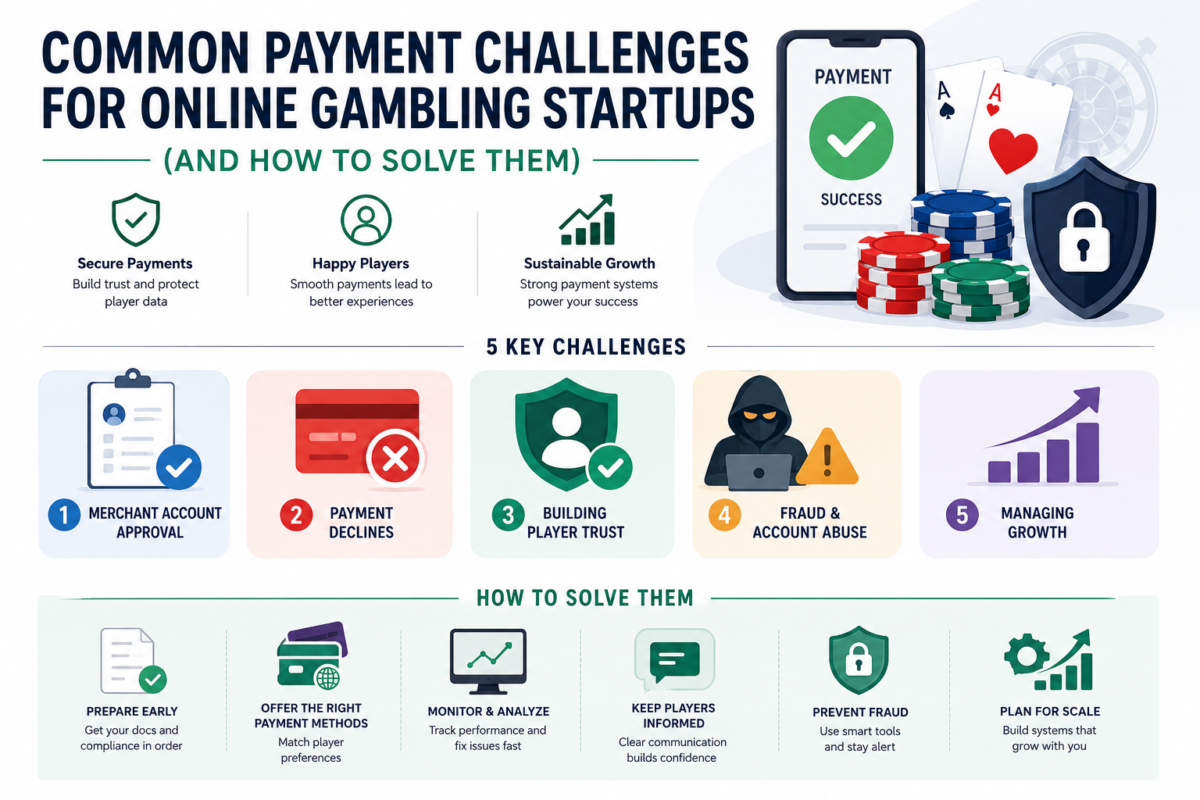
Five Payment Challenges Every Online Gambling Startup Should Prepare For
Although every business is different, several payment issues appear consistently across the iGaming industry.
1. Merchant Account Approval
Many startups assume that opening a business bank account is enough to begin accepting payments. In practice, gambling operators often require specialized payment infrastructure because of the industry’s risk profile. Applications may take longer if:
- Licensing documents are incomplete
- Business information is missing
- Compliance reviews require additional information
- Payment providers request further verification
Before applying for a merchant account, operators should understand the requirements, prepare documentation, and review applicable licensing obligations.
Early preparation can help reduce delays and create a smoother approval process.
2. Payment Declines
Failed deposits are among the most visible payment problems because players experience them immediately. Payment declines can occur for several reasons, including:
- Bank restrictions
- Fraud screening
- Customer verification issues
- Regional payment limitations
- Unsupported payment methods
- Technical transaction failures
For example, a player may attempt to deposit funds using a payment method that their bank does not permit for gambling transactions. Even if sufficient funds are available, the transaction may still be declined.
Understanding why online gambling payments get declined helps operators identify recurring issues and improve transaction success rates.
3. Building Player Trust
Players share sensitive personal and financial information when making deposits, so trust is essential. New operators may struggle to build confidence if:
- Payment pages are confusing
- Security information is unclear
- Withdrawal procedures are difficult to understand
- Verification requirements are not explained
Simple improvements can make a difference.
For example, clearly displaying accepted payment methods, explaining verification procedures, and communicating expected withdrawal times can improve player confidence.
Providing visible customer support channels and clear payment information can also help players feel more comfortable using a new platform.
4. Fraud and Account Abuse
New gambling platforms can attract fraudsters because security controls and monitoring procedures may still be developing. Common risks include:
- Stolen payment cards
- Account takeover
- Identity fraud
- Bonus abuse
- Multi-accounting
- Unauthorized payment activity
For example, a fraudster may create multiple accounts using stolen payment information to claim promotional offers before attempting withdrawals. Developing effective fraud prevention in online gambling payments can help reduce financial losses while protecting legitimate players.
Operators should also understand how customer verification, transaction monitoring, and account security contribute to fraud prevention.
5. Managing Growth
Payment systems that work during launch may become less effective as transaction volumes increase. Growth can introduce additional challenges such as:
- Increased transaction volume
- Expansion into new markets
- More payment methods
- Additional reporting requirements
- Greater compliance obligations
- More complex fraud monitoring
Planning for scalability from the beginning can help operators avoid operational disruptions later.
For example, a startup entering several countries may need to support local payment preferences rather than relying on the same payment methods in every market.
Practical Strategies to Overcome Payment Challenges
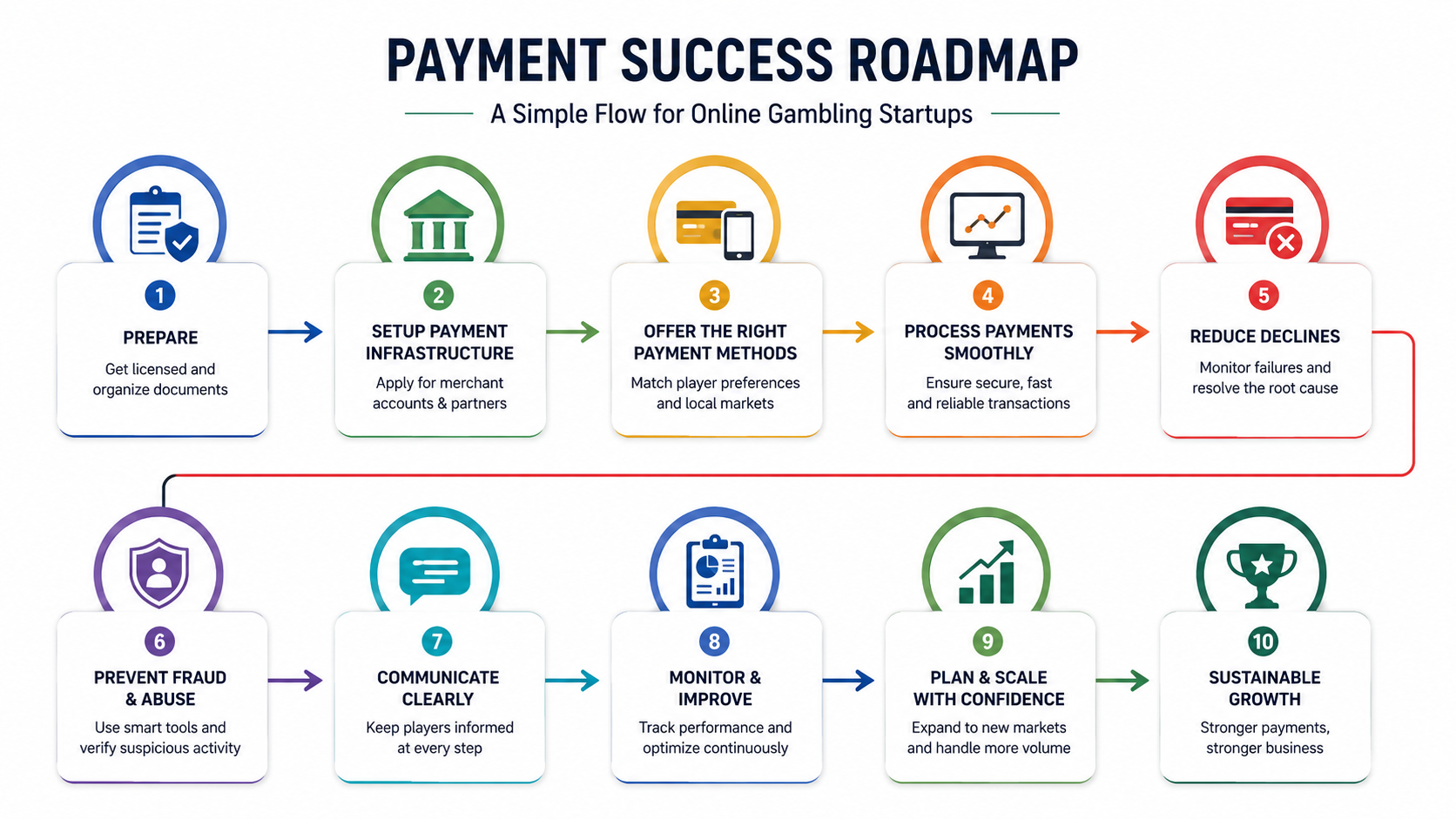
Successful operators rarely eliminate every payment issue, but they build systems that reduce problems before they affect players. Practical strategies include:
- Prepare licensing and business documentation before applying for payment services.
- Offer payment methods suitable for target markets.
- Monitor payment performance regularly.
- Investigate recurring transaction failures.
- Communicate clearly with players during deposits and withdrawals.
- Review fraud alerts and suspicious account activity.
- Build payment systems that support future growth.
For example, if customer support receives repeated questions about withdrawal delays, reviewing payment workflows may identify opportunities to improve communication or streamline verification procedures.
Small operational improvements can have a meaningful effect on player experience.
Payment Challenges Can Become Growth Opportunities
Many successful gambling operators treat payment challenges as opportunities to improve their platforms. For example:
- Frequent payment declines may indicate the need for additional payment methods.
- Fraud attempts may highlight areas where account security can improve.
- Customer questions may reveal unclear payment procedures.
- Delayed withdrawals may identify operational bottlenecks.
Instead of viewing each issue separately, operators can identify patterns and improve payment operations over time. This approach can create a better experience for players while supporting long-term business growth.
Startup Payment Readiness Checklist
Before launching, online gambling startups can review the following areas:
- Licensing documentation is complete.
- Merchant account requirements are understood.
- Payment methods match target markets.
- Deposit and withdrawal procedures are clear.
- Fraud controls are in place.
- Customer verification procedures are established.
- Payment performance is monitored.
- Player support processes are available.
- Systems can support future growth.
This checklist can help operators identify potential payment issues before they affect customers.
Final Thoughts
Payment challenges are a normal part of launching an online gambling business, but they do not have to prevent long-term success. By understanding common operational issues, preparing suitable payment infrastructure, and continuously monitoring performance, startups can reduce unnecessary disruptions and build stronger relationships with players and payment providers.
Businesses that invest in reliable payment operations early are often better positioned to grow confidently as transaction volumes, customer expectations, and regulatory requirements evolve.
The objective is not to eliminate every payment challenge. It is to identify potential problems early, create practical solutions, and build payment systems that support long-term growth.

Categories
- ACH Payments (10)
- adult payment processing (11)
- AI (9)
- Altcoins (10)
- Banking (10)
- Bitcoin (133)
- Bitcoin ETF (11)
- Bitcoin Price (30)
- Blockchain (50)
- Brokering World Hunger Away (16)
- Business (17)
- card payment processing (10)
- CBD (11)
- CBDC (11)
- Chargeback (8)
- coaching business (11)
- COVID-19 (3)
- Crypto ATMs (1)
- Crypto Banking (17)
- Crypto Bill (1)
- Crypto business owner platform (31)
- Crypto Investment (3)
- Crypto Markets (5)
- Crypto Payment (35)
- Crypto Payment Processor (4)
- Crypto Prices (1)
- Crypto Trading (92)
- Cryptocurrency (402)
- Cryptocurrency Exchange (108)
- Data Visualization (2)
- dating platforms (11)
- debt collection payment processing (10)
- Decentralized Finance (7)
- DeFi Payment (9)
- DEX (3)
- Digital Currency (23)
- dropshipping payment processing (12)
- Ethereum (2)
- FAQ (7)
- file sharing payment processing (11)
- Finance (25)
- Financial Equality (4)
- Financial Freedom (8)
- Forex (35)
- hemp (1)
- ICO (2)
- Investment (11)
- IPTV (11)
- Merchant Account (10)
- Mining (3)
- News (66)
- NFTs (2)
- online gambling (11)
- P2P (1)
- Paybito (147)
- PayBitoPro (693)
- PayBitoPro Coin Listing (6)
- PayBitoPro Exchange (2)
- Payment Gateway (48)
- peptide (10)
- Post COVID Digital Transformation (1)
- Press Release (130)
- Privacy & Security (3)
- Real Estate (1)
- Stablecoin (5)
- Technology (15)
- Travel (11)
- Uncategorized (10)
- US Presidential Election (2)
- Utility Coin (1)
- Web3 business (4)
- Web3 Wallets (2)
- White Label Crypto Exchange (8)
Recent Posts
- Payment Gateway vs. Payment Orchestration: What’s the Difference?
- What Is Smart Payment Routing? Strategies to Optimize Payment Performance
- How to Improve Payment Approval Rates for High-Risk Businesses?
- Why Are Online Payments Failing? Common Causes and How to Fix Them
- How to Use Multiple Payment Processors to Reduce Business Disruptions?