Payment Processing for Coaching Businesses: A Complete Guide to Accepting, Managing, and Scaling Coaching Payments
- August 6, 2026
- Soham Guchait
A coaching business can spend months building trust with clients, creating programs, and converting leads into customers. But when it is time to collect payment, many businesses discover that accepting money online is more complex than simply adding a checkout button. Payment processing for coaching businesses involves the systems, tools, and processes that allow coaching companies to accept payments, manage revenue collection, and deliver a smooth client payment experience.
A life coach selling one-on-one sessions, an executive coach offering premium leadership programs, or a coaching platform managing hundreds of members all have different payment requirements. The way these businesses charge customers, handle recurring revenue, manage failed transactions, and protect against disputes directly impacts growth.
Understanding how these systems work helps coaching businesses create reliable payment operations instead of treating payments as an afterthought.
How Payment Processing Works for Coaching Businesses?
When a client pays for a coaching service online, several steps happen behind the scenes before the business receives funds.
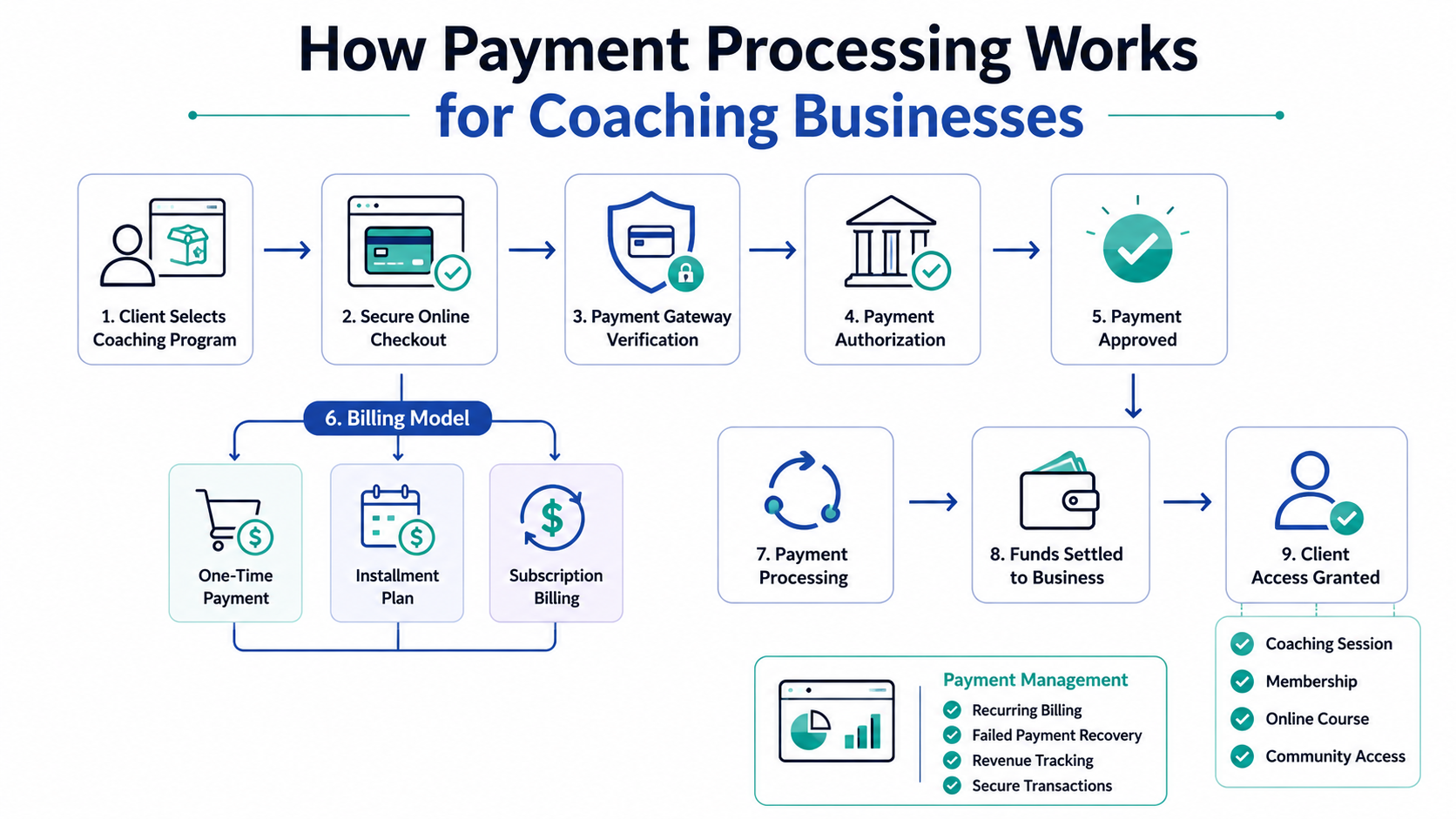
A typical payment flow involves the customer selecting a coaching package, entering payment details, and completing checkout. The transaction information is then securely transferred for authorization, where the payment method provider verifies whether the transaction can be approved. If approved, the payment is processed and the funds are eventually settled into the business account.
For coaching businesses, this process becomes more important because coaching is often based on digital delivery, recurring relationships, and higher-value purchases.
For example, consider an executive coach offering a six-month leadership coaching program costing $5,000. The business may allow the client to pay the full amount upfront, divide the cost into monthly payments, or subscribe to an ongoing coaching membership.
Each option creates different payment requirements.
A simple transaction model may work for occasional sessions, but growing coaching businesses often need more structured systems for subscriptions, payment plans, invoices, and client management.
How Coaching Businesses Accept Payments Online?
Coaching businesses use different payment models depending on their services, customers, and revenue goals.
A personal development coach offering individual consultations may only need a simple payment collection process. However, a coaching company selling multiple programs may require a more advanced setup. Common payment models include:
- One-time payments for individual coaching sessions or fixed-duration programs
- Payment plans that allow clients to split high-value coaching packages into installments
- Recurring payments for memberships, communities, and ongoing coaching access
For example, a fitness coaching business may sell a 12-week transformation program with a monthly payment option. Instead of manually contacting clients every month, automated recurring billing allows payments to be collected according to the agreed schedule.
Similarly, an online business coaching platform may combine courses, group coaching sessions, and community access into a subscription model where customers pay monthly for continued access.
The payment system needs to support the way the coaching business actually sells its services.
A mismatch between the business model and payment setup can create unnecessary friction. Clients may abandon purchases if checkout is complicated, while businesses may struggle with manual payment tracking, missed invoices, or failed renewals.
Payment Systems Used by Different Coaching Business Models
Different types of coaching businesses face different payment challenges.
A one-on-one coach usually focuses on simple payment collection, client agreements, and scheduling.
A group coaching business may need to manage multiple participants paying for the same program while maintaining accurate records.
A coaching marketplace or platform has additional complexity because it may need to manage payments between clients, coaches, and the platform itself.
For example, a coaching marketplace connecting career coaches with professionals may need a system that allows clients to pay through the platform while tracking individual coach earnings and platform fees.
As coaching businesses grow, payment operations often become connected with other parts of the business, including:
- Client onboarding systems
- Scheduling platforms
- Membership platforms
- Customer relationship management tools
- Accounting systems
This creates a more organized customer journey where payment is part of the overall experience rather than a separate activity.
The Role of Payment Gateways in Coaching Payments
A payment gateway acts as the technology layer that allows customers to submit payment information securely online. For coaching businesses, the payment gateway is often the part customers interact with directly during checkout.
A good payment experience should make it easy for clients to:
- Select a coaching package
- Understand pricing clearly
- Complete payment securely
- Receive confirmation
- Begin onboarding without delays
For example, a career coach selling a resume-building program combined with weekly coaching sessions may create a checkout flow where clients choose the package, complete payment, and immediately receive instructions for scheduling their first session.
A poor payment experience can create hesitation, especially for high-value coaching programs where customers are already making a significant financial decision.
Managing Recurring Payments and Coaching Subscriptions
Recurring revenue has become increasingly common in the coaching industry.
Many businesses now offer:
- Monthly coaching memberships
- Accountability communities
- Ongoing mentorship programs
- Subscription-based wellness coaching
However, recurring payments require more management than one-time transactions.
A subscription payment may fail because of:
- Expired cards
- Incorrect payment details
- Bank restrictions
- Security checks
- Customer account changes
Without proper payment management, businesses can lose revenue even when customers still want the service.
For example, a relationship coaching platform with a monthly membership may notice that several customers stop receiving access because their renewal payments fail. A reliable payment process should help identify these issues and provide ways to recover unsuccessful transactions.
Businesses that rely on recurring revenue should understand how subscription payments work and how failed renewals affect customer retention.
Common Payment Challenges Coaching Businesses Face
As coaching businesses expand, payment-related challenges often become operational challenges.
Some common issues include:
- Payment failures that prevent customers from completing purchases
- Refund disputes caused by unclear service expectations
- Chargebacks from customers who misunderstand recurring billing
- Difficulty accepting payments from international clients
- Limited payment options for different customer preferences
A high-ticket coaching business may experience a different challenge compared with a low-cost membership community.
For example, a leadership coach selling premium packages may need stronger payment verification and documentation processes because each transaction represents significant revenue.
Meanwhile, a meditation coaching platform with hundreds of monthly subscribers may focus more on recurring payment reliability and subscription management. Understanding these differences allows businesses to build payment processes suited to their operating model.
Scaling Payment Operations for Growing Coaching Companies
As coaching businesses grow, payment processing becomes part of the overall business infrastructure. A small coaching practice may manage payments manually in the beginning. However, as customer volume increases, manual processes create more opportunities for errors.
Growing businesses often need systems that support:
- Multiple payment options
- Automated billing
- International customers
- Revenue tracking
- Better transaction visibility
- Secure payment management
For coaching platforms, this becomes even more important. Businesses managing multiple coaches, programs, or communities require payment systems that can handle greater complexity while maintaining a smooth customer experience.
The goal is not simply to collect payments. It is to create a reliable financial process that supports long-term growth.
Final Thoughts
Payment processing for coaching businesses is not only about accepting transactions. It affects how customers purchase programs, how businesses collect revenue, and how easily coaching companies can scale.
Whether a business offers individual coaching sessions, premium programs, memberships, or a multi-coach platform, the payment system should match the way the business operates.
Understanding payment gateways, recurring billing, payment failures, disputes, and scaling requirements allows coaching businesses to build stronger payment operations and create better experiences for their clients.

Categories
- ACH Payments (10)
- adult payment processing (11)
- AI (9)
- Altcoins (10)
- Banking (10)
- Bitcoin (133)
- Bitcoin ETF (11)
- Bitcoin Price (30)
- Blockchain (50)
- Brokering World Hunger Away (16)
- Business (17)
- card payment processing (10)
- CBD (11)
- CBDC (11)
- coaching business (11)
- COVID-19 (3)
- Crypto ATMs (1)
- Crypto Banking (17)
- Crypto Bill (1)
- Crypto business owner platform (31)
- Crypto Investment (3)
- Crypto Markets (5)
- Crypto Payment (35)
- Crypto Payment Processor (4)
- Crypto Prices (1)
- Crypto Trading (92)
- Cryptocurrency (402)
- Cryptocurrency Exchange (108)
- Data Visualization (2)
- dating platforms (11)
- debt collection payment processing (10)
- Decentralized Finance (7)
- DeFi Payment (9)
- DEX (3)
- Digital Currency (23)
- dropshipping payment processing (12)
- Ethereum (2)
- FAQ (7)
- file sharing payment processing (11)
- Finance (25)
- Financial Equality (4)
- Financial Freedom (8)
- Forex (35)
- hemp (1)
- ICO (2)
- Investment (11)
- IPTV (11)
- Merchant Account (10)
- Mining (3)
- News (66)
- NFTs (2)
- online gambling (11)
- P2P (1)
- Paybito (139)
- PayBitoPro (693)
- PayBitoPro Coin Listing (6)
- PayBitoPro Exchange (2)
- Payment Gateway (40)
- peptide (10)
- Post COVID Digital Transformation (1)
- Press Release (130)
- Privacy & Security (3)
- Real Estate (1)
- Stablecoin (5)
- Technology (15)
- Travel (11)
- Uncategorized (9)
- US Presidential Election (2)
- Utility Coin (1)
- Web3 business (4)
- Web3 Wallets (2)
- White Label Crypto Exchange (8)
Recent Posts
- ACH vs Wire Transfer: Which Payment Method Is Better for Businesses?
- ACH Fraud Prevention: How Businesses Can Secure Bank Account Payments?
- ACH Credit vs ACH Debit: What’s the Difference? With Real Examples
- ACH vs Credit Card: Which Payment Method Is Better for Businesses?
- How Long Do ACH Payments Take? Processing Times, Settlement, and Same Day ACH