How Long Does Card Payment Processing Take? Authorization, Settlement and Funding Times
- August 18, 2026
- Soham Guchait
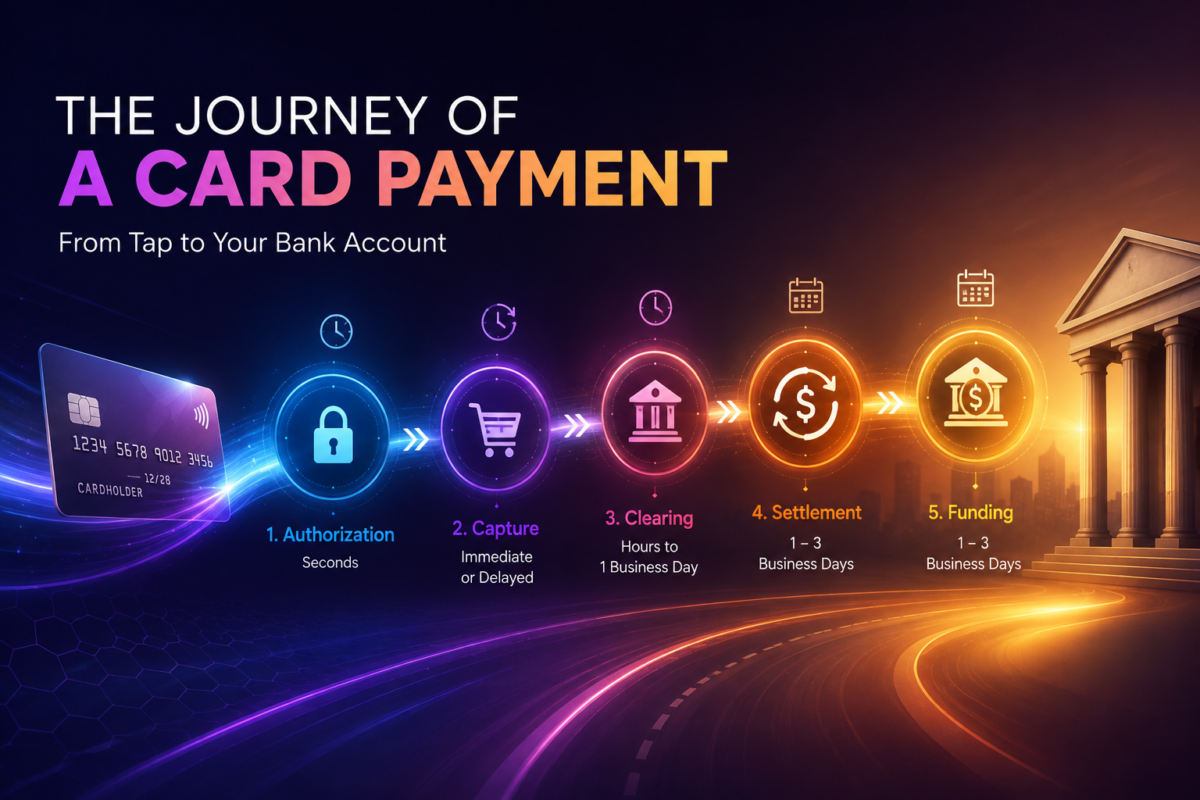
A card payment can appear to happen almost instantly. A customer taps a card, enters their details, or completes an online checkout, and the screen quickly displays “Approved”.
For a business, however, that approval is only one stage of the payment journey.
A card transaction may pass through authorization, capture, clearing, settlement and funding before the merchant actually receives the money in its bank account. These stages do not necessarily happen at the same time, which is why an approved payment can sometimes remain pending or take days to appear as available funds.
So, how long does card payment processing take?
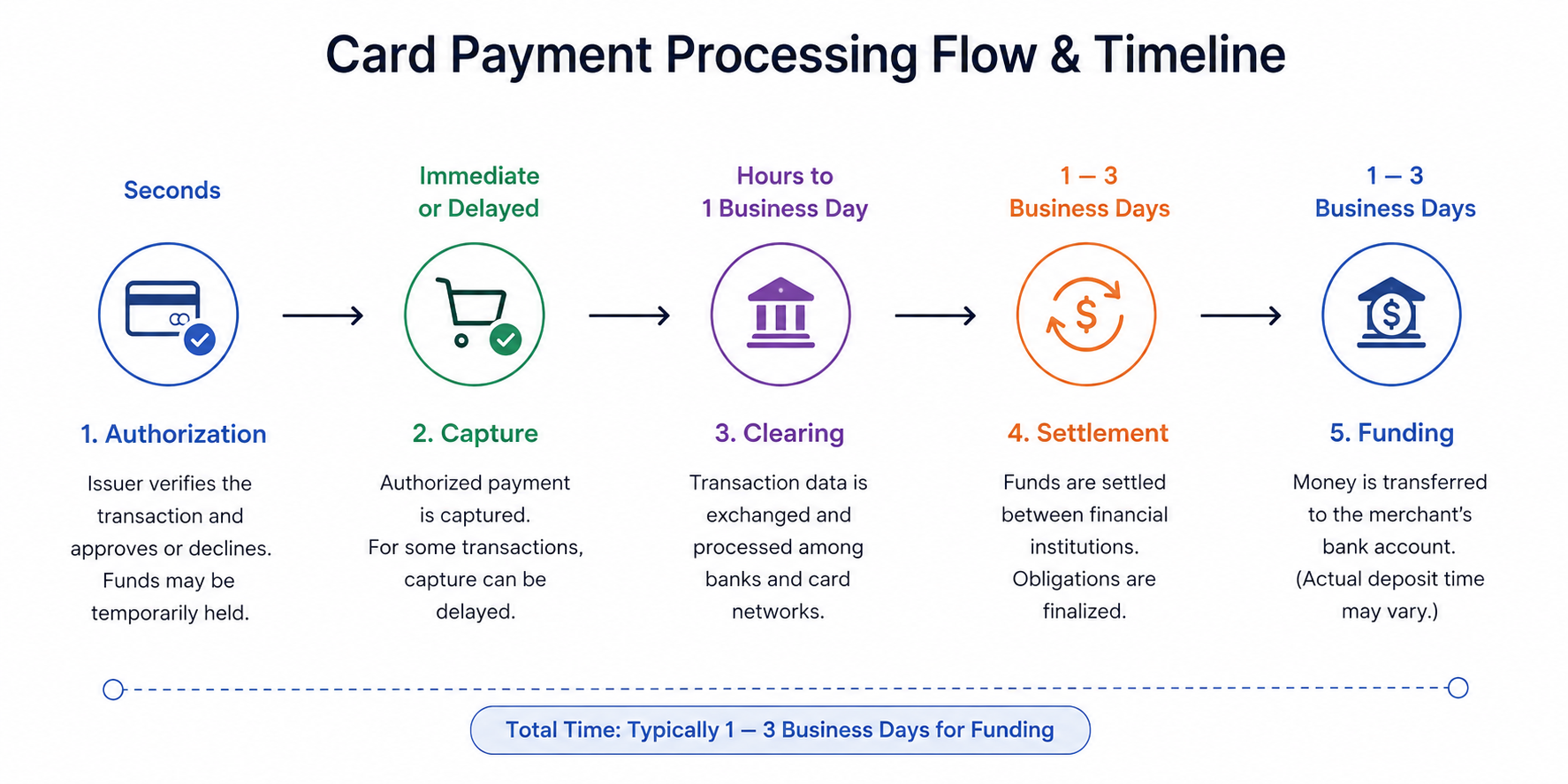
For many businesses, authorization takes only a few seconds, while merchant funding commonly takes around one to three business days. The actual timeframe depends on factors such as the payment provider, transaction type, processing cutoff, banking schedules, risk controls and the merchant’s funding arrangement.
How Long Does Each Stage of Card Payment Processing Take?
The easiest way to understand payment timing is to separate the transaction into its individual stages.
Authorization: Usually Seconds
Authorization is the stage customers notice most. When a payment is initiated, transaction information is sent through the card payment network to the cardholder’s issuing bank.
The issuer evaluates the transaction and may check factors such as available funds or credit, card validity, transaction information and potential fraud indicators. It then returns an approval or decline response. This normally happens within seconds.
However, authorization does not mean the merchant has received the money. An approval simply means the transaction has been authorized to proceed. Depending on the transaction, the issuer may also place a temporary hold on the customer’s available funds or credit.
For example, a customer purchasing a $200 laptop may see “Payment successful” almost immediately. The merchant can see the transaction as authorized, but the $200 has not necessarily reached its bank account. Understanding card payment authorization is therefore important when an approved transaction has not yet become a completed or funded payment.
Capture: Immediate or Delayed
After authorization, the transaction generally needs to be captured before it can proceed toward settlement. For an ordinary retail transaction, capture may happen automatically. However, some businesses use delayed capture when the final amount or fulfillment status is not immediately known.
Imagine an online retailer authorizes a $500 order on Monday but does not ship the goods until Wednesday. Depending on its payment setup, the retailer may capture the payment when the order is ready for shipment. An authorized transaction that has not been captured is therefore not necessarily on its way to the merchant’s bank account yet.
Clearing: Behind-the-Scenes Processing
After captured transactions are submitted, clearing takes place. During this stage, transaction information is exchanged and processed among the relevant financial institutions and card networks.
Clearing is largely invisible to customers and merchants, but it is essential for determining the amounts owed between the parties involved in the transaction. The timing can depend on when transactions are submitted and the operating schedules of the institutions involved.
Settlement: Usually One to Three Business Days
Settlement is the stage in which the financial obligations associated with transactions are processed between the relevant institutions. This is why card payment settlement should not be confused with authorization.
A transaction can be authorized in seconds but take considerably longer to settle. For many businesses, settlement and subsequent funding occur within roughly one to three business days, although the exact timeframe varies by provider and arrangement.
Funding: When the Merchant Receives the Money
Funding is the point businesses ultimately care about: When the proceeds become available in the merchant’s designated bank account.
Settlement and funding are closely related, but they are not necessarily the same event. A transaction can complete its settlement process while the merchant’s actual bank deposit remains subject to the provider’s funding schedule and banking timelines. This distinction becomes particularly important when businesses reconcile sales against deposits.
Why Can Card Payment Processing Take Longer?
A one-to-three-business-day timeframe is a general expectation rather than a universal rule. Several factors can affect when funds become available.
- Processing cutoffs are one of the most common causes. If a merchant submits transactions after its provider’s daily cutoff, those transactions may enter the next processing cycle.
- Weekends and bank holidays can also affect funding. A transaction processed late on Friday may therefore reach the merchant later than one processed earlier in the week.
- Transaction type can influence processing as well. Card-present and card-not-present payments can have different risk characteristics, while some online transactions may undergo additional fraud screening.
- Risk reviews can create additional delays when a transaction or merchant account requires further verification.
Finally, the merchant’s funding arrangement matters. Some providers offer same-day or next-business-day funding, while standard arrangements may take longer.
Scenario 1: A Friday Night Online Purchase
Consider an online retailer that receives a $3,000 card payment at 8:00 p.m. on Friday. The customer sees an approval almost immediately, but the merchant may not see the money in its bank account until a later business day. The sequence could look like this:
- Friday, 8:00 p.m. — Authorization: The issuer approves the transaction.
- Friday night — Capture: The retailer captures the payment.
- Next processing cycle — Clearing and settlement: The transaction enters the appropriate processing cycle.
- Following business day(s) — Funding: The merchant receives the applicable proceeds according to its funding schedule.
The customer can therefore see a successful payment long before the merchant sees the corresponding deposit.
Scenario 2: An Authorized Order That Ships Later
Now consider a business selling customized furniture. A customer places a $2,000 order on Monday, but the business will not manufacture the item until later in the week. The merchant authorizes the payment when the order is placed but uses delayed capture. The timeline might look like this:
- Monday — Authorization: The customer’s bank approves the transaction.
- Monday to Thursday — Authorization remains separate from funding: The merchant has approval but has not necessarily captured the transaction.
- Thursday — Capture: The business captures the payment after production begins.
- Following processing cycle — Clearing and settlement: The transaction proceeds through the post-authorization stages.
- Later business day — Funding: The merchant receives the funds according to its funding schedule.
This illustrates why the time between authorization and merchant funding can vary substantially depending on how the business handles capture.
Approved, Settled and Funded: What Is the Difference?
These terms describe different points in the payment lifecycle.
- An approved payment has passed authorization and can proceed.
- A settled payment has completed the relevant post-authorization processes required for settlement between the financial institutions.
- A funded payment is one where the merchant has received the applicable proceeds in its bank account.
For example, a customer may place an order Monday morning and receive an approval within seconds. The transaction could then be captured, included in a processing batch, settled later and finally appear as a merchant deposit according to the funding schedule. Therefore, “the customer paid” and “the merchant has the money” can refer to two different moments.
Scenario 3: Why a Merchant Deposit May Be Smaller Than the Sale?
Timing is not the only reason the amount appearing in a merchant’s bank account may differ from the original transaction.
Suppose a customer makes a $1,000 purchase. After the transaction progresses through processing, the merchant’s eventual deposit may be lower because applicable processing fees, refunds or other adjustments can affect the final amount. A simplified example could be:
- Customer purchase: $1,000
- Transaction processing: Payment is authorized, captured and settled.
- Applicable fees/adjustments: Deducted according to the merchant’s agreement.
- Merchant funding: Net proceeds are deposited.
This is why businesses should compare transaction reports with actual bank deposits rather than expecting every deposit to exactly match the day’s gross card sales. Understanding card payment processing fees can also help explain differences between transaction value and funded amounts.
How Businesses Can Reduce Payment Delays?
Businesses cannot control every part of the card network or banking system, but they can reduce avoidable delays by understanding their processing setup. Three practical areas deserve particular attention:
- Know the processing cutoff: Find out when transactions are submitted and whether late transactions move to the next cycle.
- Monitor transaction status: If an approved payment has not been funded, check whether it has been captured and included in settlement.
- Reconcile transactions with deposits: Compare gross sales, settled transactions, refunds, fees and adjustments against actual bank deposits.
This can help determine whether a delay is occurring at authorization, capture, settlement or funding rather than at checkout. Businesses should also understand how transaction environments affect processing and risk. For example, the operational characteristics of card-present and card-not-present transactions can differ, particularly when fraud controls and authentication are involved.
Frequently Asked Questions
- How long does card payment processing take?Authorization usually takes seconds, while merchant funding commonly takes around one to three business days. The exact timeframe depends on the provider, transaction, cutoff time, banking schedule and funding
arrangement. - Why is my card payment approved but still pending?Approval means the issuing bank has authorized the transaction. The payment may still need to be captured, cleared and settled before it becomes fully completed.
- Does card payment settlement happen immediately?Usually not. Authorization can happen almost instantly, while settlement generally takes longer.
- Do weekends affect card payment processing?They can. Depending on the provider and banking schedule, transactions processed around weekends or holidays may reach the merchant’s account on a later business day.
- Is settlement the same as funding?No. Settlement refers to the financial process between the relevant institutions, while funding refers to the merchant receiving the resulting proceeds in its bank account.
Final Takeaway
How long does card payment processing take? It depends on which stage of the process you mean. Authorization may take seconds. Capture can occur immediately or later. Clearing and settlement take additional time, and merchant funding follows the provider’s funding schedule.
The most important distinction for businesses is simple: An approved card payment is not necessarily a funded payment. Once a business understands the difference between authorization, capture, clearing, settlement and funding, payment timing becomes easier to predict, reconcile and troubleshoot.

Categories
- ACH Payments (10)
- adult payment processing (11)
- AI (9)
- Altcoins (10)
- Banking (10)
- Bitcoin (133)
- Bitcoin ETF (11)
- Bitcoin Price (30)
- Blockchain (50)
- Brokering World Hunger Away (16)
- Business (17)
- card payment processing (10)
- CBD (11)
- CBDC (11)
- Chargeback (8)
- coaching business (11)
- COVID-19 (3)
- Crypto ATMs (1)
- Crypto Banking (17)
- Crypto Bill (1)
- Crypto business owner platform (31)
- Crypto Investment (3)
- Crypto Markets (5)
- Crypto Payment (35)
- Crypto Payment Processor (4)
- Crypto Prices (1)
- Crypto Trading (92)
- Cryptocurrency (402)
- Cryptocurrency Exchange (108)
- Data Visualization (2)
- dating platforms (11)
- debt collection payment processing (10)
- Decentralized Finance (7)
- DeFi Payment (9)
- DEX (3)
- Digital Currency (23)
- dropshipping payment processing (12)
- Ethereum (2)
- FAQ (7)
- file sharing payment processing (11)
- Finance (25)
- Financial Equality (4)
- Financial Freedom (8)
- Forex (35)
- hemp (1)
- ICO (2)
- Investment (11)
- IPTV (11)
- Merchant Account (10)
- Mining (3)
- News (66)
- NFTs (2)
- online gambling (11)
- P2P (1)
- Paybito (147)
- PayBitoPro (693)
- PayBitoPro Coin Listing (6)
- PayBitoPro Exchange (2)
- Payment Gateway (48)
- peptide (10)
- Post COVID Digital Transformation (1)
- Press Release (130)
- Privacy & Security (3)
- Real Estate (1)
- Stablecoin (5)
- Technology (15)
- Travel (11)
- Uncategorized (10)
- US Presidential Election (2)
- Utility Coin (1)
- Web3 business (4)
- Web3 Wallets (2)
- White Label Crypto Exchange (8)
Recent Posts
- Payment Gateway vs. Payment Orchestration: What’s the Difference?
- What Is Smart Payment Routing? Strategies to Optimize Payment Performance
- How to Improve Payment Approval Rates for High-Risk Businesses?
- Why Are Online Payments Failing? Common Causes and How to Fix Them
- How to Use Multiple Payment Processors to Reduce Business Disruptions?