Card Payment Capture, Clearing and Settlement Explained
- August 18, 2026
- Soham Guchait
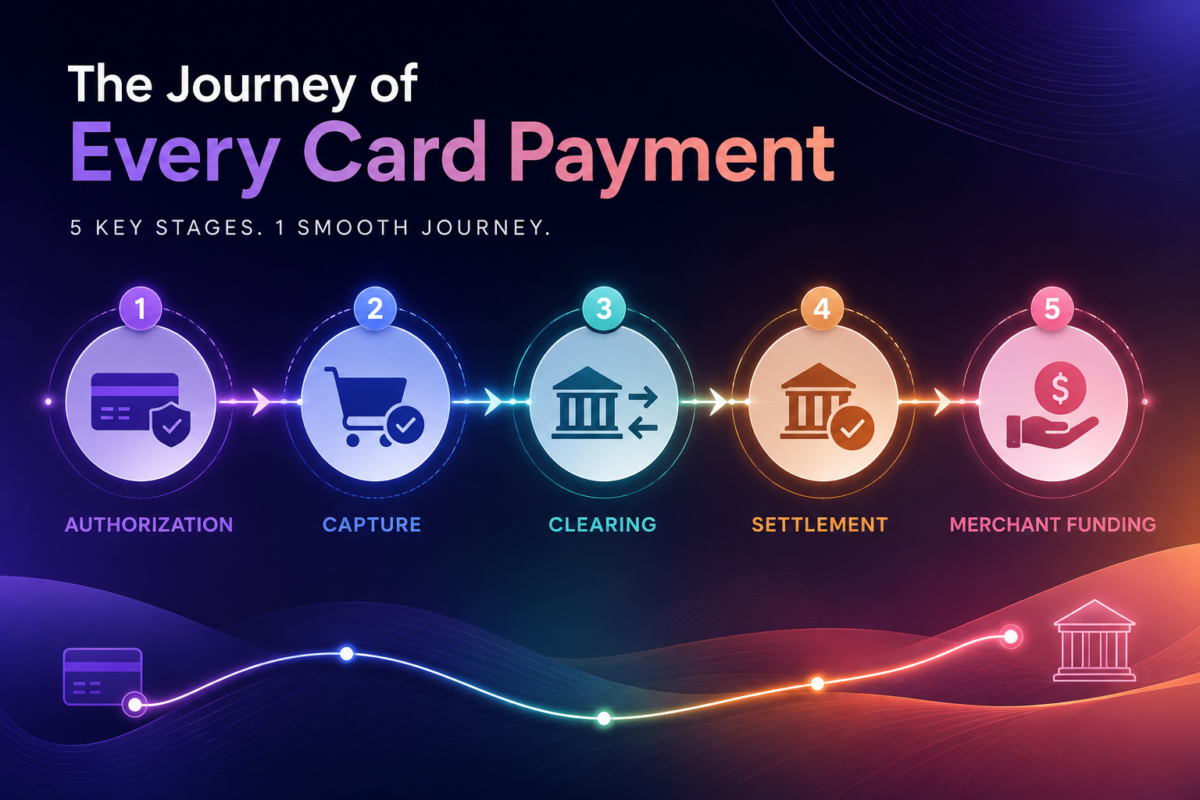
When a customer sees “Payment Successful” at checkout, it is easy to assume the money has already reached the business. In reality, an approved card transaction still has several stages to complete before the merchant receives the funds.
After authorization, the transaction moves through Capture, Clearing, and Settlement. Understanding how card payment processing works means looking at each stage of the card payment lifecycle and how they work together before the merchant receives the funds. Each stage has a different role in the card payment lifecycle, and understanding those differences helps explain why a payment can be approved immediately but take longer to appear as available business funds. A simple way to view the process is:
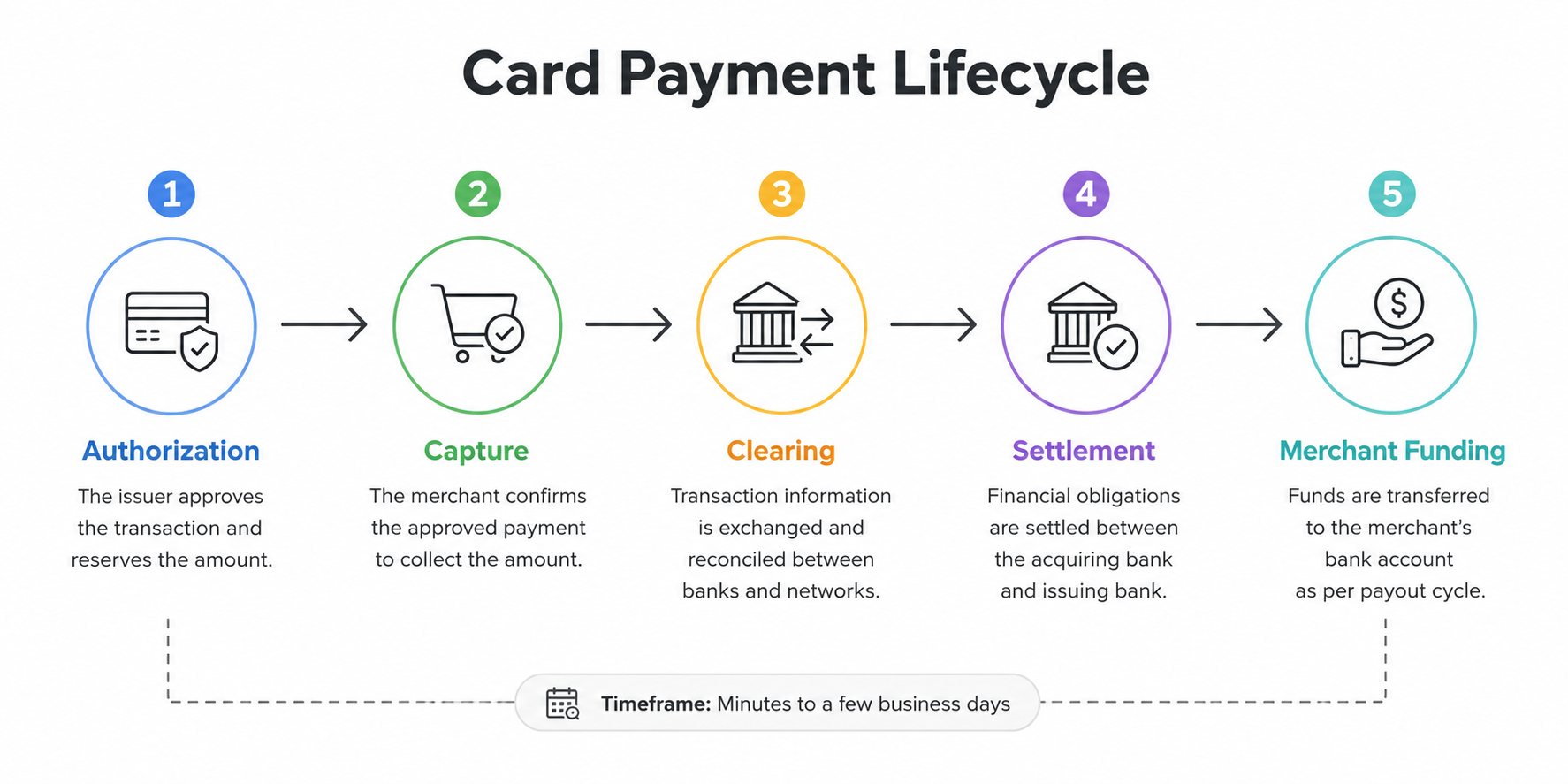
Authorization → Capture → Clearing → Settlement → Merchant Funding
Authorization determines whether the transaction can proceed. The stages that follow deal with completing the transaction and moving the associated funds through the payment system.
What Happens After Card Payment Authorization?
Authorization is the issuer’s decision on whether a particular transaction can be approved. Once approved, however, the transaction is not necessarily complete.
Consider a customer buying a $250 pair of shoes online. The customer’s bank approves the $250 transaction, and the merchant receives the approval response. The customer may now see the payment as successful or pending. At this point, the merchant has an authorized transaction – not necessarily $250 sitting in its bank account.
The merchant must then complete the appropriate processing steps. Depending on the business model and payment setup, the transaction may be captured immediately or at a later point. Once captured, it enters the post-transaction processing stages that lead toward settlement. This distinction matters because approval, settlement, and funding are separate events. A business that treats them as one event can easily misunderstand its transaction records or cash flow.
What Is Card Payment Capture?
Card payment capture is the process of confirming that an authorized transaction should be collected.
When a card payment is authorized, the issuer has effectively agreed to the transaction under the conditions of that authorization. Capture is the merchant’s instruction to proceed with collecting the approved amount.
In many ecommerce transactions, authorization and capture happen almost one after another, so customers rarely notice the difference. But businesses do not always capture payments immediately.
For example, imagine an online furniture store receives an order for a $1,500 sofa. The business may authorize the customer’s card when the order is placed but wait to capture the payment until the item is ready to ship. If the order is canceled before capture, the merchant may never complete the collection. Depending on the circumstances, the authorization can eventually be released or expire rather than becoming a settled transaction. This is one reason an authorization should not be interpreted as a guarantee that the merchant will ultimately receive the money.
Authorization vs. Capture
The distinction can be summarized simply:
- Authorization: The issuer approves or declines the transaction.
- Capture: The merchant confirms that the approved transaction should be collected.
- Settlement: The financial obligations created by the transaction are settled.
Keeping these stages separate becomes especially important when investigating transactions that show as approved but have not yet reached the merchant’s account.
What Is Card Payment Clearing?
After a transaction has been captured, it moves into clearing.
Clearing is the stage in which transaction information is exchanged and reconciled among the participants involved in the card payment. It helps establish the financial obligations resulting from completed transactions before settlement occurs.
To understand this, consider a purchase made with a card issued by Bank A at a merchant whose acquiring institution is Bank B. During authorization, Bank A decides whether the transaction can proceed.
After the transaction is captured, the relevant transaction information is processed through the card payment network. During clearing, the parties exchange and reconcile the information needed to determine what is owed between them.
Clearing is therefore less about asking “Can this customer make the purchase?” and more about processing the completed transaction and establishing the obligations that need to be settled. This is one of the reasons card payments involve more infrastructure than a simple transfer between two bank accounts.
What Is Card Payment Settlement?
Settlement is the stage in which the financial obligations created by processed card transactions are settled between the relevant participants.
Once transactions have gone through the necessary processing and clearing activities, settlement allows the corresponding financial positions between the acquiring and issuing sides to be resolved.
For merchants, this is the stage most closely associated with getting paid. However, settlement should not automatically be confused with the exact moment funds become available in the merchant’s bank account.
The merchant’s actual funding time can depend on its payment arrangement, acquiring relationship, processing schedule, transaction type, weekends, holidays, and other operational factors.
For example, a merchant could process a card transaction on Monday, have it successfully captured and settled, and still receive the funds according to a later funding schedule. So when a business asks, “When will I actually have access to this money?”, settlement is only part of the answer.
Capture, Clearing and Settlement: What’s the Difference?
The easiest way to understand the three stages is to look at what each one accomplishes.
- Capture completes the merchant’s instruction to collect an authorized transaction.
- Clearing processes and reconciles the transaction information needed to establish the financial obligations between the participants.
- Settlement resolves those financial obligations and moves the transaction toward the merchant funding process.
They are connected, but they are not interchangeable. A customer might therefore experience the following sequence without realizing it:
Payment approved → Transaction captured → Transaction cleared → Transaction settled → Funds made available to merchant
The entire process can happen quickly, but the individual stages still serve different purposes.
A Practical Example of the Full Process
Suppose an online electronics store sells a laptop for $1,200. The customer enters their card details and submits the order. First, the transaction is authorized. The issuing bank evaluates the request and approves the $1,200 purchase.
Next, the merchant captures the transaction. This tells the payment system that the merchant intends to collect the authorized amount. The transaction then moves through clearing. Relevant transaction information is exchanged and reconciled so the financial obligations associated with the purchase can be determined. Settlement follows. The applicable financial obligations between the participants are settled, and the transaction moves toward the merchant’s funding process.
The merchant may then see the $1,200 included in an upcoming payout rather than immediately appearing as usable cash in its bank account. From the customer’s perspective, this may all look like one payment. From the payment system’s perspective, it is a sequence of distinct events.
Can the Captured Amount Be Different From the Authorized Amount?
In some transaction environments, the final amount can differ from the initial authorization. This is more common where the final value of a transaction is not known at the moment the payment is initially authorized.
For example, a restaurant transaction may begin with an authorization and later be completed for the final bill amount. Hotels and car rental businesses can also use authorization processes where the final charge depends on what the customer ultimately owes.
The exact rules for changing an authorized amount depend on the transaction type, card network requirements, merchant configuration, and payment infrastructure. For a standard ecommerce purchase where the customer buys a fixed-price product, the authorized and captured amounts will often be identical.
Why Clearing and Settlement Matter to Businesses?
The difference between these stages becomes particularly important when a business manages its cash flow.
Suppose an online retailer records $30,000 in card sales on a particular day. That figure does not necessarily mean the retailer has $30,000 immediately available to spend.
Some transactions may still be awaiting capture. Others may be going through clearing or settlement. Even after settlement, the merchant’s funding schedule determines when the funds become available in its bank account. This is why businesses need to distinguish between sales volume, approved transactions, settled transactions, and available funds.
A company that understands these differences can make better decisions about inventory purchases, supplier payments, refunds, and operating expenses. The cost side of card acceptance also becomes easier to understand once the transaction lifecycle is clear, because processing fees can be associated with different parts of the payment ecosystem.
What Happens If a Payment Is Captured but Not Yet Funded?
A captured transaction has moved beyond authorization, but the merchant may still need to wait for the later processing and funding stages.
For example, a customer might place an order on Friday evening. The merchant captures the payment shortly afterward, but the merchant’s funds may not become available until a later processing or funding cycle. This does not necessarily indicate a failed payment.
It simply reflects the fact that transaction completion and merchant funding do not always happen at exactly the same time. For businesses that rely heavily on card revenue, understanding this timing can make a significant difference when forecasting available cash.
Capture, Clearing and Settlement in Card Payment Processing
The post-authorization lifecycle becomes much clearer when each stage is given its own role.
- Authorization determines whether a transaction can proceed.
- Capture confirms that the merchant wants to collect the authorized transaction.
- Clearing processes and reconciles the transaction information between the relevant participants.
- Settlement resolves the resulting financial obligations.
- Merchant funding makes the applicable funds available to the business according to its funding arrangement.
So, an approved card payment is not necessarily a settled payment, and a settled payment is not necessarily the same moment as merchant funding.
That distinction is one of the most important things for a business to understand when managing card transactions. Once the difference between these stages is clear, it becomes much easier to understand payment timing, investigate transaction discrepancies, and accurately track when card revenue actually becomes available.

Categories
- ACH Payments (10)
- adult payment processing (11)
- AI (9)
- Altcoins (10)
- Banking (10)
- Bitcoin (133)
- Bitcoin ETF (11)
- Bitcoin Price (30)
- Blockchain (50)
- Brokering World Hunger Away (16)
- Business (17)
- card payment processing (10)
- CBD (11)
- CBDC (11)
- Chargeback (8)
- coaching business (11)
- COVID-19 (3)
- Crypto ATMs (1)
- Crypto Banking (17)
- Crypto Bill (1)
- Crypto business owner platform (31)
- Crypto Investment (3)
- Crypto Markets (5)
- Crypto Payment (35)
- Crypto Payment Processor (4)
- Crypto Prices (1)
- Crypto Trading (92)
- Cryptocurrency (402)
- Cryptocurrency Exchange (108)
- Data Visualization (2)
- dating platforms (11)
- debt collection payment processing (10)
- Decentralized Finance (7)
- DeFi Payment (9)
- DEX (3)
- Digital Currency (23)
- dropshipping payment processing (12)
- Ethereum (2)
- FAQ (7)
- file sharing payment processing (11)
- Finance (25)
- Financial Equality (4)
- Financial Freedom (8)
- Forex (35)
- hemp (1)
- ICO (2)
- Investment (11)
- IPTV (11)
- Merchant Account (10)
- Mining (3)
- News (66)
- NFTs (2)
- online gambling (11)
- P2P (1)
- Paybito (147)
- PayBitoPro (693)
- PayBitoPro Coin Listing (6)
- PayBitoPro Exchange (2)
- Payment Gateway (48)
- peptide (10)
- Post COVID Digital Transformation (1)
- Press Release (130)
- Privacy & Security (3)
- Real Estate (1)
- Stablecoin (5)
- Technology (15)
- Travel (11)
- Uncategorized (10)
- US Presidential Election (2)
- Utility Coin (1)
- Web3 business (4)
- Web3 Wallets (2)
- White Label Crypto Exchange (8)
Recent Posts
- Payment Gateway vs. Payment Orchestration: What’s the Difference?
- What Is Smart Payment Routing? Strategies to Optimize Payment Performance
- How to Improve Payment Approval Rates for High-Risk Businesses?
- Why Are Online Payments Failing? Common Causes and How to Fix Them
- How to Use Multiple Payment Processors to Reduce Business Disruptions?