Payment Gateway vs Payment Processor: What’s the Difference?
- August 17, 2026
- Soham Guchait
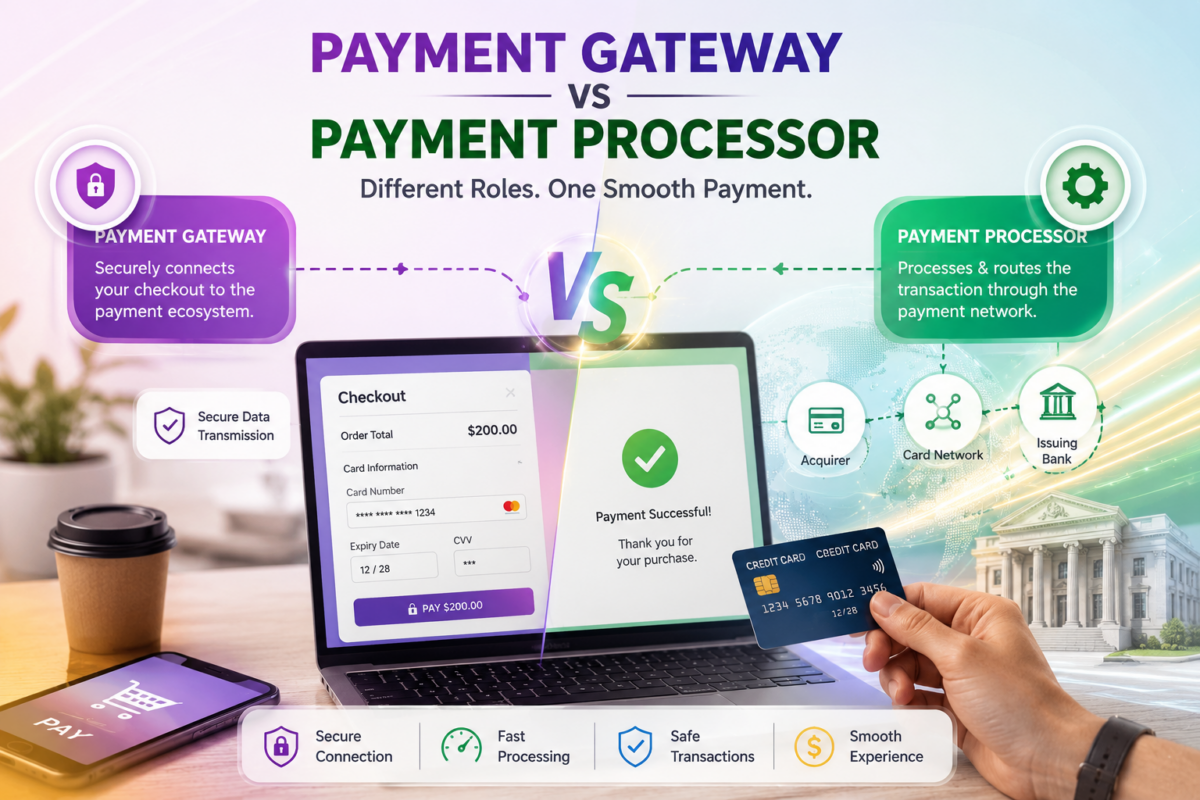
When a customer pays $200 for an order online, the checkout may make the transaction look like a single action: Enter Card Details, Click Pay, and Receive Confirmation. Behind that button, however, different systems perform different jobs. Two terms that frequently cause confusion are payment gateway and payment processor.
They are closely connected, and a business may use both, but they are not necessarily the same thing. The easiest way to understand the difference is to follow the payment request and identify what each component does along the way.
What Is a Payment Gateway?
A payment gateway is a technology layer that connects a merchant’s checkout or application with the systems involved in processing a payment.
When a customer enters payment information and submits an order, the gateway facilitates the secure transmission of the transaction into the payment-processing flow. It also helps return the resulting transaction response to the merchant’s website or application.
Think of the gateway as the connection between the merchant’s payment experience and the downstream payment infrastructure.
For example, imagine an online clothing store selling a $200 jacket.
The customer enters their card details and clicks Pay. The merchant’s checkout needs to send that payment request into the payment ecosystem. The gateway facilitates that communication. But the gateway does not necessarily decide whether the customer’s bank will approve the transaction. That responsibility belongs to other participants in the payment system.
What Is a Payment Processor?
A payment processor is responsible for processing and facilitating communication for payment transactions between the relevant parties in the payment ecosystem.
For a typical card transaction, the processor can facilitate communication between the merchant or acquiring side and the card network and issuing institution. The processor is therefore involved deeper in the transaction-processing infrastructure than the customer-facing checkout itself.
Using the same $200 purchase, the processor helps move the authorization request through the relevant payment infrastructure so that the issuing bank can evaluate it and return a response. The processor may also be involved in subsequent transaction processing activities, depending on the payment arrangement.
The important point is that a payment processor and payment gateway can perform different functions even when they are supplied together.
Payment Gateway vs Payment Processor: The Core Difference
The simplest distinction is:
A payment gateway facilitates the secure communication of payment information between the merchant’s checkout and payment-processing infrastructure, while a payment processor facilitates the processing and routing of the transaction through the relevant payment ecosystem.
This distinction becomes clearer when looking at the transaction itself.
|
Payment Gateway |
Payment Processor |
|
Connects the merchant’s checkout or application to payment infrastructure |
Facilitates transaction processing between relevant payment participants |
|
Handles the payment-entry/communication layer |
Handles processing and routing functions |
|
Can return authorization results to the merchant’s system |
Helps communicate authorization requests and responses through the payment network |
|
Closely associated with the checkout experience and integration |
More closely associated with transaction-processing infrastructure |
|
May be provided separately from processing |
May be bundled with gateway functionality |
These roles can overlap depending on the provider and architecture. Some payment companies offer gateway, processing, acquiring, and other services together, which is one reason the terminology can become confusing.
How Do the Gateway and Processor Work Together?
Consider a customer purchasing a $200 jacket.
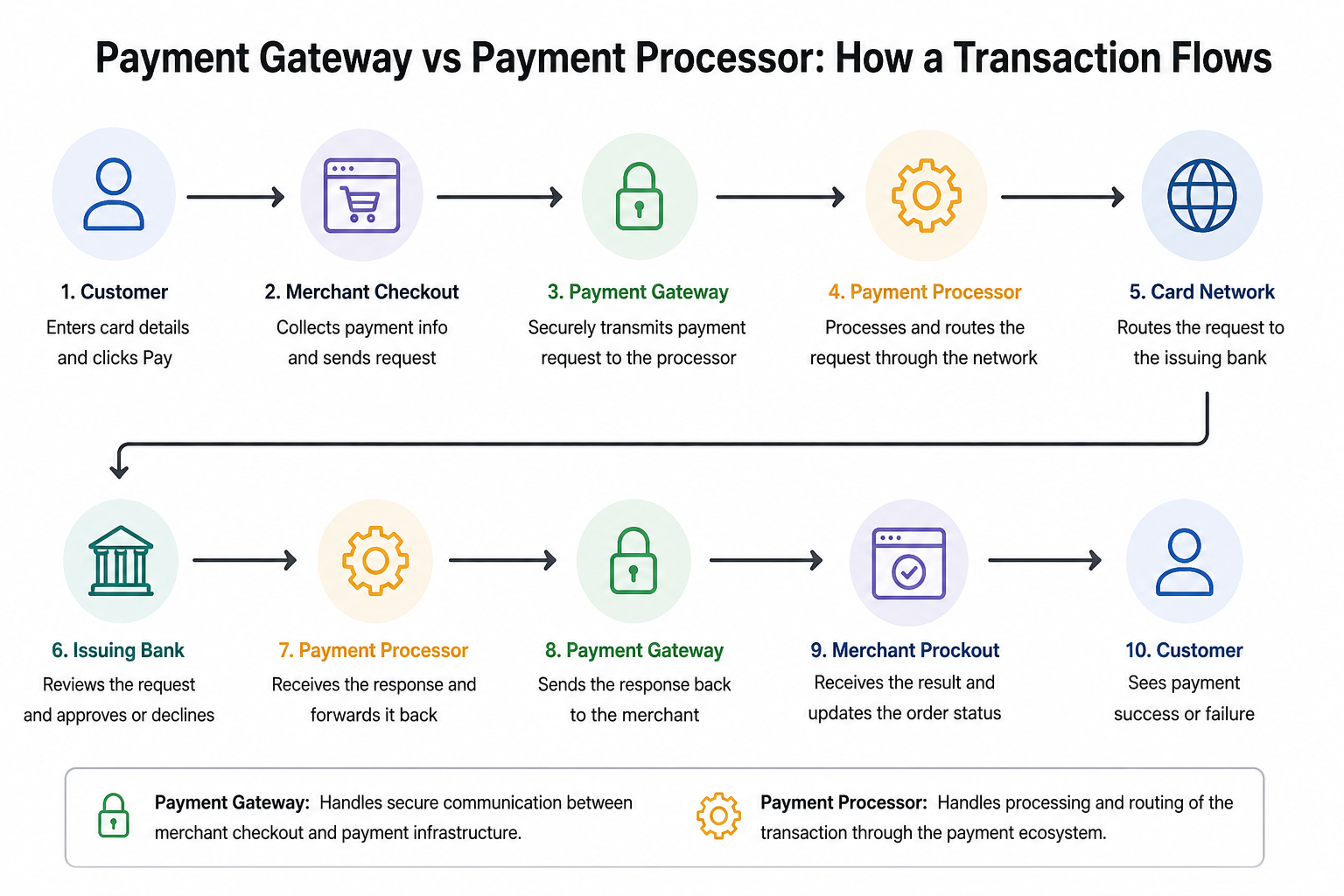
The customer enters their card information on the merchant’s checkout and submits the payment. The gateway receives the payment request and facilitates its movement into the processing flow. The processor then helps route and process that transaction through the appropriate acquiring and card-network infrastructure. The transaction reaches the customer’s issuing institution, which evaluates the authorization request. If the issuer approves it, the response travels back through the payment infrastructure.
The merchant’s checkout ultimately receives the result and can tell the customer that the payment was successful. The customer may see only:
Payment Successful
But the gateway and processor have participated in different parts of the underlying communication and transaction flow.
Why Are Payment Gateway and Payment Processor Often Confused?
The confusion largely comes from how payment services are packaged.
A business may sign up with one provider and receive a checkout solution, gateway functionality, processing, reporting, fraud tools, and other payment services through the same platform.
From the merchant’s perspective, it can therefore look like one system is doing everything. Technically, however, different functions can still exist underneath that unified experience.
There is another reason for the confusion: The terms are sometimes used loosely in payment-industry discussions. A provider may describe its offering as a “payment gateway” even when it provides broader payment-processing capabilities.
The correct question is therefore not simply:
“Which company is the gateway?”
It is:
“What function does each component perform in this payment architecture?”
That distinction is much more useful when evaluating payment infrastructure.
A Realistic Transaction Example
Imagine an ecommerce business selling a $750 laptop.
The customer submits their card payment.
1. The Gateway Handles the Payment Entry
The merchant’s checkout sends the transaction into the configured gateway flow.
The gateway securely handles the payment information and transaction details according to the integration architecture.
2. The Processor Handles the Transaction Flow
The transaction enters the relevant processing infrastructure.
The processor helps communicate the authorization request through the acquiring side and card network toward the customer’s issuer.
3. The Issuer Makes the Authorization Decision
The issuing bank evaluates the transaction and returns an approval or decline.
4. The Response Travels Back
The result moves back through the relevant payment infrastructure until the merchant’s system receives it.
5. The Merchant Updates the Order
If approved, the ecommerce system can mark the order as paid or authorized according to its transaction setup. The important lesson is that the gateway did not independently approve the $750 purchase. It facilitated the connection that allowed the transaction to enter the processing ecosystem.
Does a Business Need Both a Payment Gateway and a Payment Processor?
There is no universal answer because payment architectures vary.
A business may work with separate gateway and processor providers. Alternatively, one provider may offer both functions as part of an integrated payment solution.
The distinction is therefore more about functionality than the number of companies involved.
For example, a merchant might have:
Merchant → Gateway Provider → Separate Processor → Card Network
Another merchant could use an arrangement where gateway and processing capabilities are supplied together:
Merchant → Integrated Payment Provider → Card Network
The underlying functions still need to be performed even when they are presented as one service. This is why businesses evaluating payment infrastructure should look beyond product labels and examine what the provider actually handles.
Payment Gateway vs Payment Processor vs Merchant Account
A third term often enters the discussion: Merchant Account.
A merchant account is not simply another name for a payment gateway or processor. It is an account arrangement associated with receiving card-payment funds for a business.
The gateway provides technology for the payment transaction flow.
The processor facilitates transaction processing.
The merchant account relates to the merchant’s ability to receive and settle card-payment funds.
These components can be provided by different organizations or bundled into a broader payment arrangement.
Why the Difference Matters to a Business?
Understanding the difference is not merely a technical exercise.
It can affect how a business evaluates:
- Integration requirements
- Payment architecture
- Transaction routing
- Supported payment methods
- Reporting and reconciliation
- Security responsibilities
- Technical support
- Pricing structures
- Scalability
For example, if a developer is troubleshooting why an authorization request never reaches the issuing bank, knowing which layer is responsible can dramatically narrow down the problem.
Likewise, when comparing payment providers, a business can ask a much better question:
“Which payment functions does this provider actually perform?”
rather than relying solely on whether the product is called a gateway or processor.
The Bottom Line
A payment gateway and a payment processor are closely related, but they serve different roles within payment infrastructure.
The gateway primarily connects the merchant’s payment experience with the systems that process the transaction.
The processor facilitates the transaction’s movement and processing through the relevant payment infrastructure.
They can be provided separately or bundled together, which is why the distinction is often invisible to merchants. Once this difference is clear, it becomes easier to understand the rest of the payment stack – including how gateway implementation models affect the checkout experience, how businesses integrate payment systems, and where transaction failures can occur.
For businesses evaluating payment technology, the most useful approach is to look beyond terminology and understand what each component actually does.

Categories
- ACH Payments (10)
- adult payment processing (11)
- AI (9)
- Altcoins (10)
- Banking (10)
- Bitcoin (133)
- Bitcoin ETF (11)
- Bitcoin Price (30)
- Blockchain (50)
- Brokering World Hunger Away (16)
- Business (17)
- card payment processing (10)
- CBD (11)
- CBDC (11)
- Chargeback (8)
- coaching business (11)
- COVID-19 (3)
- Crypto ATMs (1)
- Crypto Banking (17)
- Crypto Bill (1)
- Crypto business owner platform (31)
- Crypto Investment (3)
- Crypto Markets (5)
- Crypto Payment (35)
- Crypto Payment Processor (4)
- Crypto Prices (1)
- Crypto Trading (92)
- Cryptocurrency (402)
- Cryptocurrency Exchange (108)
- Data Visualization (2)
- dating platforms (11)
- debt collection payment processing (10)
- Decentralized Finance (7)
- DeFi Payment (9)
- DEX (3)
- Digital Currency (23)
- dropshipping payment processing (12)
- Ethereum (2)
- FAQ (7)
- file sharing payment processing (11)
- Finance (25)
- Financial Equality (4)
- Financial Freedom (8)
- Forex (35)
- hemp (1)
- ICO (2)
- Investment (11)
- IPTV (11)
- Merchant Account (10)
- Mining (3)
- News (66)
- NFTs (2)
- online gambling (11)
- P2P (1)
- Paybito (147)
- PayBitoPro (693)
- PayBitoPro Coin Listing (6)
- PayBitoPro Exchange (2)
- Payment Gateway (48)
- peptide (10)
- Post COVID Digital Transformation (1)
- Press Release (130)
- Privacy & Security (3)
- Real Estate (1)
- Stablecoin (5)
- Technology (15)
- Travel (11)
- Uncategorized (10)
- US Presidential Election (2)
- Utility Coin (1)
- Web3 business (4)
- Web3 Wallets (2)
- White Label Crypto Exchange (8)
Recent Posts
- Payment Gateway vs. Payment Orchestration: What’s the Difference?
- What Is Smart Payment Routing? Strategies to Optimize Payment Performance
- How to Improve Payment Approval Rates for High-Risk Businesses?
- Why Are Online Payments Failing? Common Causes and How to Fix Them
- How to Use Multiple Payment Processors to Reduce Business Disruptions?