What Is a Merchant Account and How Does It Work?
- August 14, 2026
- Soham Guchait
When a customer pays for something with a credit or debit card, the money does not move directly from the customer’s account to the business’s bank account. Several systems and financial institutions are involved before the transaction is completed and the merchant receives the funds.
A merchant account is one of the important pieces of that infrastructure. It allows a business to accept card payments and provides the framework through which those transactions are processed and settled.
That distinction matters because a merchant account is not the same thing as a regular business bank account, payment gateway, or payment processor. Understanding what each component does makes the entire payment process much easier to follow.
What Is a Merchant Account?
A merchant account is a specialized type of account that allows a business to accept card payments. It is associated with the acquiring side of the payment system and is used to facilitate the processing and settlement of card transactions.
The easiest way to understand its purpose is to look at what happens after a customer makes a purchase.
Imagine an online customer buys a $500 product using a credit card. The customer sees a payment confirmation within seconds, but the merchant does not necessarily receive the $500 in its business bank account at that exact moment.
The transaction still has to pass through authorization, clearing, and settlement before the funds are made available to the business. A merchant account therefore sits between accepting a card payment and receiving the resulting funds.
How Does a Merchant Account Work?
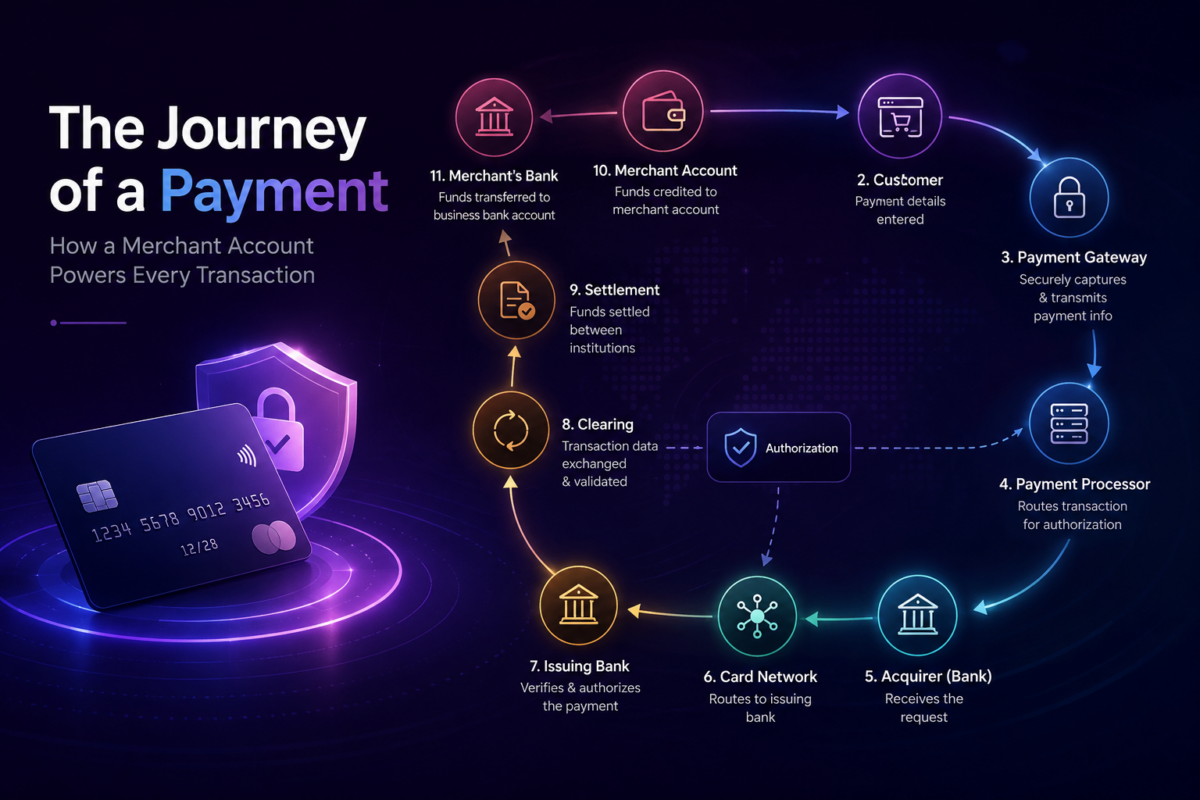
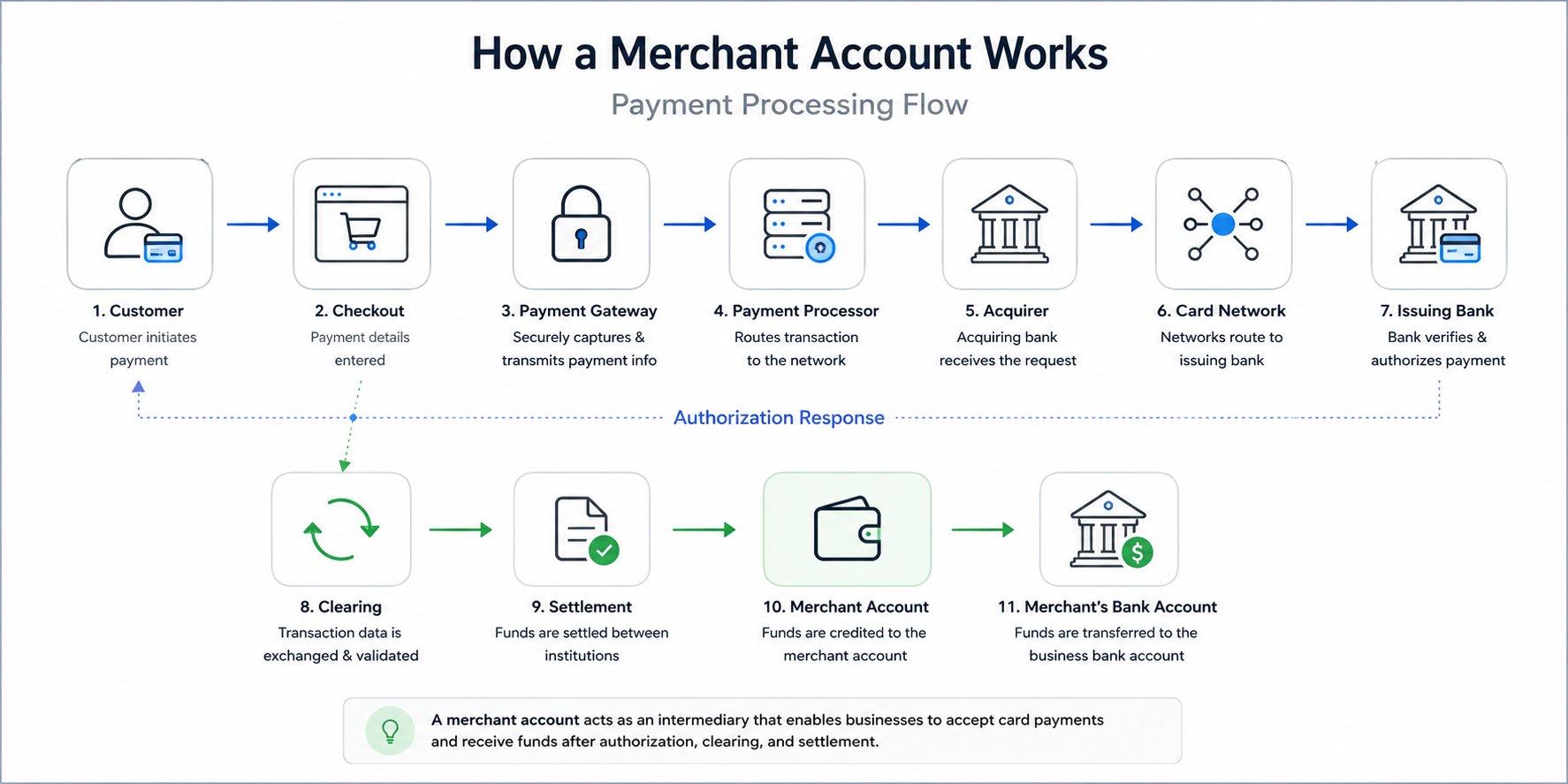
A card transaction involves several participants, each handling a different part of the process. A simplified payment flow looks like this:
Customer → Checkout → Payment Gateway → Payment Processor → Acquirer → Card Network → Issuing Bank → Authorization → Clearing → Settlement → Merchant’s Bank Account
Here is what that means in practice.
1. The Customer Submits the Payment
The process begins when a customer enters card details online or uses a card at a physical point-of-sale terminal.
For an online transaction, the payment information is transmitted through the payment gateway. The gateway provides the technology that securely communicates the transaction details to the payment-processing infrastructure.
2. The Transaction is Sent for Authorization
The transaction is then routed through the payment-processing system and card network to the customer’s issuing bank.
The issuing bank checks the transaction and determines whether it should be approved or declined. It may consider factors such as whether the card is valid, whether sufficient credit or funds are available, and whether the transaction triggers relevant security controls.
If approved, an authorization response is sent back through the payment infrastructure. At this point, however, the merchant has not necessarily received the money. Authorization essentially means that the transaction has been approved to proceed. The movement of funds happens later.
3. The Transaction Moves Through Clearing and Settlement
After authorization, transaction information is submitted for clearing and settlement.
Clearing involves the exchange and reconciliation of transaction information between the relevant parties. Settlement is the stage in which the financial obligations created by those transactions are resolved and funds move toward the merchant side. This distinction explains why a payment can be approved immediately while the merchant’s access to the funds happens later.
4. The Merchant Receives the Funds
Once the transaction has completed the necessary processing and settlement steps, the proceeds are eventually transferred to the business’s designated bank account.
The exact timing can vary depending on the payment arrangement, transaction type, provider, and settlement schedule. For a business, this creates an important distinction between a payment being approved and the money becoming available.
Merchant Account vs. Payment Gateway
The terms merchant account and payment gateway are often used together, but they serve different purposes.
A payment gateway is primarily a technology layer that securely captures and transmits payment information. A merchant account, on the other hand, is part of the financial arrangement used to process and settle card transactions.
For example, suppose a customer enters their card details on an ecommerce checkout page. The gateway helps transmit that payment information into the processing system. The merchant account is associated with the merchant’s ability to receive and settle the resulting card transaction.
This difference becomes particularly useful when looking at the broader payment infrastructure. A business can interact with a single provider that combines several services, but the underlying functions can still be distinct. That is also why understanding how a merchant account and payment gateway work together is useful before evaluating different payment setups.
Merchant Account vs. Payment Processor
A payment processor has another role in the transaction.
The processor facilitates the communication and movement of transaction information between the different participants involved in processing a card payment. The merchant account, meanwhile, is the financial account arrangement associated with accepting and settling those transactions. The distinction can become less obvious when a provider bundles processing, gateway technology, merchant-account services, and other capabilities into one offering.
But conceptually, they answer different questions:
- Merchant account: Where does the merchant receive and settle card payments?
- Payment processor: How is the transaction processed between the different parties?
- Payment gateway: How is the customer’s payment information securely captured and sent for processing?
Understanding these roles is important because a problem with one part of the payment process does not necessarily mean there is a problem with the others.
Why Do Businesses Need a Merchant Account?
For businesses using a traditional merchant-account model, the account provides the infrastructure required to accept card payments and receive the proceeds from those transactions. It also connects to several operational considerations that businesses need to understand before accepting cards at scale.
These can include:
- Settlement: How and when transaction proceeds reach the business?
- Processing costs: The fees associated with accepting card payments.
- Risk management: How transaction activity and business characteristics affect processing arrangements?
- Refunds and disputes: What happens when a completed transaction is reversed or challenged?
This is one reason applying for a merchant account is not simply equivalent to opening a conventional bank account. Payment providers and acquiring institutions generally need information about the business and its expected transaction activity before establishing the processing relationship.
For businesses preparing for that process, understanding how to get a merchant account and what the application involves can help clarify what happens before processing begins.
What Does a Merchant Account Have to Do With Business Risk?
Payment processing involves financial risk because a transaction can sometimes be disputed, reversed, refunded, or associated with fraudulent activity. As a result, the characteristics of a business can influence how its payment activity is evaluated.
Consider two businesses that each process $100,000 per month.
The first business has an average transaction value of $500, meaning it processes roughly 200 transactions per month.
The second has an average transaction value of $10,000, meaning it processes roughly 10 transactions per month.
Their monthly processing volume is identical, but their transaction patterns are very different. The second business has substantially fewer transactions but much larger individual payment amounts. Depending on the business model and other circumstances, that difference can affect how its payment activity is assessed.
This is where merchant-account underwriting becomes important. Providers may evaluate factors such as the nature of the products or services being sold, expected transaction volume, average transaction size, sales channels, operating history, and other relevant characteristics. The purpose is not simply to determine whether a business should be approved. Risk assessment can also influence the terms and controls associated with the processing relationship.
What Happens When a Card Payment Is Declined?
A declined transaction means that the authorization request was not approved. The reason can vary. For example, the issuing bank may decline a transaction because of insufficient available credit, an expired card, restrictions on the account, or a security-related decision.
A Decline is also different from a Chargeback.
A decline happens during authorization, before the transaction is successfully completed. A chargeback generally occurs after a transaction has been processed, when a cardholder disputes the transaction through the card-issuing process.
This distinction is important for businesses because different payment problems require different responses. Treating every unsuccessful transaction as the same type of failure can make it harder to identify what actually happened.
Merchant Account and Business Cash Flow
One of the most practical reasons to understand merchant accounts is cash flow.
Suppose an online store receives ten successful $500 card transactions in one afternoon. Its checkout system may show $5,000 in successful payments, but that does not necessarily mean $5,000 is immediately available in the company’s operating bank account. The transactions still have to move through the relevant processing and settlement stages. This creates a useful way of thinking about card revenue:
Customer payment → Authorization → Processing → Clearing → Settlement → Funding
The time between these stages matters to businesses that rely heavily on card payments to purchase inventory, pay employees, or cover operating expenses.
Settlement timing can also become more complicated when transactions are subject to additional review, reserves, holds, refunds, or disputes. Understanding how merchant-account reserves and settlement delays affect cash flow is therefore an important next step for businesses processing significant card volume.
The Merchant Account Is Only One Part of Payment Processing
A merchant account is important, but it does not operate by itself. A typical card payment can involve:
Merchant → Payment Gateway → Payment Processor → Acquirer → Card Network → Issuing Bank
Each participant has a defined role, and the transaction moves through multiple stages before the merchant ultimately receives its funds. That is why a customer can experience a payment as a simple two-second event while the underlying transaction involves considerably more infrastructure.
Once this basic structure is understood, other payment concepts become easier to make sense of. Merchant IDs, processing fees, underwriting, reserves, settlement timing, refunds, and chargebacks are all connected to the broader payment-processing ecosystem.
Key Takeaway
A merchant account is a specialized financial arrangement that enables a business to accept and settle card transactions. It is different from both a regular business bank account and the technology used to transmit payment information.
The most important point is that a successful card payment is not the same thing as immediate receipt of funds. A transaction must move through authorization, processing, clearing, and settlement before the proceeds ultimately reach the merchant’s bank account.
Once a business understands where the merchant account fits into that process, the rest of the payment ecosystem becomes much easier to understand—and decisions about payment infrastructure can be made with a clearer picture of what is actually happening behind every card transaction.
Categories
- ACH Payments (10)
- adult payment processing (11)
- AI (9)
- Altcoins (10)
- Banking (10)
- Bitcoin (133)
- Bitcoin ETF (11)
- Bitcoin Price (30)
- Blockchain (50)
- Brokering World Hunger Away (16)
- Business (17)
- card payment processing (10)
- CBD (11)
- CBDC (11)
- Chargeback (8)
- coaching business (11)
- COVID-19 (3)
- Crypto ATMs (1)
- Crypto Banking (17)
- Crypto Bill (1)
- Crypto business owner platform (31)
- Crypto Investment (3)
- Crypto Markets (5)
- Crypto Payment (35)
- Crypto Payment Processor (4)
- Crypto Prices (1)
- Crypto Trading (92)
- Cryptocurrency (402)
- Cryptocurrency Exchange (108)
- Data Visualization (2)
- dating platforms (11)
- debt collection payment processing (10)
- Decentralized Finance (7)
- DeFi Payment (9)
- DEX (3)
- Digital Currency (23)
- dropshipping payment processing (12)
- Ethereum (2)
- FAQ (7)
- file sharing payment processing (11)
- Finance (25)
- Financial Equality (4)
- Financial Freedom (8)
- Forex (35)
- hemp (1)
- ICO (2)
- Investment (11)
- IPTV (11)
- Merchant Account (10)
- Mining (3)
- News (66)
- NFTs (2)
- online gambling (11)
- P2P (1)
- Paybito (147)
- PayBitoPro (693)
- PayBitoPro Coin Listing (6)
- PayBitoPro Exchange (2)
- Payment Gateway (48)
- peptide (10)
- Post COVID Digital Transformation (1)
- Press Release (130)
- Privacy & Security (3)
- Real Estate (1)
- Stablecoin (5)
- Technology (15)
- Travel (11)
- Uncategorized (10)
- US Presidential Election (2)
- Utility Coin (1)
- Web3 business (4)
- Web3 Wallets (2)
- White Label Crypto Exchange (8)
Recent Posts
- Payment Gateway vs. Payment Orchestration: What’s the Difference?
- What Is Smart Payment Routing? Strategies to Optimize Payment Performance
- How to Improve Payment Approval Rates for High-Risk Businesses?
- Why Are Online Payments Failing? Common Causes and How to Fix Them
- How to Use Multiple Payment Processors to Reduce Business Disruptions?