How to Accept Card Payments for a Business: What Businesses Need to Know?
- August 18, 2026
- Soham Guchait
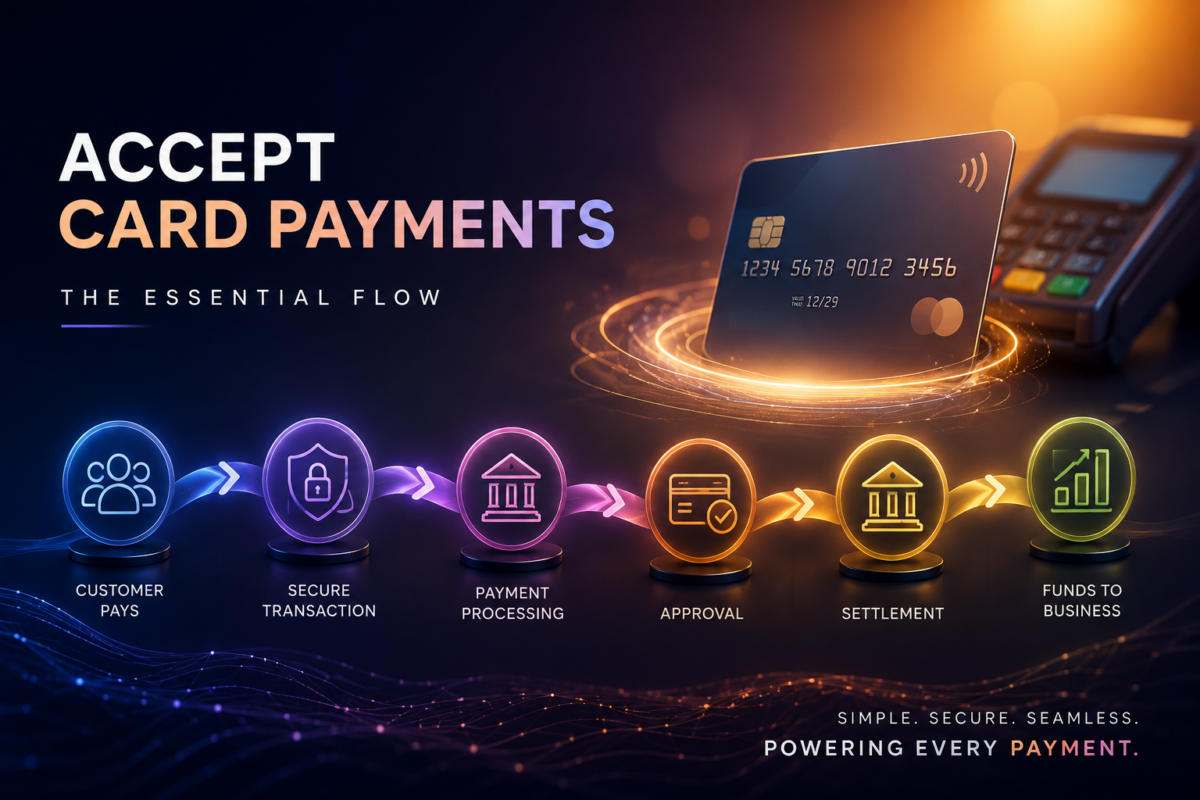
For many businesses, accepting card payments is no longer simply an additional convenience. Customers expect to be able to pay by credit or debit card whether they are purchasing from a physical store, booking a service online, subscribing to a platform, or placing an order through a mobile device.
But accepting cards involves more than adding a “Pay by Card” button or buying a card terminal. A business needs the right payment infrastructure, a suitable acceptance method, appropriate security controls and a clear understanding of costs and settlement.
So, how do you accept card payments for a business?
The answer depends largely on how customers interact with the business. A physical retailer, an ecommerce store and a service business taking payments remotely may require different setups, even though the underlying card-processing ecosystem is similar.
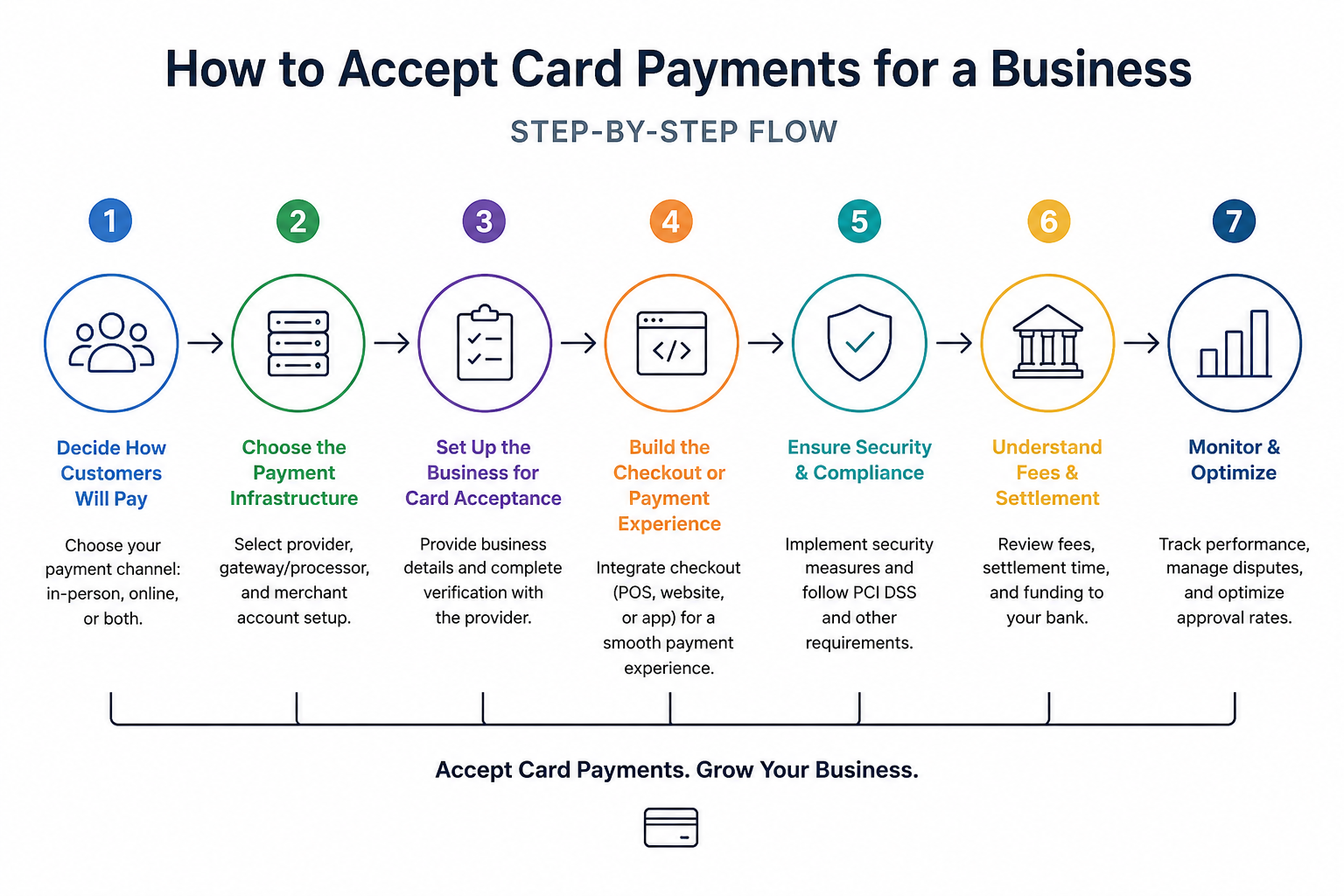
1. Decide How Customers Will Pay
The first decision is not which provider to choose. It is determining where and how customers will make payments.
A business that operates from a physical location will generally need a point-of-sale system and card-reading hardware. Customers can insert, tap or otherwise present their cards at checkout. Contactless payments can also be supported where the terminal and payment setup allow them.
For an ecommerce business, there is no physical card terminal. Instead, the customer enters payment information through an online checkout, where the transaction is securely transmitted for processing.
Businesses that operate in both environments may need both. For example, imagine a clothing retailer with a physical shop and an online store. A customer visiting the store might tap a card on a terminal, while another customer purchases the same product through the website. Both transactions ultimately enter the card-processing ecosystem, but the technology used to initiate them is different. This distinction also matters because card-present and card-not-present transactions can have different security, authentication and fraud considerations.
2. Choose the Payment Infrastructure
Once the acceptance environment is clear, the business needs to determine how the payment will move from the customer’s card to the business.
A typical setup can involve a payment service provider or processor, a payment gateway for online transactions, a merchant account or another arrangement for receiving card proceeds, and the business’s bank account. These components can be provided separately or bundled together, depending on the provider and business model. Some payment service providers combine several functions into one service, which can simplify setup.
A payment gateway primarily provides the technology for securely transmitting payment information between the checkout environment and the payment infrastructure. A merchant account, where applicable, is used to receive and temporarily hold card transaction funds before they are transferred to the business’s bank account.
The important point is that businesses do not necessarily need to assemble every component independently. The appropriate arrangement depends on the provider, transaction environment and business requirements.
What should a business evaluate?
- Acceptance channels: Can the setup handle online, in-person or mobile transactions as required?
- Integration: Can it connect with the website, POS, accounting system or other business software?
- Supported cards and currencies: Does it support the cards and markets the business actually serves?
- Settlement and funding: How are transactions settled, and when does the business receive its funds?
- Reporting: Can the business easily track transactions, refunds, fees and settlements?
The goal is not to choose the system with the most features. It is to choose infrastructure that fits how the business actually operates.
3. Set Up the Business for Card Acceptance
Before processing transactions, the business will generally need to provide information required for account setup and verification.
The exact requirements vary according to the provider, location, business structure and type of activity. Businesses should therefore expect some form of verification before card acceptance is activated.
For example, a provider may need information about the business, its owners or representatives, products or services, expected transaction activity and banking arrangements. This process is not merely administrative. Payment providers need to understand the businesses entering their networks and the transactions they will process.
A business should also make sure that the information it provides accurately represents its actual operations. Significant differences between the stated business model and subsequent transaction activity can create unnecessary reviews or interruptions.
4. Build the Checkout or Payment Experience
The technical implementation depends on the acceptance environment.
For an online business, the checkout needs to provide customers with a secure way to enter payment information and submit the transaction. The payment gateway and other payment infrastructure then transmit the necessary information for authorization.
For a physical business, the equivalent experience is the POS terminal. The customer presents the card, the terminal collects the required transaction information and the payment is sent for authorization. The customer experience matters here because payment acceptance is part of the overall buying process. A technically functional payment system can still create problems if checkout is confusing, slow or difficult to use.
For instance, an online retailer may have excellent products and competitive prices, but if customers encounter unnecessary steps during checkout or repeated payment failures, completed purchases can suffer.
5. Understand the Cost Before You Start
Accepting card payments comes with costs, and businesses should understand how those costs are calculated rather than looking only at one advertised percentage.
Card-processing costs can include several components, such as interchange, card-network fees and provider or processor markups. Pricing may also vary according to the transaction type, card, geography, processing volume and other factors. This makes the effective processing rate more useful for evaluating overall acceptance costs than looking at a single headline rate.
Consider a business that processes $50,000 in card transactions each month. A seemingly small difference in the effective rate can produce a meaningful difference in monthly processing expenses.
Businesses should therefore examine the complete pricing structure, including transaction fees, monthly charges where applicable, refund-related costs, chargeback fees and any additional services they actually need. Understanding these costs also makes it easier to compare different acceptance arrangements realistically.
6. Protect Cardholder Information
Security cannot be treated as an optional addition to card acceptance.
Businesses that accept payment cards have responsibilities under the Payment Card Industry Data Security Standard (PCI DSS), with specific requirements depending on how card data is handled and how the payment environment is implemented. The objective is to reduce the exposure of sensitive payment information and maintain a secure payment environment.
Depending on the setup, security measures may include encryption, tokenization, authentication technologies, fraud monitoring and secure payment interfaces. The appropriate controls depend on the business’s payment environment.
A business should also avoid unnecessarily storing sensitive card information. Using established payment infrastructure can reduce the amount of payment data that the business’s own systems directly handle, although it does not eliminate the business’s responsibility to understand its applicable compliance obligations.
Scenario 1: Starting an Online Store
Suppose a small business is launching an online store selling home accessories. The owner wants customers to pay by card directly through the website. A practical setup might involve:
- Creating the online storefront and checkout.
- Selecting a suitable payment provider.
- Connecting the checkout to the required payment infrastructure.
- Completing business verification.
- Configuring the business’s bank account for funding.
- Testing successful, declined and refunded transactions.
- Reviewing security and applicable PCI DSS responsibilities before launch.
The business does not need to understand every technical interaction occurring behind the scenes, but it does need to understand what each component does and how the pieces fit together.
Scenario 2: A Business With Both Online and Physical Sales
Now consider a restaurant that accepts orders through its website and also takes payments at its physical location. The restaurant may need:
- A POS terminal for in-person card transactions.
- An online checkout for website orders.
- Payment infrastructure capable of supporting both transaction environments.
- Consistent reporting for online and in-person sales.
- Processes for refunds, disputes and reconciliation.
- Security controls appropriate to both environments.
The important consideration is not simply whether the provider accepts cards. It is whether the complete setup works across the business’s actual sales channels.
What Happens After the Customer Pays?
Once a customer submits a card payment, the transaction goes through authorization and subsequent processing stages before the merchant receives its funds.
Authorization determines whether the transaction is approved or declined. After an approved transaction is captured, it can move through clearing and settlement before the merchant receives funding according to its arrangement.
This is why the message “Payment approved” should not be interpreted as “the money is already in the business bank account”.
Businesses that want to understand what happens between checkout and merchant funding should look at the full card payment processing workflow, particularly the distinction between authorization, capture, clearing and settlement.
How Should a Business Choose a Card Payment Setup?
There is no universally best setup. The right choice depends on the business’s customers, sales channels, transaction volume and operational requirements. Before committing to a solution, businesses should consider:
- Where customers are located and how they prefer to pay?
- Whether payments are primarily online, in person or both?
- Expected transaction volume and average transaction value.
- Required currencies and markets.
- Integration with existing business systems.
- Pricing and the likely effective processing cost.
- Fraud prevention and security requirements.
- Settlement and funding expectations.
- Quality of reporting and customer support.
- How easily the system can scale as transaction volume grows?
A small local retailer may prioritize simple POS acceptance, while a global ecommerce business may care more about international cards, currencies, fraud controls and integrations.
Frequently Asked Questions
- What does a business need to accept card payments?
The exact requirements vary, but businesses generally need a suitable payment provider or processing arrangement, an acceptance method such as a POS terminal or online checkout, appropriate banking arrangements, and security and compliance measures. - Can a business accept card payments without a traditional merchant account?
Yes, depending on the payment model. Some payment service providers or payment facilitators combine functions that traditionally required a separate merchant account. - How much does it cost to accept card payments?
Costs vary by provider, transaction type, card, location and pricing model. Businesses should evaluate the complete fee structure and effective processing rate rather than relying on a single advertised percentage. - Is PCI DSS required for businesses accepting cards?
Businesses accepting payment cards have PCI DSS responsibilities, although the specific requirements depend on how payments and cardholder data are handled. - Is accepting cards different for online and physical businesses?
Yes. Online transactions generally involve a card-not-present environment and online checkout infrastructure, while physical transactions commonly use POS hardware and card-present methods. The underlying processing ecosystem is related, but the operational and security considerations can differ.
Final Takeaway
Learning how to accept card payments for a business starts with understanding the business’s actual payment needs rather than immediately choosing a provider.
A business must determine where customers will pay, select suitable payment infrastructure, complete the necessary verification, build a reliable checkout experience, understand processing costs and maintain appropriate security controls. The best setup is ultimately one that fits the business’s transaction environment, customers and growth plans without adding unnecessary complexity.
Once those foundations are in place, card acceptance becomes more than simply giving customers another way to pay – it becomes a structured part of the business’s overall payment and financial operations.
Categories
- ACH Payments (10)
- adult payment processing (11)
- AI (9)
- Altcoins (10)
- Banking (10)
- Bitcoin (133)
- Bitcoin ETF (11)
- Bitcoin Price (30)
- Blockchain (50)
- Brokering World Hunger Away (16)
- Business (17)
- card payment processing (10)
- CBD (11)
- CBDC (11)
- Chargeback (8)
- coaching business (11)
- COVID-19 (3)
- Crypto ATMs (1)
- Crypto Banking (17)
- Crypto Bill (1)
- Crypto business owner platform (31)
- Crypto Investment (3)
- Crypto Markets (5)
- Crypto Payment (35)
- Crypto Payment Processor (4)
- Crypto Prices (1)
- Crypto Trading (92)
- Cryptocurrency (402)
- Cryptocurrency Exchange (108)
- Data Visualization (2)
- dating platforms (11)
- debt collection payment processing (10)
- Decentralized Finance (7)
- DeFi Payment (9)
- DEX (3)
- Digital Currency (23)
- dropshipping payment processing (12)
- Ethereum (2)
- FAQ (7)
- file sharing payment processing (11)
- Finance (25)
- Financial Equality (4)
- Financial Freedom (8)
- Forex (35)
- hemp (1)
- ICO (2)
- Investment (11)
- IPTV (11)
- Merchant Account (10)
- Mining (3)
- News (66)
- NFTs (2)
- online gambling (11)
- P2P (1)
- Paybito (147)
- PayBitoPro (693)
- PayBitoPro Coin Listing (6)
- PayBitoPro Exchange (2)
- Payment Gateway (48)
- peptide (10)
- Post COVID Digital Transformation (1)
- Press Release (130)
- Privacy & Security (3)
- Real Estate (1)
- Stablecoin (5)
- Technology (15)
- Travel (11)
- Uncategorized (10)
- US Presidential Election (2)
- Utility Coin (1)
- Web3 business (4)
- Web3 Wallets (2)
- White Label Crypto Exchange (8)
Recent Posts
- Payment Gateway vs. Payment Orchestration: What’s the Difference?
- What Is Smart Payment Routing? Strategies to Optimize Payment Performance
- How to Improve Payment Approval Rates for High-Risk Businesses?
- Why Are Online Payments Failing? Common Causes and How to Fix Them
- How to Use Multiple Payment Processors to Reduce Business Disruptions?