ACH vs Credit Card: Which Payment Method Is Better for Businesses?
- August 19, 2026
- Soham Guchait
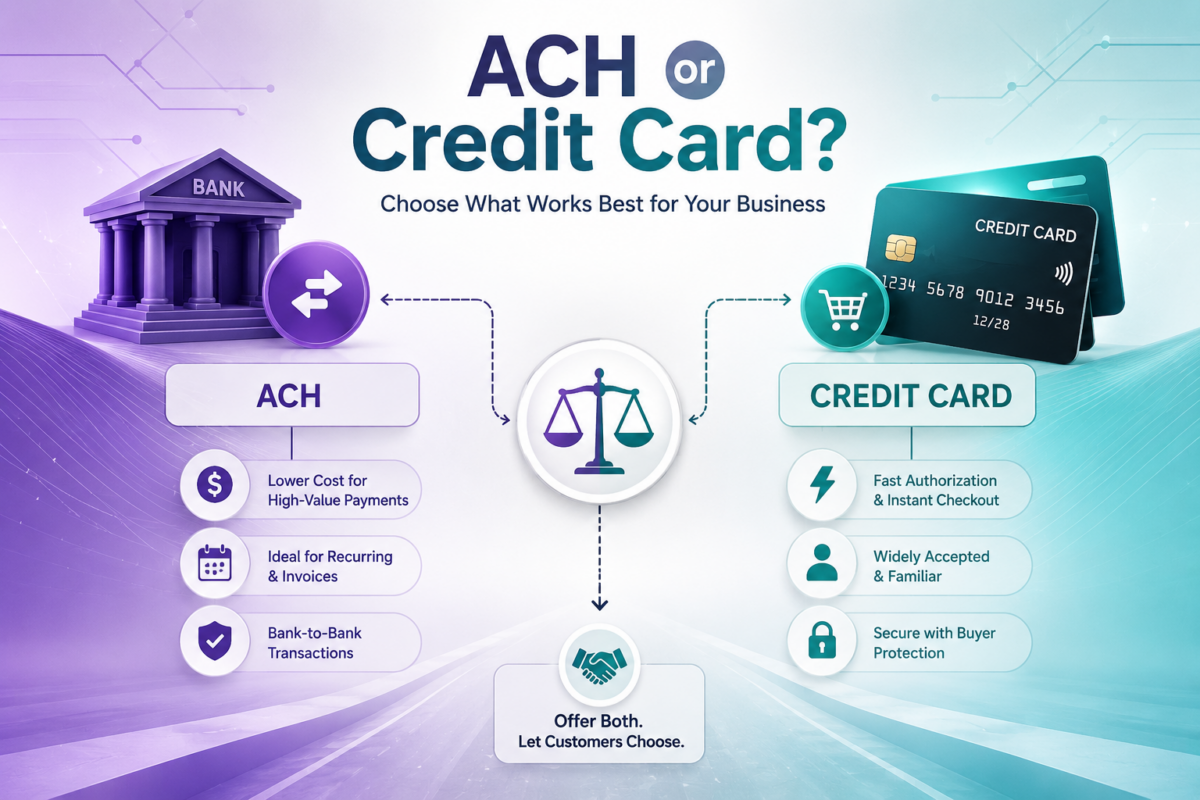
Choosing between ACH and credit cards is not simply a question of which payment method is cheaper or faster. The better option depends on what you sell, how much your customers pay, how often they pay, and how much payment friction your business can tolerate.
For a $20 online purchase, a credit card may be the obvious choice. For a $2,000 recurring B2B invoice, ACH may make more sense. Many businesses use both because each method solves a different payment problem. So, ACH vs credit card comes down to cost, speed, customer convenience, risk, recurring payments, and the type of transaction involved.
ACH vs Credit Card: What Is the Difference?
ACH payments move money directly between bank accounts through the Automated Clearing House network. Credit card payments use a card network and typically involve the cardholder, issuing bank, acquiring side, and payment processor.
The practical difference is straightforward:
- ACH: Bank-account-based payment
- Credit card: Card-based payment
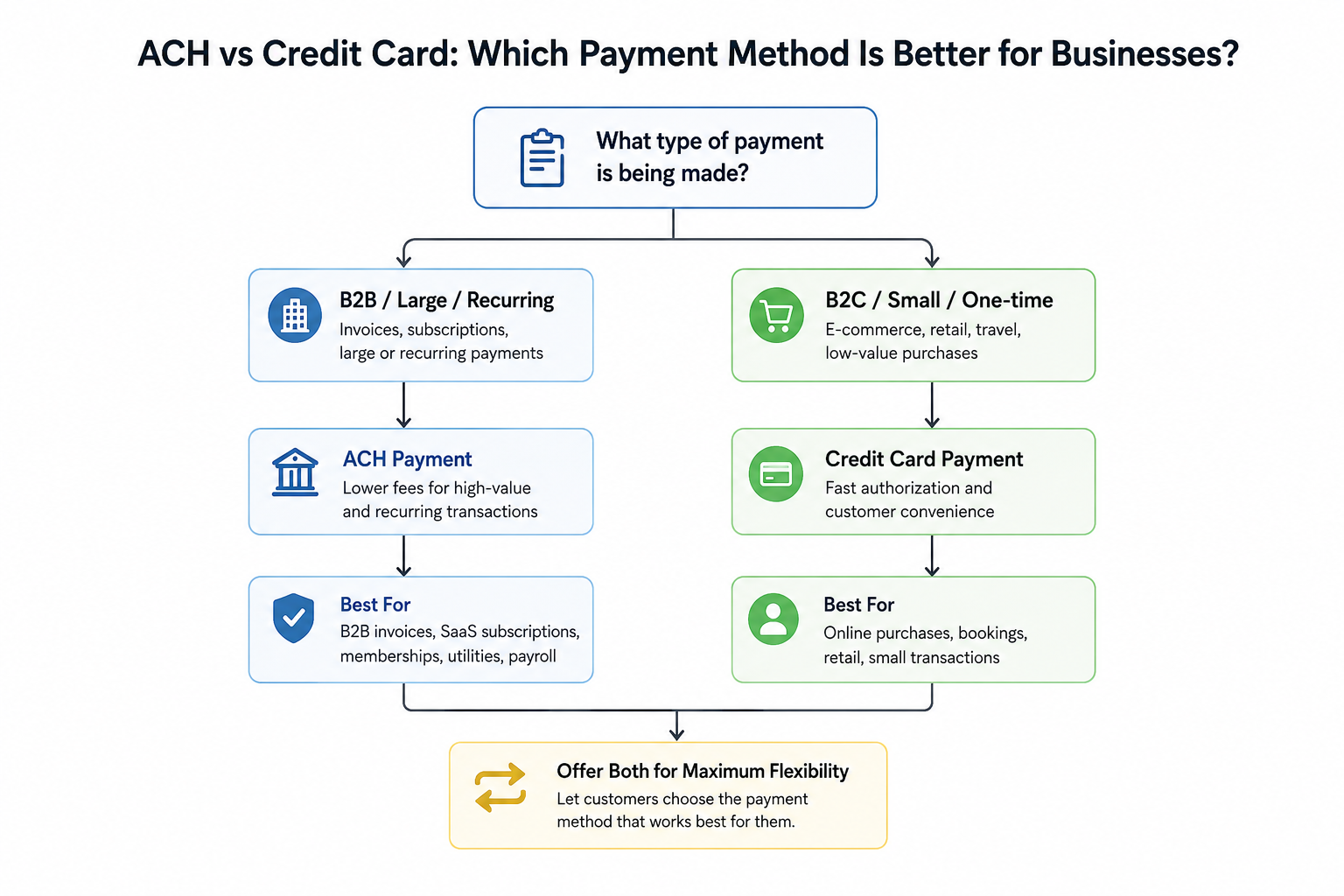
- ACH: Commonly suited to invoices, payroll, subscriptions, and larger recurring payments
- Credit cards: Commonly suited to retail, e-commerce, travel, and smaller purchases
Neither method is universally better. The right choice depends on the transaction and customer. For businesses accepting ACH, understanding the transaction process can also help with timing and reconciliation.
ACH vs Credit Card: Which Costs Less?
Cost is one of the biggest reasons businesses consider ACH.
Credit card payments generally involve fees associated with processing the card transaction. Depending on the pricing arrangement, these can include percentage-based charges, per-transaction fees, and other applicable costs.
ACH pricing varies by provider and agreement. It may involve a flat transaction fee, percentage-based pricing, monthly charges, or additional fees for services such as returns. This creates an important distinction for businesses with high-value transactions.
Hypothetical example:
Imagine a consulting company collecting a $5,000 invoice. A percentage-based card fee can become significant as the transaction value increases, while an ACH fee structure may be less sensitive to the payment amount. That does not mean ACH will always cost less. Actual pricing depends on the provider, business volume, transaction type, and agreement.
Which Is Faster: ACH or Credit Card?
Credit card transactions are generally designed for quick authorization, which makes them convenient for purchases where customers expect immediate confirmation.
ACH transactions can involve processing and settlement windows. Timing depends on factors such as submission time, banking days, transaction type, and whether the payment qualifies for Same Day ACH.
The important distinction is between Authorization and Final Settlement.
A customer may receive confirmation that a transaction was initiated without the funds being fully settled into the business’s account at that exact moment. For businesses where payment timing directly affects cash flow, understanding ACH processing windows is particularly important.
ACH vs Credit Card for Recurring Payments
Recurring payments are one area where ACH can be particularly useful.
Consider a SaaS company charging customers $500 every month. The business could accept recurring card payments, but it may also offer ACH so customers can authorize recurring withdrawals from their bank accounts. ACH can be attractive for:
- SaaS subscriptions
- Memberships
- Insurance payments
- Professional services
- Property management
- Utility payments
- Recurring B2B invoices
Credit cards remain valuable for recurring billing because customers are familiar with them and often prefer the convenience. The best approach can be to offer customers a choice rather than forcing every customer into one payment method.
Customer Convenience: ACH vs Credit Card
Credit cards have a major advantage in familiarity. Most consumers already understand how to pay with a card, and card details can often be stored for future purchases.
ACH requires bank-account information and appropriate authorization. Some customers may be comfortable with that; others may prefer not to provide bank details. The preferred option can also depend on the customer. For example:
An online retailer selling a $75 product may benefit from making card payments extremely prominent.
A B2B software company collecting a $3,000 annual subscription may find ACH more attractive to customers who prefer paying directly from a business bank account.
Payment choice should therefore reflect actual customer behavior rather than a blanket assumption that one method is superior.
Risk and Payment Disputes
ACH and credit cards also differ in how payment problems can arise.
ACH transactions can be returned for reasons such as insufficient funds, incorrect account information, or other conditions defined by ACH rules. Businesses therefore need processes for handling returns and reconciling affected transactions.
Credit cards have their own dispute and chargeback mechanisms. A cardholder may dispute a transaction through their card issuer, potentially creating additional administrative work for the merchant. Neither payment method eliminates payment risk. Businesses should consider:
- How are transactions authorized?
- How is customer information verified?
- How returns or disputes are handled?
- How suspicious transactions are detected?
- How are payment records reconciled?
For businesses accepting bank-account payments, security deserves particular attention.
When Should a Business Choose ACH?
ACH can be a strong option when the transaction involves an established customer relationship, recurring billing, invoices, or relatively high payment values. ACH can be a strong option when the transaction involves an established customer relationship, recurring billing, invoices, or relatively high payment values. For larger or time-sensitive business transactions, businesses may also consider wire transfers as another bank-based payment option. It may be worth considering when: It may be worth considering when:
- Customers regularly pay invoices
- Payments are recurring
- Average transaction values are relatively high
- Customers prefer bank-account payments
- The business wants an alternative to card payments
- Finance teams want payment methods suited to account-based reconciliation
For example, a marketing agency billing a client $4,000 each month may offer ACH alongside cards so the client can pay directly from its business bank account. Businesses should still account for authorization, processing schedules, returns, and reconciliation.
When Are Credit Cards the Better Choice?
Credit cards often make more sense when speed, familiarity, and ease of checkout are priorities. They can be particularly useful for:
- E-commerce purchases
- Online bookings
- Restaurants and retail
- Low-value transactions
- Customers who prefer card rewards or credit
- Purchases where immediate payment authorization matters
A customer buying a $40 product is unlikely to want a complicated bank-payment process. A familiar card checkout can make more sense.
Can a Business Accept Both ACH and Credit Cards?
Yes. Many businesses can benefit from offering both payment methods. Instead of asking, “Which payment method should we eliminate?” a better question is:
“Which payment method should we offer for each type of customer and transaction?”
A business might use:
| Situation | Potentially suitable option |
| $50 e-commerce purchase | Credit card |
| $2,500 B2B invoice | ACH |
| Monthly SaaS subscription | ACH or credit card |
| Urgent online purchase | Credit card |
| Large recurring service payment | ACH |
These are examples, not universal rules. Customer preferences, pricing, operational requirements, and risk controls should determine the final mix.
ACH vs Credit Card: What Should Businesses Consider?
Before choosing a primary payment method, evaluate the entire payment lifecycle – not just the transaction fee. Ask:
- What is the average transaction value?
- Are payments one-time or recurring?
- How quickly does the business need confirmation and settlement?
- What does the customer prefer?
- How will returns, disputes, and failed payments be handled?
- How easily can the finance team reconcile transactions?
- What security and authorization controls are required?
For many businesses, the answer will be a combination of ACH and cards rather than one replacing the other.
Frequently Asked Questions
Is ACH cheaper than a credit card?
It can be, particularly for certain transaction sizes and pricing structures, but there is no universal rule. Compare the actual fees, monthly charges, return fees, and other costs applicable to your business.
Is ACH faster than a credit card?
Usually, credit cards provide faster transaction authorization. ACH timing depends on processing schedules, banking days, transaction type, and eligibility for Same Day ACH.
Is ACH safer than using a credit card?
Neither method should be considered automatically risk-free. ACH requires appropriate authorization and account-security controls, while card payments have their own fraud and dispute risks.
Should a small business accept ACH or credit cards?
It depends on the business. E-commerce and retail businesses may prioritize cards, while B2B, subscription, and invoice-based businesses may find ACH particularly useful. Offering both can provide more flexibility.
Conclusion
The choice between ACH vs credit card should be based on the economics and practical needs of each payment scenario. ACH can be useful for recurring payments, invoices, and bank-account transactions, while credit cards can provide familiar and convenient checkout experiences.
For many businesses, there is no need to choose only one. A thoughtful payment strategy can use ACH for transactions where bank-account payments make sense and cards where speed and customer convenience matter most.

Categories
- ACH Payments (10)
- adult payment processing (11)
- AI (9)
- Altcoins (10)
- Banking (10)
- Bitcoin (133)
- Bitcoin ETF (11)
- Bitcoin Price (30)
- Blockchain (50)
- Brokering World Hunger Away (16)
- Business (17)
- card payment processing (10)
- CBD (11)
- CBDC (11)
- Chargeback (8)
- coaching business (11)
- COVID-19 (3)
- Crypto ATMs (1)
- Crypto Banking (17)
- Crypto Bill (1)
- Crypto business owner platform (31)
- Crypto Investment (3)
- Crypto Markets (5)
- Crypto Payment (35)
- Crypto Payment Processor (4)
- Crypto Prices (1)
- Crypto Trading (92)
- Cryptocurrency (402)
- Cryptocurrency Exchange (108)
- Data Visualization (2)
- dating platforms (11)
- debt collection payment processing (10)
- Decentralized Finance (7)
- DeFi Payment (9)
- DEX (3)
- Digital Currency (23)
- dropshipping payment processing (12)
- Ethereum (2)
- FAQ (7)
- file sharing payment processing (11)
- Finance (25)
- Financial Equality (4)
- Financial Freedom (8)
- Forex (35)
- hemp (1)
- ICO (2)
- Investment (11)
- IPTV (11)
- Merchant Account (10)
- Mining (3)
- News (66)
- NFTs (2)
- online gambling (11)
- P2P (1)
- Paybito (147)
- PayBitoPro (693)
- PayBitoPro Coin Listing (6)
- PayBitoPro Exchange (2)
- Payment Gateway (48)
- peptide (10)
- Post COVID Digital Transformation (1)
- Press Release (130)
- Privacy & Security (3)
- Real Estate (1)
- Stablecoin (5)
- Technology (15)
- Travel (11)
- Uncategorized (10)
- US Presidential Election (2)
- Utility Coin (1)
- Web3 business (4)
- Web3 Wallets (2)
- White Label Crypto Exchange (8)
Recent Posts
- Payment Gateway vs. Payment Orchestration: What’s the Difference?
- What Is Smart Payment Routing? Strategies to Optimize Payment Performance
- How to Improve Payment Approval Rates for High-Risk Businesses?
- Why Are Online Payments Failing? Common Causes and How to Fix Them
- How to Use Multiple Payment Processors to Reduce Business Disruptions?